Showing posts with label Cricket. Show all posts

Monday, September 14, 2020

A New Verizon - Embracing Prepaid with a Tracfone Acquisition

Verizon announced its intention to acquire America Movil's US Tracfone property which includes not only the Tracfone brand but also nine other prepaid brands.  The Tracfone property brings ~21M subscribers, 90K distribution doors and 850 employees.  


The transaction will include $3.125 billion in cash and $3.125 billion in Verizon common stock and also includes up to an additional $650 million in future cash consideration related to the achievement of certain performance measures and other commercial arrangements.  Expected deal close is 2H21.


Why It Matters

The old Verizon of old is gone in which it eschewed or minimized its prepaid operations for the chase of higher ARPU bearing postpaid users.  Surprisingly after 10 quarters of net prepaid losses, 2Q20 showed a positive net adds. 


As of 2Q20, prepaid only accounted for ~4M users (~4%) of the ~94M retail base. Tracfone by far has been the largest prepaid player and (if closed by 2H21), Verizon will be the largest prepaid player with ~25M subs. As of 2Q20, competitors' prepaid bases:
  • AT&T (~18M)  
  • T-Mobile (~11+M) 
  • DISH (~9M)   
Moreover, the Tracfone unit reported >$8B in revenue which helps to provide a purely wireless growth story even when the other strategic bets didn't pan out (e.g., Yahoo/AOL, Oath, Terremark, etc). But Verizon could be in the driver's seat as Tracfone's America Movil parent has been absorbing years of net losses with the only bright spot in 2Q20 in which the unit beat out its competitors in net adds with 214K.


Looking Ahead

Verizon could work the new acquisition in ARPU to drive greater revenue as Tracfone's ARPU has been steadily increasing to $28 partly due to the strength of Straight Talk. There is room to grow with peers' prepaid ARPU in the mid to high $30s.  Going forward, it remains to be seen in 2H21 what Verizon will do with the multitude of value brands, whether to shrink and focus or leave under the notion that each value segment is important.  My bet is consolidation as 10 brands on to of Verizon Prepaid, Visible and Yahoo Mobile is quite the stuffed portfolio.   


Thursday, August 1, 2019

2Q19 America Movil Prepaid - Still Bleeding but Moving Some KPIs

For eleven quarters now, America Movil USA has been losing subscribers.  For 2Q19, it was 164,0000.  To be sure that is a big number and with a half glass full view, it's better than the same quarter a year ago with 635,000 losses.  As usual, its Safelink brand brought the most headache with 95,000 followed by 42,000 at the other brands. Surprisingly, the positive Straight Talk growth engine lost 30,000. This speaks to the competitive environment within the prepaid segment.

Still, the company's subscriber base is still formidable with 21.4 million subscribers but T-Mobile with 21.3 million will likely surpass America Movil as the largest US prepaid provider next quarter or the following. For those who are keeping track, AT&T is less than 4 million behind T-Mobile. 


One can argue these new losses have shrunk relative to the massive numbers in 2017 and 2018. Yet to the company's credit, there some some positive key performance indicators (KPI), churn and ARPU.  Churn has moved from mid-4% to a decent 3.7% level this quarter. ARPU has risen to $26 now from $20 at EOY '15, $24 at EOY '17 and somewhat stable at $26 at EOY '18.  Overall quarterly revenue has wavered slightly above and below the $2B mark.  

Why It Matters

It's clear that the big, no huge, loss quarters are slowly going away but Safelink continues to be an albatross around the company's neck. Straight Talk growth to offset some loss isn't assured as prepaid competition continues to be a two horse race between T-Mobile and AT&T. Based on trends, America Movil USA will cede its position as the 2nd largest US prepaid player. 

The company may be allowing the shedding of customers to trade for ARPU and revenue lift by focusing on its flagship Straight Talk brand. Looking ahead as a '19 goal, crossing from negative to positive growth would be a momentous milestone. 

Monday, June 17, 2019

AT&T's Prepaid Growth Story

If one looks at the last couple of quarters of net add performance, the prepaid market seems to be flattening. Powerhouses Metro by T-Mobile and Cricket which had dominated with large net additions have dropped from their high go-go growth past days.  Prepaid competition has always been tough and will certainly continue.  The drama in the T-Mobile/Sprint deal where uncertainty and change has brought concern to the dealer networks and employee bases, AT&T is standing out as the stable ship.  

To appreciate the AT&T's prepaid growth story, it began with the Leap acquisition announced in July of '13 and closed in March of '14.  Between the acquisition announcement and the close, Leap's subscriber base shrunk from about 5 million to over 4.5 million.  With Leap, AT&T's prepaid base moved to about 10 million subscribers at the close.  The Leap brand, Cricket, though known was declining and had an impact on AT&T's results in 2014. However, with brand expansion beyond Leap's regional footprint and AT&T's national coverage, the new Cricket began its growth story.   Increasing the 'doors' or distribution was central in this effort. This included expanding its dealer network and big box retail.


From 2015 to 2018, the AT&T prepaid net add annual run tallied over a million subscribers, negating 2014's growing pains which included decommissioning the Leap CDMA network and subscriber device migration.  


As prepaid evolved, it's still attracting a price sensitive segment but low plan price and free/discounted phones are just but several buying considerations. Embedding value is now mirroring postpaid plans. For example, Metro by T-Mobile is including mobile hotspot capability, music, generous Google storage and even Amazon Prime in higher tier plans. For Cricket's part, because of AT&T's Mexican network assets and Canadian roaming agreements, unlimited plan users can roam without charge in those countries.     


Recently, I had the opportunity to chat with John Dwyer, President of AT&T Prepaid on the state of his business.  A couple of Cricket highlights came up namely in the area of customer satisfaction triggered by comments made on the 1Q19 earnings call.  Though these were selected for the best PR, Chairman Stephenson revealed some important data points: 1) churn was under 3% and 2) Cricket subscribers accounted for 10 of the 17 million base, and had more than doubled since the Leap acquisition close.

Low churn is a key indicator of customer satisfaction and John reinforced that notion with JD Power wins in purchasing experience and customer satisfaction. As the former head of customer experience, he said that Cricket's net promoter score (NPS) moved from a -7 to now 43. By the way, NPS ranges from -100 to 100.  The 10 million Cricket subs suggest that there are 7 million prepaid subs to be share between branded prepaid and prepaid IoT.             

Branded prepaid took a shellacking in 4Q18 negating most of Cricket's 240K net adds. Observers checking the AT&T branded plans would note a double data promotion on its $50 ($40 with autopay) that runs until the end of July that suspiciously counters a similar promotion at Verizon, which isn't a surprise as each company have been longtime postpaid rivals for the same demographic.  This should hold true for each's branded prepaid offerings.

Back to the growth story - the last two quarters are shockingly lower than the previous 14 quarters.  The question is has the growth engine stalled because of overall market trends? Indeed, competitors' previous quarter net addition numbers were comparably lower.  One possibility could be on the coat tails of the FirstNet buildout wherein AT&T claims a positive trajectory for postpaid growth.  While they cite promotional activity for FirstNet accounts to include families, FirstNet is also going to rural communities in which AT&T has planned on new distribution. While the focus is on postpaid growth, it's logical that prepaid distribution would also follow. It's unclear whether we'll see 300K+ net additions but at least there is a runway.  A caveat is that with T-Mobile's 600 MHz expansion, their rural coverage will also increase and prepaid could also follow in increasing distribution, if there is commitment from Seattle (the new power center) versus formerly the MetroPCS HQ of Dallas.  In the next year, we'll see how the AT&T prepaid growth engine performs, firing on all cylinders or sputtering.         

Tuesday, May 14, 2019

CY 1Q19 Sprint Prepaid: Another Down Quarter & Stealing for Postpaid

Sprint prepaid has recovered from the previous quarter's 173,000 net losses with only 14,000 losses in CY1Q19. Statistically, they seem to be on the mend.  Sprint management has continually citing Boost Mobile's performance and doing heavy competitive lifting against stronger competitors Metro by T-Mobile and AT&T's Cricket.  It's no surprise that some T-Mobile and AT&T's net gains came from Sprint prepaid losses.  


However, this is disingenuous as Sprint's prepaid numbers should have formally shown better results.  There has been an on-going assignment of better performing (stable paying) subs to Sprint's non-branded postpaid category, thereby enhancing the postpaid number count. For CY1Q19, prepaid to postpaid migrations totaled 129,000.  On the postpaid side,  the company lost 189,000 phone subs. Without that 'help' from prepaid, the postpaid optics would have worse. Back in CY4Q18, with 173,000 prepaid losses, 107,000 migrated to the postpaid bucket. Then, Sprint posted 26,000 postpaid phone net losses. So the take away is that while prepaid performance is bad, postpaid is in rougher shape without its prepaid unit. 

By no means is Sprint the only carrier using prepaid to postpaid migration accounting to help its postpaid optics. T-Mobile is also expanding its postpaid numbers with this approach, piling onto the string of phenomenal postpaid growth quarters.  For 1Q19, 120,000 prepaid migrated to postpaid. What's important here is that they would have beaten AT&T for the 1Q19 prepaid title if they didn't do the migration. These migrations allowed T-Mobile to report 656,000 net phone adds. In 4Q18, there were 160,000 prepaid to postpaid which allowed T-Mobile to break one million phone net add mark.  Optics is everything in pushing your message.

Looking at churn, Sprints low 4% churn is highest of the big four prepaid competitors. T-Mobile is at 3.85% and America Movil is at 3.7% in the quarter and AT&T's Cricket reported to be sub 3%. On the other end of the spectrum, the non-competitive Verizon prepaid unit has continually lost prepaid subs and doesn't report its churn.  Churn has a lot to do with volatility or stability of the operating unit.   

Why it matters:  Without prepaid to postpaid migration accounting, Sprint prepaid appears to be staying somewhat lockstep against competitors in acquiring customers.  Since this accounting practice has been in place for many quarters, it's likely that prepaid numbers will continue to assist any Sprint postpaid 'recovery.'

There has been continuous talk about T-Mobile and Sprint shedding its prepaid assets as one or one of several conditions of regulatory approval.  It's no surprise, if that is the case, that Boost is the sacrificial lamb with its 8.8 million subs versus the more successful T-Mobile's 21.2 million.  T-Mobile can argue that they can keep its own prepaid unit as a counterweight to America Movil's 21.6 million count.  America Movil management has also publicly stated that they'd be willing to look at adding subs from any merger shedding. However, that would put them squarely ahead as the prepaid giant with close to 30 million subs.  How well would those optics look?  Yet with all this conjecture, we won't know until a decision happens in June or July.


Tuesday, April 30, 2019

1Q19 AT&T Prepaid Returns to the Pole Position

Last quarter, AT&T ceded its prepaid net add position to T-Mobile. AT&T had led five out of the last eight quarters.  With the acquisition Leap Wireless and its Cricket brand, AT&T slowed the MetroPCS juggernaut that had been dominating the prepaid sector since T-Mobile bought them. Both companies had a similar playbook, de-commission the old CDMA network and expand brand and distribution beyond the old regional footprints.  For people playing wireless industry Trivial Pursuit, MetroPCS’ kickoff expansion was coined “Apollo 15.”  To put it in a competitive context, from 1Q15-4Q18, AT&T and T-Mobile accounted for over 10 million net additions while competitors were in negative territory.  

Company
Prepaid Net Additions / Losses
AT&T
5.24M
T-Mobile
5.14M
Sprint
-1.66M
Verizon
-1.48M
America Movil
-4.33M

Fast forward to 1Q19 results, we find that even with 96,000 net adds (85,000 were phone net adds), AT&T won out against T-Mobile’s 69,000.  This is a recovery of sorts against a shocking 4Q18 in which AT&T seemed to have lost its growth mojo


Looking at the drop in growth seems somehow disturbing after so many go-go quarters.  Is prepaid plateauing, especially since all other prepaid competitors have loss subscribers (Sprint hasn’t reported yet as of this writing)?  It may be but there are some silver linings: 1) Some solace for the prepaid group as their 85,000 phone adds beat their postpaid brethren.
2) In his prepared remarks, Chairman Stephenson reiterated the company’s strategy to focus on the high-value prepaid segment but divulged (for the first time in my recollection) that Cricket had its lowest ever quarterly churn rate of less than 3%, down more than 60 basis points year-over-year. Prepaid revenue growth was solid, up more than 6%. We now have more than 10 million Cricket subscribers, double what we had when we acquired the company in 2014 with more than 17 million total prepaid customers under the umbrella of AT&T.”

Why it matters:  Chairman Stephenson’s unveiling of prepaid metrics (prepaid churn and ARPU are not publicly available metrics) suggest tremendous stability in the Cricket base.  For long-time industry watchers, prepaid churn ranged in the mid 4% to 5%. Therefore, churn less than 3% is a tremendous achievement. Moreover, stating there are over 10 million Cricket subscribers since the 2014 acquisition, out of the over 17 million prepaid base gives context on Cricket’s explosive performance.

Growth and acquiring switchers is an expensive game. For 4Q18 earnings, AT&T cited a competitor’s loss-leading handset promotion which took a toll on its branded prepaid. With its debt paydown targets from the Time-Warner acquisition, the company is unlikely to respond to any loss-leading promotion. This has been articulated in both the prepaid and postpaid side. As a result, explosive growth may not be on the horizon in the near term, barring extreme competitive circumstances. 

Caveat: If postpaid distribution will expand under FirstNet, prepaid may ride its coat tails.

Thursday, February 7, 2019

4Q18 T-Mobile Prepaid Recovers A Bit

T-Mobile took back net additions leadership for the quarter amid a slowdown in 2017 and 2018 from monstrous growth in 2015 and 2016.  With 135K adds, the company beats continued prepaid nemesis AT&T which posted 26K but only 13K phone net additions


Why it Matters: 

T-Mobile needed to slow the AT&T prepaid momentum a bit as it has been moving towards prepaid leadership in terms of additions since 2Q17.  Were it not for AT&T branded prepaid losses, Cricket's 240K net adds would have continued AT&T's domination.  A quarterly win is a nice reversal of 2018 fortune.


It's no secret that postpaid has better revenue upside than prepaid and in the 3Q18 earnings call, President Mike Sievert explained that their focus had been converting competitors' prepaid users to T-Mobile postpaid.   Data point: Prepaid makes up 33% of its branded base and 30% of the revenue.

Despite how the company and others in the industry have been stating that the prepaid/postpaid plan lines have blurred, T-Mobile postpaid hovers at ~$46 while its prepaid ARPU is in the mid $38 range. So Mike's argument holds water. What is unique is that in 4Q, T-Mobile admitted that its gains were from lower churn but also plan and handset promotions.  The promotions are a sharp contrast to not responding to 3Q AT&T promotions.  Will T-Mobile by Metro continue its  promotional run or is the AT&T branded prepaid losses a quarterly anomaly? Though with the 4Q win, AT&T safely won the 2018 leadership. What will '19 look like?   

Thursday, January 31, 2019

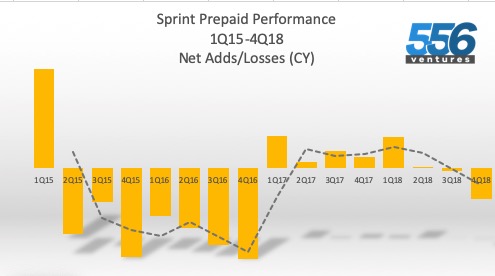
4Q18 Sprint Prepaid Tanks

Just when you thought Sprint prepaid turned the loss corner in 2017, it started sputtering in 2Q18 and then totally tanked in 4Q19 with 174K net losses.  Sprint bet big on prepaid in the Dan Hesse days and embarked on a multi-brand strategy.  Then, Assurance, a lifeline brand created to counter America Movil's Safelink greatly added to the prepaid base. Then with the fallout of lifeline investigations, those numbers quickly went away. Meanwhile in 2017, under then CEO Claure, Sprint announced the re-launch of its limbo brand, Virgin Mobile.  The new Virgin Mobile was supposed to be an "industry game-changer" with an iPhone only bent. It hasn't moved the needle in prepaid competition.


Why it matters: Essentially, Sprint prepaid is a one brand pony - Boost.  In the CY4Q18 earnings call and material, Sprint noted that Boost continues to be a strong contender. In the previous quarter, Boost accounted for <200K net additions. For this quarter, rather than provide a definitive number, Sprint CEO Combes only stated that Boost delivered eight consecutive quarters before "migration."

Migration? What's that? In a nutshell, Sprint has identified high-value and stable Boost or Virgin Mobile subscribers and offer them a non-branded Sprint postpaid plan and device financing.  For this quarter they totaled 100K, which also classified them in the Sprint postpaid subscriber base.  

In CY3Q18, Combes managed expectations that this quarter would be negative.  One can only assume that Virgin Mobile is the brand that is in a freefall since Sprint no longer reports Lifeline (Assurance) subs due to regulatory constraints. However, Sprint expects a return to growth in CY1Q19/FY4Q18. Even if Sprint prepaid bounces back, it will be a while before it matches the momentum of AT&T Cricket or Metro by T-Mobile.

Wednesday, January 30, 2019

4Q18 AT&T Prepaid Momentum Stunted but Cricket is OK

After a monster run at huge net additions, the prepaid group somehow fell off a cliff. It's not a pretty sight, is it?  After its Leap Wireless acquisition, the company completed the acquisition in 1Q14, the company began to ramp up to expand the Cricket brand beyond the legacy region footprint.  T-Mobile's MetroPCS had a similar ramp in growth from 1Q15 to 1Q17.  By 2Q17, AT&T prepaid started taking the industry prepaid net add leader.  Therefore, AT&T 4Q18 prepaid numbers were a jaw dropper.


What happened:  Many industry watchers have become accustomed to Cricket as the net addition driving force.  However in the traditional cut-throat holiday selling quarter, promotions abounded.  Detailed in the earnings call Q&A, Chairman Randall Stephenson assured analysts that Cricket still had growth momentum with 240K net adds but the branded prepaid side suffered these losses. He pointed to two factors: 1) Branded prepaid subs were moving to competitors' postpaid and 2) AT&T did not want to counter a loss leading handset promotion (A $250 device was offered at $100).  As a result the prepaid phone net adds only amounted to 13K.  


Why it Matters:  While AT&T has been disciplined about not getting into promotions that hurt margin, it does impact the view that growth and competition is hurting them in the very visible net addition metric. It's likely that the AT&T branded prepaid loss could factor in the gains at T-Mobile, perhaps both pre and postpaid.  Unless the competition can sustain a loss leader strategy and Cricket growth stagnates, AT&T 1Q19 prepaid net additions should climb out of that cliff. Stephenson has noted glowingly in the past about Cricket's ARPU (~$35) being close to postpaid.  Prepaid has been a bright spot over the last two years of growth and revenue contribution, offsetting the declining and handcuffed postpaid side. With more of the same postpaid performance anticipated in '19, prepaid needs to get its mojo back.  


Monday, September 24, 2018

MetroPCS to Metro by T-Mobile & Plan Changes

T-Mobile is rebranding its MetroPCS prepaid business unit with the new moniker Metro by T-Mobile. Honestly, it's time or should have been done maybe two years after the MetroPCS was acquired at the end of 2012 and closed in early 2013. The PCS part of the brand harkens back to the PCS spectrum the company was operating. Quite frankly, the industry shortcut nomenclature was always Metro, so BFT.


How we got here: T-Mobile CEO John Legere teased a series of Twitter posts last Friday, the 21st.

With T-Mobile and Legere promoting a "LegereForBatman" campaign, you'd think maybe another T-Mobile executive could have been the Riddler as a stretch joke. 


But long-time industry observers may have noted the Legere tweet's question marks were the MetroPCS colors. Even T-Mobile CFO (also ex-MetroPCS CFO) Braxton Carter weighed in on John's tweet:


Plan Changes

Aside from the Metro rebrand, the other announcement component is the revised plans.  The new $50 and $60 plans are more competitive not just for the additional hotspot data ($50 from 0 -> 5GB and $60 from 10 -> 15GB) but it's notable that marquee external partner value has been to the prepaid segment.  The inclusion of Google One storage and Amazon Prime membership in a plan is something out of a postpaid plan playbook.


But that's the point that T-Mobile is making; the lines between postpaid and prepaid are getting blurred. However, that's not entirely true. The fine print says that Metro subscribers will get throttled when there is congestion so that T-Mobile One (postpaid) users have data priority.  Still, the new plans validate a long standing effort to boost the prepaid average revenue per user by focusing higher plan price points.  Moreover, another trend is to promote family lines. The value proposition here, similar to postpaid, is that family plans decrease churn. Churn is especially critical in the prepaid sector, where the price sensitive customer has a tendency to jump providers for the best deal.  So the introduction of Google One and Amazon Prime membership are more anti-churn value components to sweeten the pot and to move the conversation away from the traditional lowest monthly cost mindset.

Big Picture

Step back and look at the macro view.  After blistering growth since integration, T-Mobile prepaid (predominantly MetroPCS) has cooled since 2Q17.  While Metro has slowed, arch rival AT&T's Cricket side has greater growth momentum than Metro.


Meanwhile, Sprint's and American Movil's Tracfone prepaid units continue to recover from staggering losses due to its earlier bets on the lifeline segment (Assurance and SafeLink).  In the near term, it's looking like a two carrier race.  We'll see what happens in 4Q if these plans can make an impact. The yea's not done yet; competitors may also get into the value race as holiday sales take shape.


Monday, April 30, 2018

Why T-Mobile Needs Sprint to Increase Business Revenue

On Sunday, April 29, 2018, T-Mobile and Sprint announced their intent to merge creating a $146B transaction to hopefully close in 1H19.  During the call, CEOs John Legere and Marcelo Claure talked up the consumer benefits of a combined company and that with this new company, the US would take back 5G leadership from the Asians.

There are so many areas to address in this proposed merger from regulatory hurdles, consumer benefits, job growth (or layoffs), the ‘mother of all networks,’ the winning brand, which executives came out ahead, etc.  I’ll start with the business service side because I’ve been asking this question to T-Mobile since the Un-carrier 9.0 announcement in March 2015 (Un-carrier for Business). The offering helped stimulate additional subscriber growth and impinged upon competitors’ specific business segments. Beyond the discounted plan structure, the ability to use free Wi-Fi during air travel, and free 2G global roaming, sophisticated higher revenue business services have not been in the T-Mobile portfolio.  


Sure, T-Mobile’s SyncUp fleet management solution or DIGITS offer another layer but those products also compete with similar or more sophisticated services from Sprint, AT&T and Verizon. It’s probably safe to say that much of T-Mobile’s business growth are lines in the small-medium business segment.  

For those who are wondering what sophisticated business services may be, here’s a Sprint example below: 

With a strong consumer message, I continue to wonder what of the business prospects with the combined company.   To be sure, much of the T-Mobile’s and Sprint’s business revenue challenges are unique. T-Mobile either doesn't see the return on investment in creating a sophisticated business portfolio, as that wouldn't be relevant to its subscriber base or they were waiting on Sprint all along.  Sprint has the business services (wireless and wireline) but lack the network credibility of their competitors.   I'm happy they addressed my question on the merger call and followed up with this responding vague Tweet. 


The low hanging fruit from the T-Mobile business expansion standpoint (and in their Twitter response) is rural America, bringing broadband competition to wireless and wireline incumbents. But that should already be on the T-Mobile radar, merger or not.  For Sprint’s part, the company’s 2.5 GHz 5G vision would be a compelling one in upselling and retaining its incumbent business base. Yet with capital constraints and other financial challenges, the pace, breadth and full realization of that Sprint-only 5G network is questionable (i.e., lots of major regions or national). Sprint is already in LTE catch up mode against competitors. 

A far-reaching network is everything. Verizon and AT&T know this and have invested tens of billions in their networks.  Both companies have captured consumer and business marketshare as a result. A new T-Mobile with a true 5G national network, combining low (600 MHz), mid-band (2.5 GHz) and future millimeter wave assets will surely provide a formidable network competitor to the big two, and foundational to future business revenue expansion.  

Assuming the deal is done and approved by 1H19 projections, it’s logical that parents, DT and Softbank, would increase capital (and not count on OpEx synergies) to accelerate the network vision (pun intended).  T-Mobile has a solid track record in integration (MetroPCS), network expansion and great execution. I’d expect no less from the combined Sprint and T-Mobile network planning and engineering teams. T-Mobile is already on track to plant a national 5G network flag thanks to its 600 MHz (albeit with thin dedicated spectrum), when that will be supplemented by the 2.5 GHz (>300M POPs) is the big question.   If the deal isn't approved, T-Mobile will need to build up its business portfolio to truly compete.   

[[[updated May 2, 1018]]]

On T-Mobile's 1Q18 Earnings Call, CEO Mike Sievert addressed the attacking the business segment at the new T-Mobile.   He stated: " Our business plan is funded for an expansion of our enterprise team. In year one, we’re going to take advantage of this set of capabilities and get after it and we funded our plan in year one to hire aggressively to get after the business market."

Tuesday, February 27, 2018

2017 Prepaid Roundup - Winners and Losers

Yes, it's true. 2017 is two months behind us and the wireless industry is talking about the up and coming 5G.  While the US carrier sector focuses on the higher revenue and lower churn bearing postpaid segment, prepaid is often overlooked. Though prepaid experiences lower average revenue per user and higher churn, prepaid revenue and subs are still a formidable wireless segment.

The big 5 prepaid players, some with flanker brands, dominate the net addition or loss numbers. Therefore, the focus will be on AT&T, Sprint, T-Mobile, Verizon and America Movil.


Losers

It's pretty obvious from the above chart which company is the year's biggest loser. America Movil lost over 2.9M subscribers. According to the company, the dominant contributor was Safelink (government subsidized lifeline program) disconnects. America Movil wasn't the only company that bet big on the government program. Sprint's Assurance Wireless brand targeted the same segment and also suffered previous losses in its prepaid base.


The second loser was Verizon prepaid. After what looked like an upward trend in 2Q and 3Q, the company crashed with 184K losses, mostly with prepaid basic phones. Verizon and America Movil are moving to increase revenue with smartphone subscribers, in essence deemphasizing the classic pay as you go customer.  These two companies are somewhat late to the party as that's been the strategy for T-Mobile's MetroPCS and AT&T's Cricket for several years.

Winners

The clear winner in terms of sub adds is clearly AT&T's Cricket.  This flanker brand has been the steady growth catalyst since 2015.  What's important for AT&T is the momentum shift from 2016 in which T-Mobile (MetroPCS) dominated with over 2.5M adds versus AT&T's ~1.6M. It's likely the two company rivalry will continue. Despite losing the overall 2017 growth title, T-Mobile is a winner. Last but not least is Sprint with its major brands Boost Mobile and Virgin Mobile. Though Sprint came out 373K subs in the positive and paled in comparison to AT&T and T-Mobile, one needs context.  In 2016, Sprint lost about 500K subs and in 2015 the loss number was over 1.5M.  So 2017 was a win for Sprint in my book  

2018  

Coming out of 2017, each player is focused on growing subscribers using the multi-line strategy. While the revenue per user part is less than a single line, the playbook is decidedly reminiscent of postpaid. Remember the old voice days when the financial community were shortsightedly concerned that carriers were leaving money on the table with meager $10/month add-a-lines?  The tradeoff obviously is in lower churn. More lines equals the less likelihood to churn.  The equation changes a bit with prepaid as price is also a main consideration.   At the end of '17 and also now, competitors are moving to the 4 lines for $100/month.   As this is tax 'refund' season (for some), competitors are throwing in the free phone promotion here or there.  But Cricket has somewhat escalated a price war with a $40/month unlimited single line price. The promo duration ends on April 12th. The fine print is that the plan price is only for one year.

Surprisingly, competitors haven't matched as the equivalent plan is still $50.  Historically, the sub activity has  usually occurred in the 1st and 3rd quarters.  It's hard to say whether each competitor will be the instigator for more plan action but there is a balance between acquiring more subscribers while showing higher ARPU/ARPA/ABPU trends and increasing margin AND decrease churn. It's a tall order.

Distribution will define further growth opportunities. MetroPCS can certainly ride the T-Mobile postpaid's coat tails as the company expands into the hinterlands with its 600 MHz spectrum.  Similarly, Cricket can expand its national brand footprint as it gains more dealers.  It's likely that AT&T and T-Mobile will dominate the prepaid scene as Verizon's focus has always been the more lucrative postpaid.  Sprint's tight corporate budget also suggests that its acquisition money should heavily favor postpaid to further its turnaround story (I'm still waiting for Virgin Mobile's 'game-changing' contribution.  Lastly, America Movil will likely continue to shed lifeline customers with incremental growth in the Walmart exclusive Straight Talk.  Let's see what happens.  


Monday, February 5, 2018

AT&T Prepaid - 4Q17, A Strong 2017

AT&T's reinvigorated prepaid group has been plugging away after the Leap Wireless (Cricket) acquisition and integration in 2014. Rather than keep the then AT&T Aio flanker brand, Cricket's name had better traction in the prepaid sector.  While AT&T is more than just the Cricket brand (remember GoPhone?), Cricket brings in the lion's share of the additions.

Overall, the Cricket unit has been a positive development, adding over 1.3 million (M) subs in 2015 and over 1.5M in 2016.  Its playbook mirrors its chief rival, MetroPCS which was acquired in 2012. The regionally limited MetroPCS brand expanded along with the T-Mobile national footprint, increasing the brand's distribution reach.  This has also been the case as Cricket increased its footprint and distribution.  With about a 1.5 to 2 year head start, MetroPCS has been the industry prepaid net add leader, with more than 1.3M in 2015 and over 2.3M in 2016.  Given this trajectory, one would expect them to lead in 2017.  However, for 2017, the overall prepaid net add leader is AT&T with just over 1M net adds to T-Mobile's 855 thousand.  


The overall trend, based on the leaders' numbers, is that prepaid isn't growing as hot as it was several years ago.  4Q17's numbers for both companies seem anemic in a Year over Year comparison.  Yet more confounding for industry watchers, AT&T has incorporated prepaid IoT (they say vehicle connectivity) into its 3 and 4Q17 numbers. Those account for 152 thousand additions. If we remove those numbers, AT&T still wins 2017 with 861 thousand, barely edging out T-Mobile's prepaid group.

Looking ahead to 2018, there are two things I'm looking for in the near term:

  1. 1Q18 net add numbers: Generally, carriers' 1Q numbers have been the year's strongest. Will these numbers be 2016 or 2017 levels? As of this writing, Boost, Cricket and MetroPCS's lead offer are similar - 4 lines for $100. 
  2. AT&T Prepaid IoT ramp:  AT&T has been building IoT connected vehicle business with auto manufacturers for several years now with the fruit of embedded connections for every vehicle. As new models and more manufacturers get online, the prepaid IoT numbers should increase. Churn and ARPU for this segment should be interesting if broken out (ideally).        

Monday, January 29, 2018

Verizon Prepaid - 4Q17 (More Cowbell, er ARPA!)

Verizon's prepaid group is going through a roller coaster ride.   For many quarters, the company's prepaid group had been losing subscribers at an alarming rate. From 1Q15 to 2Q16, the losses totaled 758,000! A momentary hike of 83,000 net additions in 3Q16 reversed in the next two quarters of a low 26,000 losses. It seemed that with new plans, the prepaid group was going to be on the upswing with positive growth in 2Q and 3Q17.  However, 4Q17 saw subscriber losses again.


To be fair, Verizon's retail wireless business is predominantly postpaid. Prepaid only accounts for less than 5% of the company's retail subscribers.  However for 4Q17, Verizon stated that its 184,000 prepaid sub losses were predominantly basic phone subscribers as it "deliberately reduced" focus in this area.  This makes sense as it's been the overall prepaid sector trend to cater to higher-ARPU bearing smartphone plans.  Some can argue that it took too for Verizon to come around to switch its tactics, in order to address an increasingly lucrative prepaid sector.  AT&T and others have long argued that given the no-contracts postpaid environment, prepaid and postpaid ARPUs were somewhat converging.  

As evident by Verizon's prepaid plans, they are indeed trying to boost ARPU.  Though the minimum single line monthly is $40, the important point is that the company is emphasizing additional lines (as with competitors) to increase ARPA. It's clear that Verizon is not going to be the least cost provider but as wireless veteran observers know, that's not their strategy.  As with postpaid, the company conveys to the market that it is a premium provider with a formidable network.


What will 2018 hold for the Verizon prepaid group? I have to think that there will continue to be basic phone losses but when will the smartphone plan additions outweigh the losses?  The prepaid subscriber base currently sits as about 5.4M, does the company care about increasing the sub count or keeping it level while trading it for newer subs that boost overall revenue? I suspect the latter.


Wednesday, May 11, 2016

Talking About Sprint Since Marcelo Claure's On-Boarding

Dan Meyer from RCR Wireless and I discuss Sprint's CY1Q16 results but revisit where Sprint is since Marcelo Claure has taken over as CEO.  We look at his priorities when he took over in August 2014 in the areas of:
  • The executive team - who is in, who left, how the company is organizing
  • Network - CapEx
  • Cost containment including leasing companies, layoffs and $2.5B savings target
  • Stabilizing revenue, the postpaid subscriber base and being the Value carrier


In the back half of the video, we talk about Glenlivet 12.

Monday, April 25, 2016

Handset Promos - BOGO from the US carriers + Scotch Second Take

In early 1Q16, the US carrier community pushed Buy One Get One (Free or 1/2 price) BOGOs hard in an effort to retain existing subscribers with an upsell of an additional line.  In parallel with this effort was the availability of the Samsung Galaxy S7, announced in February at Mobile World Congress.

Secondarily, it has to be that Samsung continues its marketing push to retain its loyal Galaxy customers to push them to the next iteration, whether they're Galaxy S4, S5 or S6 customers.

All these BOGOs are yet continuous carrier efforts to trot out the latest hardware. But BOGOs are not new and have been used for years. Unfortunately, the era of contract free plans and equipment financing have cut into upgrade rates.  In the old days, additional upgrades help retain/lock customers longer with low subsidized values. Given the sobering price tag of new devices and long term financing (24-30 months), that desire to upgrade has trended downward as more subscribers are keeping their handsets longer. Don't get me wrong, the early adopters will always have a place but the mainstream upgrade trend is slowing.  Caveat: We'll see how the public en masse embraces the next generation of iPhone (7).


For those scotch watchers, Dan Meyer and I talk a bit about the scotches we're currently drinking for the webcast here. We are self-admitted newbies and don't go in-depth as dedicated scotch YouTubers do but we share our likes and other scotch thoughts.

Thursday, October 29, 2015

Verizon 3Q15 Results and Unlimited Data Trending

Dan Meyer and I talk about Verizon's 3Q15 highlights and takeaways. Also we talk about unlimited data moves from carriers.


Thursday, January 29, 2015

What 2015 Brings

Originally posted on Fiercewireless just before the Christmas holiday.

2014 is nearly at and end and it's the time of the year when there are countless year-end review articles and 2015 predictions. While there were many highlights of 2014, I choose to hone in on network and competition.  Instead of predictions, my 2015 expectations have been laid out with technology paths and the previous year's events.

Network 
Every carrier knows that beyond service plan value and pricing, the network is the core of customer choice. It's no surprise that despite goals the carriers reach, improving, expanding and transforming the network will never really be done. Although AT&T Mobility and Verizon Wireless have reached their coverage targets, capital is still being expended to bolster networks for capacity and coverage. T-Mobile US and Sprint continue their breakneck pace to reach LTE network parity with larger competitors.   

AT&T met its 300 million POP coverage target in early September, surpassing its original end of the year target as it needed to close the gap against its main rival, Verizon. AT&T also needed to keep pace in its Voice over LTE introduction, albeit available in only in select markets. Aside from adding coverage, capacity, and expanding VoLTE in 2015, the company continues its ambitious transformation into a software-centric network by 2020.  Two big acquisitions, slated to be complete by the first half of 2015 will trigger network related work.  First, the DirecTV acquisition, the company will need to fulfill its promise to provide fixed wireless broadband to rural markets. With the acquisition of Mexican carrier Iusacell expected to close in the first quarter of next year, much of the remaining year should be laying a foundation for what AT&T touts to be the first North American mobile service area.

Sprint's 2014 travails from the "rip and replace" Network Vision program and turbulent corporate changes contributed to massive uncertainty and subscriber losses. Although the company ended the year with 260 million LTE POPs covered on its PCS spectrum, roaming deals with rural carriers is set to expand its own LTE geographic reach to 298 million POPs in 2015. Ironically, as competitors over delivered on coverage and timing, Sprint met its end of year 100 million 2.5GHz LTE POP target, despite skepticism. In August, the 2.5 GHz buildout strategy shifted to address the heavy data consumption markets, with the logic that the popular unlimited proposition is empty without a high capacity foundation. Still, Sprint hasn't disclosed any POP targets for 2015, as it has previously.   

T-Mobile over delivered and beat its own 2014 250 million POP target with 260 million covered LTE POPs. For 2014, the network story was one of aggressive execution by acquiring and deploying 700 MHz A-Block spectrum and refarming/implementing MetroPCS' spectrum to exceed its target. The company is very public about reaching an end of 2015 300 million POP target (without roaming) to close the network perception gap against larger competitors. In doing so, it will continue work to put in service remaining 700, AWS and PCS spectrum.  At the same time, to get better low-band breadth, it will opportunistically purchase additional 700 MHz spectrum. However, since some regional and rural carriers will implement the same A-Block flavor, LTE roaming agreements are logical.

Though Verizon Wireless technically met the 30 million POPs covered threshold in mid-2013, the company continued to deploy and put into service AWS spectrum for capacity and fill-in. Since reaching the 300 million mark, it added 8 million more by the end of 2014. Though it has already started refarming its PCS spectrum for LTE on a limited scale, this effort will likely continue as planned in 2015.

Technologies of Common Interest
  • Carrier Aggregation: This LTE Advanced feature provides the capability to extend coverage, capacity and speed. AT&T has already started using the carrier aggregation feature mainly with its 700 and AWS assets. While AT&T does not have a national AWS footprint, it's logical that PCS spectrum that it is refarming would also be put into play.  As part of its 2014 2.5 GHz buildout, Sprint stated that it was rolling out two-carrier aggregation but eventually add another carrier (end of 2015) for three-carrier aggregation to raise the speed game.  T-Mobile has not said when it will deploy carrier aggregation, but it will be planned for the coming years to piece together its 700 and AWS and PCS assets.  Verizon Wireless will enable carrier aggregation to its national 700 (Band 13) and AWS footprint.   Given early PCS refarming and LTE deployment, there could be the technical possibility of 700 and PCS aggregation where appropriate.

    One likely byproduct of all this work will be increased speed, possibly allowing one carrier to best another nationally or in specific markets. Regardless, RootMetrics is the biggest beneficiary, as every carrier have used reliability and speed claims for public relations from their reports. Behind the scenes, it's certain that carrier in-house test organizations, third party specialists Nielsen Mobile and GWS will be busy verifying.
  • VoLTE: AT&T, T-Mobile and Verizon Wireless all have implemented VoLTE. Only AT&T has not claimed nationwide capability but that hasn't stopped inter-carrier interoperability activity planned for 2015. Though T-Mobile was snubbed from the press release, it would be logical that they plug in eventually.  Sprint's CDMA-based HD Voice implementation and introduction leaves them out of the VoLTE club temporarily but it has a more important focus: expanding 800 MHz and 2.5 GHz LTE. 
  • LTE Broadcast: Only AT&T and Verizon have committed to this technology and have high hopes to monetize their investment.  Business models will be tested for sure.
Competition

2014 was remarkable in the level of competition. Since space is short, we'll just focus on postpaid and prepaid. On the postpaid side, there were nearly 80 pricing actions and promotions from the top four carriers, not counting the numerous extensions of promotional offers. This was more than double that of 2013. Several standout service plan tools drove customer action; these included Early Termination Fee (ETF) credit, tablet data for life, double data promotions, and no money down equipment installation plans.  

Carriers departed from the past practice of constantly restructuring their rate plans, gaming the right price point with the right data level. Though AT&T and Verizon changed their plans in the beginning of the year (i.e., Mobile Share to Mobile Share Value and Share Everything to More Everything) and Sprint rebooted in August with its Family Share Pack and iPhone for Life, limited time promotions in the back half of 2014 drove postpaid volatility and grabbed all the media headlines. Promotions gave carriers a temporary lever to address competition without permanent price drops or higher data levels.

Entering the fourth quarter, this visual graph showed the postpaid net add trending in the previous three quarters, showing T-Mobile and Verizon Wireless with good postpaid net add energy.
Source: Carrier Reports
However, carriers' full 2014 results won't be known until late January or early February when fourth-quarter earnings calls are conducted.  What we do know has been telegraphed: due to intense competition, Verizon and AT&T warned that churn was a concern. T-Mobile increase its 2014 total net add guidance from 2.8-3.3 million to 4.3-4.7 million and Sprint was confident that they would deliver positive fourth-quarter postpaid net adds

Without full 2014 data, can we expect the same intensity of postpaid competition in 2015? It's obvious that competition will never cease in the wireless sector but there are some road signs that it won't lull.
  • Sprint's need to grow: Sprint lost nearly 600,000 customers by Q3. They cannot stop the march to win back customers.  Going after AT&T's and Verizon's large postpaid bases will likely continue, but how aggressive will the campaign be – sustained intensity in each quarter or pick and choose?
  • T-Mobile and Sprint will continue to employ a $350 ETF switching credit. For T-Mobile, it's an "uncarrier 4.0" tenet while Sprint will need it as a necessary tool to prevent T-Mobile getting all the switching spoils.
  • AT&T and Verizon won't sit back and play defense. 2014 showed that the big two hit back with their own switching and double data promotions. However, they won't be instigators.
Yet the intensity may be tempered as there were signs of financial community/investor skittishness that dropped stock prices. Industry competition is great for consumers but the wireless sector's volatility impacts decreasing margins and perceived overpaying for future spectrum.  2014 will likely be a blowout year for T-Mobile but replicating that performance has already been downplayed at various recent investor conferences. Rather, the thrust was about stabilizing ARPU, retention and upselling. Still, T-Mobile won't stop given their momentum.   

Prepaid never sees the headlines that postpaid commands. Though growth wasn't what it was in previous years, it's still hotly contested and relevant.  In prepaid, there were about 70 price and promotion actions, not counting any extensions. This was up a hair from 2013. The prepaid graph illustrates TracFone (folded in acquisitions) and T-Mobile being the big winners up to Q3.
Source: Carrier Reports
Unlike the postpaid activity predominantly occurring in the first three months and the last four months of the year, prepaid promotions and actions were evenly spread across the year. The battles for high-value monthly users consistently apply among the various TracFone brands, AT&T's Cricket, T-Mobile's MetroPCS and Sprint's Boost and Virgin Mobile brands.  While price sensitivity has always been a prepaid hallmark, a shift in network and LTE marketing is broadening.  Meanwhile, legacy CDMA user migration is still on the plate for Cricket and MetroPCS as each seek to move those customers onto the parent's LTE networks. 
2015 competition should be spirited, as Cricket and MetroPCS will continue their head-to-head fight. Boost and Virgin will try to stay relevant in the fight while. Given postpaid's momentum, prepaid growth may be stymied at similar 2014 rates. Get the popcorn ready for next year.