Showing posts with label Leap Wireless. Show all posts

Monday, June 17, 2019

AT&T's Prepaid Growth Story

If one looks at the last couple of quarters of net add performance, the prepaid market seems to be flattening. Powerhouses Metro by T-Mobile and Cricket which had dominated with large net additions have dropped from their high go-go growth past days.  Prepaid competition has always been tough and will certainly continue.  The drama in the T-Mobile/Sprint deal where uncertainty and change has brought concern to the dealer networks and employee bases, AT&T is standing out as the stable ship.  

To appreciate the AT&T's prepaid growth story, it began with the Leap acquisition announced in July of '13 and closed in March of '14.  Between the acquisition announcement and the close, Leap's subscriber base shrunk from about 5 million to over 4.5 million.  With Leap, AT&T's prepaid base moved to about 10 million subscribers at the close.  The Leap brand, Cricket, though known was declining and had an impact on AT&T's results in 2014. However, with brand expansion beyond Leap's regional footprint and AT&T's national coverage, the new Cricket began its growth story.   Increasing the 'doors' or distribution was central in this effort. This included expanding its dealer network and big box retail.


From 2015 to 2018, the AT&T prepaid net add annual run tallied over a million subscribers, negating 2014's growing pains which included decommissioning the Leap CDMA network and subscriber device migration.  


As prepaid evolved, it's still attracting a price sensitive segment but low plan price and free/discounted phones are just but several buying considerations. Embedding value is now mirroring postpaid plans. For example, Metro by T-Mobile is including mobile hotspot capability, music, generous Google storage and even Amazon Prime in higher tier plans. For Cricket's part, because of AT&T's Mexican network assets and Canadian roaming agreements, unlimited plan users can roam without charge in those countries.     


Recently, I had the opportunity to chat with John Dwyer, President of AT&T Prepaid on the state of his business.  A couple of Cricket highlights came up namely in the area of customer satisfaction triggered by comments made on the 1Q19 earnings call.  Though these were selected for the best PR, Chairman Stephenson revealed some important data points: 1) churn was under 3% and 2) Cricket subscribers accounted for 10 of the 17 million base, and had more than doubled since the Leap acquisition close.

Low churn is a key indicator of customer satisfaction and John reinforced that notion with JD Power wins in purchasing experience and customer satisfaction. As the former head of customer experience, he said that Cricket's net promoter score (NPS) moved from a -7 to now 43. By the way, NPS ranges from -100 to 100.  The 10 million Cricket subs suggest that there are 7 million prepaid subs to be share between branded prepaid and prepaid IoT.             

Branded prepaid took a shellacking in 4Q18 negating most of Cricket's 240K net adds. Observers checking the AT&T branded plans would note a double data promotion on its $50 ($40 with autopay) that runs until the end of July that suspiciously counters a similar promotion at Verizon, which isn't a surprise as each company have been longtime postpaid rivals for the same demographic.  This should hold true for each's branded prepaid offerings.

Back to the growth story - the last two quarters are shockingly lower than the previous 14 quarters.  The question is has the growth engine stalled because of overall market trends? Indeed, competitors' previous quarter net addition numbers were comparably lower.  One possibility could be on the coat tails of the FirstNet buildout wherein AT&T claims a positive trajectory for postpaid growth.  While they cite promotional activity for FirstNet accounts to include families, FirstNet is also going to rural communities in which AT&T has planned on new distribution. While the focus is on postpaid growth, it's logical that prepaid distribution would also follow. It's unclear whether we'll see 300K+ net additions but at least there is a runway.  A caveat is that with T-Mobile's 600 MHz expansion, their rural coverage will also increase and prepaid could also follow in increasing distribution, if there is commitment from Seattle (the new power center) versus formerly the MetroPCS HQ of Dallas.  In the next year, we'll see how the AT&T prepaid growth engine performs, firing on all cylinders or sputtering.         

Monday, March 25, 2019

2019 Prepaid - What Do Trends From Previous Years Say?

1Q19 Earnings season is about a month away.  Postpaid gets much of the focus because it brings in revenues and because it's a big chunk of the bread and butter revenue of many carriers.  However, though prepaid is a minor asterisk on many carriers, it doesn't mean that competition isn't just as formidable.

Trends could be a good predictor of future performance.  For every earnings call, I try to display a couple of years worth of net additions or losses on Twitter and occasionally, I write a blog or two. Let's look at the previous years' aggregate results and see if anything is interesting.

2017


It's clear the biggest loser was America Movil (Tracfone) as a huge loss factor was the lifeline brand, Safelink.  Tracfone was once a huge prepaid force to be reckoned with and to be fair it still is.  At the end of 2017, it had over 23 million customers.

Verizon didn't have a bad 2017. As the company is over 90 some odd percent postpaid. It didn't seem like a huge impact, as the carrier stated its intent to move feature phone subs off its 3G network and onto higher ARPU bearing smartphone plans.

Sprint looked like it was recovering and turned the corner from abysmal years '15 and '16 due to Assurance Wireless losses, their lifeline brand.  The Sprint prepaid group's flagship Boost Mobile continued to contribute as Virgin Mobile seemingly didn't help the cause.

Lastly, the T-Mobile and AT&T fight was the most competitive.  The real story behind those two companies' momentum is the respective purchases of regional players MetroPCS and Leap Wireless (Cricket).  T-Mobile dominated all of '15 and '16 as it expanded its distribution doors beyond the MetroPCS footprint.   AT&T used the same playbook in revamping and expanding Cricket's distribution nationally. Within the weeds, 2Q17 was the inflection point in which AT&T led for the remainder of the year.   This is important as AT&T and T-Mobile are emerging as the dominant prepaid forces.

2018


America Movil continued to lose!  Persistent blame was cast on its lifeline brand.  Corporately, it appeared an underlying industry strategy was to embrace the higher ARPU bearing and flagship Straight Talk brand for sub growth and revenue.  Straight Talk now makes up ~9.1 million out of its overall 21.7 million base.  The higher ARPU strategy yielded positives as its overall corporate end of year ARPU hit $26 vs '17's $24 vs '16's $23.  In addition, the overall corporate churn trend continues to improve.

While Verizon '17 prepaid looked encouraging, '18 saw significant prepaid losses.  Its sub base is barely 4 million and while there are some who point to the semi-linked Visible brand to address its prepaid ambition, it's a tough and price sensitive market.    

Sprint was supposed to have turned the corner in '17 but you would have been wrong for '18. 1Q18 saw some good momentum but in the end, 4Q18 tanked.  Clearly Sprint is more focus on good postpaid numbers, as it even categorized some Boost Mobile users with a good payment record and moving them into the overall postpaid count.

Again, the AT&T and T-Mobile dynamic proved to show the most interesting outcomes, as the two continue to battle it out for growth. Throughout '18 prepaid adds slowed with T-Mobile claiming that the prepaid-postpaid lines have blurred significantly.  There are a combination of factors perhaps, like any competitor, the carrier would rather spend its resources into higher-ARPU bearing postpaid users AND AT&T's Cricket has put the competitive screws on Metro by T-Mobile.  The big BUT is in 4Q18 where unexpectedly, T-Mobile came roaring back, besting AT&T. With its positive momentum, AT&T should have dominated 4Q18 but its branded prepaid tanked the numbers.    Still, overall in '18 AT&T was the net prepaid winner.

2019?

With abundant losses behind it, America Movil may cross into positive territory in 2019 as its losses were ~100K in 4Q18.  The first quarter trend for each year typically carries over some of the 4Q momentum.  If that is true, then American Movil may potentially see '19 as a turnaround year, barring overwhelming competition.  The increasing ARPU trend should continue as it's likely the company will add more resources into getting more Straight Talk traction.

Though Verizon 4Q18 losses only amounted to 90K, nearly 600K of its overall '18 losses happened in 1H18. Seemingly, it could be on the upswing.  Yet, the jury is still be out as Verizon doesn't really seem to address its offerings competitiveness to grow or retain its prepaid base.

Sprint is a big unknown.  Through earnings calls, filings and market looks, Boost Mobile seems to be holding its own while Virgin Mobile is a non-contributor.  The trend is negative as Sprint, which once was a significant prepaid player is inconsequential as far as marketshare.  All the indicators are going in the wrong direction, their churn is up and their prepaid ARPU is declining.

The growth money still in on AT&T's side as its prepaid momentum is greater than T-Mobile's.  If one extracts the 4Q18 glitch, AT&T continues to be the growth leader, barring additional AT&T branded prepaid losses.  The bottom line is that both companies would continue to shape 2019 prepaid growth.

Finally, here's how the prepaid business units shape up versus the overall branded base to note who is shrinking and contracting.
       

Thursday, February 7, 2019

4Q18 T-Mobile Prepaid Recovers A Bit

T-Mobile took back net additions leadership for the quarter amid a slowdown in 2017 and 2018 from monstrous growth in 2015 and 2016.  With 135K adds, the company beats continued prepaid nemesis AT&T which posted 26K but only 13K phone net additions


Why it Matters: 

T-Mobile needed to slow the AT&T prepaid momentum a bit as it has been moving towards prepaid leadership in terms of additions since 2Q17.  Were it not for AT&T branded prepaid losses, Cricket's 240K net adds would have continued AT&T's domination.  A quarterly win is a nice reversal of 2018 fortune.


It's no secret that postpaid has better revenue upside than prepaid and in the 3Q18 earnings call, President Mike Sievert explained that their focus had been converting competitors' prepaid users to T-Mobile postpaid.   Data point: Prepaid makes up 33% of its branded base and 30% of the revenue.

Despite how the company and others in the industry have been stating that the prepaid/postpaid plan lines have blurred, T-Mobile postpaid hovers at ~$46 while its prepaid ARPU is in the mid $38 range. So Mike's argument holds water. What is unique is that in 4Q, T-Mobile admitted that its gains were from lower churn but also plan and handset promotions.  The promotions are a sharp contrast to not responding to 3Q AT&T promotions.  Will T-Mobile by Metro continue its  promotional run or is the AT&T branded prepaid losses a quarterly anomaly? Though with the 4Q win, AT&T safely won the 2018 leadership. What will '19 look like?   

Wednesday, January 30, 2019

4Q18 AT&T Prepaid Momentum Stunted but Cricket is OK

After a monster run at huge net additions, the prepaid group somehow fell off a cliff. It's not a pretty sight, is it?  After its Leap Wireless acquisition, the company completed the acquisition in 1Q14, the company began to ramp up to expand the Cricket brand beyond the legacy region footprint.  T-Mobile's MetroPCS had a similar ramp in growth from 1Q15 to 1Q17.  By 2Q17, AT&T prepaid started taking the industry prepaid net add leader.  Therefore, AT&T 4Q18 prepaid numbers were a jaw dropper.


What happened:  Many industry watchers have become accustomed to Cricket as the net addition driving force.  However in the traditional cut-throat holiday selling quarter, promotions abounded.  Detailed in the earnings call Q&A, Chairman Randall Stephenson assured analysts that Cricket still had growth momentum with 240K net adds but the branded prepaid side suffered these losses. He pointed to two factors: 1) Branded prepaid subs were moving to competitors' postpaid and 2) AT&T did not want to counter a loss leading handset promotion (A $250 device was offered at $100).  As a result the prepaid phone net adds only amounted to 13K.  


Why it Matters:  While AT&T has been disciplined about not getting into promotions that hurt margin, it does impact the view that growth and competition is hurting them in the very visible net addition metric. It's likely that the AT&T branded prepaid loss could factor in the gains at T-Mobile, perhaps both pre and postpaid.  Unless the competition can sustain a loss leader strategy and Cricket growth stagnates, AT&T 1Q19 prepaid net additions should climb out of that cliff. Stephenson has noted glowingly in the past about Cricket's ARPU (~$35) being close to postpaid.  Prepaid has been a bright spot over the last two years of growth and revenue contribution, offsetting the declining and handcuffed postpaid side. With more of the same postpaid performance anticipated in '19, prepaid needs to get its mojo back.  


Monday, February 5, 2018

AT&T Prepaid - 4Q17, A Strong 2017

AT&T's reinvigorated prepaid group has been plugging away after the Leap Wireless (Cricket) acquisition and integration in 2014. Rather than keep the then AT&T Aio flanker brand, Cricket's name had better traction in the prepaid sector.  While AT&T is more than just the Cricket brand (remember GoPhone?), Cricket brings in the lion's share of the additions.

Overall, the Cricket unit has been a positive development, adding over 1.3 million (M) subs in 2015 and over 1.5M in 2016.  Its playbook mirrors its chief rival, MetroPCS which was acquired in 2012. The regionally limited MetroPCS brand expanded along with the T-Mobile national footprint, increasing the brand's distribution reach.  This has also been the case as Cricket increased its footprint and distribution.  With about a 1.5 to 2 year head start, MetroPCS has been the industry prepaid net add leader, with more than 1.3M in 2015 and over 2.3M in 2016.  Given this trajectory, one would expect them to lead in 2017.  However, for 2017, the overall prepaid net add leader is AT&T with just over 1M net adds to T-Mobile's 855 thousand.  


The overall trend, based on the leaders' numbers, is that prepaid isn't growing as hot as it was several years ago.  4Q17's numbers for both companies seem anemic in a Year over Year comparison.  Yet more confounding for industry watchers, AT&T has incorporated prepaid IoT (they say vehicle connectivity) into its 3 and 4Q17 numbers. Those account for 152 thousand additions. If we remove those numbers, AT&T still wins 2017 with 861 thousand, barely edging out T-Mobile's prepaid group.

Looking ahead to 2018, there are two things I'm looking for in the near term:

  1. 1Q18 net add numbers: Generally, carriers' 1Q numbers have been the year's strongest. Will these numbers be 2016 or 2017 levels? As of this writing, Boost, Cricket and MetroPCS's lead offer are similar - 4 lines for $100. 
  2. AT&T Prepaid IoT ramp:  AT&T has been building IoT connected vehicle business with auto manufacturers for several years now with the fruit of embedded connections for every vehicle. As new models and more manufacturers get online, the prepaid IoT numbers should increase. Churn and ARPU for this segment should be interesting if broken out (ideally).        

Monday, May 12, 2014

Video: Trends in 1Q14 US Carriers' Results

Dan Meyer, Editor-in-Chief from RCR Wireless and I talk 1Q14 US carrier results and any trends happening from the big 4. RCR Story Link


Wednesday, May 7, 2014

Bullet Point Analysis: Boost Mobile Moves Defensive - The Battleground 40, 50, 60 Price Points

WHAT IS IT?

On May 6, Boost Mobile replaced its old monthly plan portfolio with a new Unlimited Select plans at three price points and specific data thresholds.


ANALYSIS

The prepaid sector is often characterized by high churn profiles and low credit scores. However, it is also a sector with high revenue and subscriber growth potential, courting feature phone upgraders (either prepaid customers or postpaid users looking for better deals in prepaid).  Sprint has made big bets on prepaid as a corporate growth engine. Prepaid subs represents 28% of the overall Sprint customer base.  Various sub brands (Assurance, Boost Mobile, Virgin Mobile) address specific prepaid demographics.  Yet 1Q14 was a bad quarter for prepaid with 465K losses, most of it blamed on Assurance brand losses. Boost's unlimited plans (along with Virgin Mobile's Beyond Talk plans) that garner higher monthly ARPU is clearly an important revenue component to Sprint's prepaid strategy and needs to be protected.  

Now with Boost's new plans at $40, $50 and $60, these numbers are the magic competitive price points to wage the prepaid war in mid to late 2014.  Boost Mobile is merely catching up defensively to rivals that already presented those price points and sometimes the same data thresholds.  

  • AT&T's flanker brands Aio/Cricket is in integration mode but Aio's price points and data thresholds match directly with the new Boost plans.  AT&T has been very vocal about being aggressive in attaining growth at the 'low end' using Cricket and will be a threat Boost.   Tactically, it's likely that the unified Cricket portfolio will come out with the added lower $40 price point (Currently $50-$70).  Moreover, AT&T's mid-April GoPhone plan action added a $40/500 MB plan to match T-Mobile's $40 Simple Starter launched earlier 10 days earlier.
  • T-Mobile's MetroPCS plan portfolio already has the same price points and always has been a strong competitor to Boost. By T-Mobile's 1Q14 prepaid earnings metrics, MetroPCS is doing well and though T-Mobile doesn't break out its contribution, the company added 465K prepaid users.  T-Mobile's internal code word in launching new markets is Apollo. The company is up to 30 new markets and continuing.  This Metro expansion has not only eaten into Cricket marketshare, it certainly has impacted Boost.    
COMPETITIVE IMPACT?

Every competitor has its own differentiation despite the same price points. The challenge is to communicate this to the target audience and cut through the usual selection criteria of device and plan pricing.
  • AT&T's GoPhone portfolio has the advantage of built-in international calling and messaging while rivals MetroPCS and Boost need international package add-ons.  
  • The new Cricket has high hopes and promise for its parent. Its primary focus is to recapture lost ground from MetroPCS and Boost will be impacted in the mix. It's uncertain if Muve music, which was an apparent differentiator, will continue to be promoted.  UPDATE: Muve Music is said to be on the auction block. Certainly, at a minimum, the expanded underlying AT&T LTE footprint and perhaps speed will be touted.
  • MetroPCS continues to expand in an effort to migrate its legacy CDMA users (featurephone) to new LTE handsets on top of expanding its distribution to grab marketshare in new markets.  Boost's plans again are catching up to MetroPCS.
Boost Mobile needed to make its latest portfolio change to keep up with its main competitors.  There aren't any features in the new Unlimited Select plans that stand out against competitors. Boost Shrinkage discount approach is unique but how well does that retain a fickle customer segment?  Cricket and AT&T plans stand out as unlimited international texting (and limited international calling for GoPhone) are baked in.  Metro and Boost need to figure out if these features are competitively substantial in winning prepaid monthly adds.   
     

Wednesday, April 23, 2014

Bullet Point Analysis: AT&T GoPhone Adjustments, Defensive & Offensive

WHAT IS IT?

On April 18, AT&T announced two smartphone GoPhone prepaid plan adjustments and introduced a Wal-Mart specific plan:

  • The $60 plan increased data from 2 to 2.5 GB + enabled Wi-Fi hotspot capability + unlimited talk 
  • The $40 plan increased data from 200 to 500MB + 500 minutes of talk 
  • Available at Wal-Mart stores nationwide, a new plan with 1GB of data for $45 a month + unlimited talk

Existing $40/$60 plan customers will automatically receive these increase data levels.  Moreover, not announced, the smartphone $50 unlimited calling and texting plan with WiFi-only (no data allotment) is no longer available. Though the plans are supposed to kick off on April 25, the changes are already available online.

ANALYSIS

The plan action with three components are a mix of defensive and offensive moves.  Anytime a company makes a change, there are clearly causes and effects.  
  • As I wrote in my previous post on T-Mobile's newly launched $40 Simple Starter, that plan threatened prepaid competitors.  Eight days later, AT&T shored up its entry $40 GoPhone plan seemingly in a defensive move to match Simple Starter data threshold of 500 MB.  On the surface, it's merely a match but AT&T provides a differentiation for a specific segment of prepaid audience, those who text internationally. Still, Simple Starter addresses the needs of the talker as the plan offers unlimited calling; AT&T only provides 500 anytime minutes.  Against Verizon's $45 ALLSET, $40 price point comes out ahead for the price sensitive though Verizon's add-on data options offer better value. 


While the $40's nemesis was T-Mobile, the $60 GoPhone plan goes up against the Sprint's prepaid SmartPlus unlimited plan at the same price point with the same 2.5 GB threshold (throttled to 3G afterwards).  Sprint's other prepaid brands Boost and Virgin Mobile match other competitors such as MetroPCS and Cricket best.


  • Finally, the tell tale sign of an offensive against Tracfone's Straight Talk is a Wal-Mart only plan. The $45/1GB plan matches the price point exactly though StraightTalk is unlimited and throttled after 2.5GB. The AT&T brand, WiFi hotspot tethering, as well as LTE access could be a differentiation but traditional value Wal-Mart shoppers may simplistically look at more data.  

  • The ace in the hole for GoPhone is international messaging that competitors do not offer for the respective price points. This will appeal stronger to a specific subscriber demographic.  Provided that AT&T heavily markets this either in niche advertising or social channels, it may be lost.

AT&T's prepaid moves should be construed as urgent since it has lost prepaid subs for the last two quarters ( -32K 4Q2013 & -50K 1Q14).  Though the year-over-year view (-166 4Q12 & -184K 1Q13) looks better, the long and short of it is AT&T lost subs. By contrast, Verizon Wireless has had positive prepaid growth for the last eight quarters, decent for a primarily postpaid company whose prepaid subs are less than 6% of the retail/branded customer base.

COMPETITIVE IMPACT?


  • AT&T's GoPhone move is just one component of a reversing prepaid strategy which mainly hangs it hat on the new Cricket market expansion. T-Mobile's MetroPCS brand had been targeting AT&T and Cricket heavily with the 'Apollo' market launches.  In the 1Q14 earnings call, AT&T said that the new Cricket will re-launch at the end of 2Q14, likely targeting T-Mobile and MetroPCS trying to reacquire lost subs. T-Mobile's entry plan featurephone switching growth may be blunt if AT&T markets heavily against that segment.
  • Sprint overall needs to consider international messaging for postpaid and SmartPlus given this AT&T action. It may be too early to see how Sprint branded prepaid performs since Sprint doesn't specifically break out brand performance. 
  • Verizon's ALLSET plan's $45 price point doesn't match well but it may be unlikely that a plan change is unnecessary unless AT&T makes inroads for a couple of quarters and attains notable marketshare.


Thursday, April 10, 2014

Bullet Point Analysis: T-Mobile's $40 Simple Starter Threatens Competitors' Prepaid As Well

WHAT IS IT?

On Wednesday, April 8, T-Mobile announced a new plan called Simple Starter aimed at the individual entry smartphone data user.  Specifically with the following features: 

  • 500 MB of LTE data 
  • Unlimited Talk and Text
  • The subscriber has ability to add on data when 500 MB has been reached
  • For an additional $5, the customer can add 500 MB/day or $10 for the next week


ANALYSIS

There are benefits for T-Mobile but this minor plan introduction isn't likely to shake up the industry, hence no UnCarrier X.0 associated with it.  Even its previous plan adjustment (31 days prior), that offered additional data and expanded the Simple Choice portfolio from three plans to four and Stateside international texting did not warrant a X.0 or 4.1 moniker.   

T-Mobile Benefits

  • From a portfolio viewpoint, T-Mobile now has a lower price point to grab entry data users who aren't sure how much data they may use.  
While T-Mobile has an opportunity to upsell its featurephone users, its designs are at other carriers' postpaid featurephone base. As of 4Q13, Verizon Wireless has 30% of its postpaid subs not on smartphones while it's 23% at AT&T and around 20% or less at Sprint.  This is helped by T-Mobile's $650 switching offer (UnCarrier 4.0) launched in January. On pure out-the-door price perspective, T-Mobile bests even the lower and equivalent pricing (recent price moves at the entry end) from AT&T ($25/1GB) and Verizon Wireless ($30/500MB) simply because of the device access charge ($25/AT&T NEXT, $30/Verizon Wireless EDGE). Sprint's $55 single line Framily plan also comes in higher.  Given the target featurephone customer is likely to be price sensitive, T-Mobile may be successful with this segment. 
  • T-Mobile also has an opportunity in converting prepaid users to postpaid.  Let's face it, the 'no-contract' has some of the hallmarks of prepaid but it's still postpaid.   Simple Choice and Simple Starter plans do not have the 'handcuffs' that come with subsidized two-year contracts, however, most T-Mobile customers will take advantage of the equipment installation plan (EIP) with 24 month device financing (a different type of contract lock).  A quick scan of the leading monthly prepaid offerings suggest that the $40 price point for Simple Starter has the potential to make inroads into the prepaid sector.   Looking at the table below, most competitors are at the $45 and greater price point.  Note that the only prepaid offerings at $40 are MetroPCS (T-Mobile brand) and Net10 and Simple Mobile (Tracfone that also buys wholesale from T-Mobile).   
Logically, competitors may provide more data than T-Mobile's Simple Starter, but there may also be an element of brand aspiration and effective T-Mobile marketing momentum beyond features and price to help adoption.  

Looking at Simple Starter, the plan is characteristically old school prepaid. That is, if a customer runs out of data, they can refill. In the olden days, it was minutes, now it's data.  Verizon Allset and AT&T GoPhone plans do just that. Innovation-wise and addressing 'users' pain points and frustrations,' Simple Starter is unremarkable. 
  • If T-Mobile is successful with drawing price sensitive entry postpaid switchers and prepaid (that's where the industry growth is), T-Mobile has one of several upcoming elements to help drive to their 2014 2-3 million postpaid net add target. 


COMPETITIVE IMPACT?
  • It's clear that Tier 1 competitors' featurephone bases are the targets of Simple Starter, helped with the UnCarrier 4.0 switching proposition. As T-Mobile is offering a out-the-door lower price, it will be tough for rivals to drop pricing, especially at AT&T and Verizon because they want to maintain premium network brand positioning.  At Sprint, Framily from a single line price viewpoint is vulnerable. If T-Mobile had been feeding off Sprint users in the past, it will continue to do with the remaining featurephone base. Sprint's equivalent switching promotion may help stem the bleeding in possibly attracting gross adds.  If the T-Mobile postpaid brand aggressively targets the prepaid segments that MetroPCS doesn't, this could spell trouble for Tracfone, AT&T, Verizon Wireless and Sprint's prepaid group.  
  • T-Mobile claims to have additional minor and major announcements to come. All those are components to reach or exceed their 2014 goals.  By all rumors, T-Mobile will post stellar postpaid net adds for Q1 2014 (1million+?). Let's see how T-Mobile does Q2 and Q3 go for gross and net adds.  

Wednesday, March 12, 2014

RCR Wireless Webinar on Spectrum (U.S.)

I took part in an RCR Wireless Webinar entitled : Spectrum Economics - The Emerging New Paradigm of Spectrum Use

Spectrum is the lifeblood of the wireless telecommunications space, and with a finite resource straining to serve an increasingly data-hungry consumer base, the pressure is on to free up new assets, for carriers to get their hands on what’s available and for equipment vendors to find more efficient ways to use what’s available. RCR Wireless News will take a look at the current spectrum market, from the ways the federal government is trying to free up spectrum, to the importance of current spectrum auctions and looking at developments in technology and small cells designed for greater efficiency.


What You Will Learn: 
How the wireless industry values wireless spectrum and ways in which vendors and wireless carriers are trying to squeeze more efficiency out of current supplies. Also a view on how the federal government is looking to free up more spectrum for non-conventional uses.

Who Should Watch: 
Those involved with network planning, including small cells and non-traditional networks. Also, those involved with roadmap planning for wireless carriers, vendors and equipment providers. 

Moderator: Dan Meyer, Editor-in-Chief, RCR Wireless News 
Analyst Angle: William Ho, Principal Analyst, 556 Ventures
Panelist: Jeffrey S. Silva, Sr. Policy Director, Telecommunications, Medley Global Advisors
Panelist: Steve Berry, President and CEO, Competitive Carriers Association

Register at RCR Wireless here to hear it.

Tuesday, July 16, 2013

AWS Spectrum Maps - Before and After: AT&T-Leap Buyout

In yesterday's post, we saw the results of a combined entity spectrum depth map that displayed the 700MHz, Cellular, PCS and AWS bands.  However, one of the points I brought up was AT&T staying in the AWS spectrum game for LTE capacity fill in (to 700) and to position itself from an AWS LTE roaming standpoint. In this post, we are fortunate to show the AWS holdings for Leap and AT&T. 

Leap AWS spectrum

AT&T AWS spectrum

Combined AT&T-Leap AWS spectrum


What have we concluded? Specifically, the AWS national footprint still far from filled as evidenced by the white on the map. Once AWS LTE roaming happens, AT&T has the option to fill those areas, if necessary.

Despite the AWS gaps, we can see that Leap will strength AT&T LTE in specific markets such as:
  • (West) Seattle, central California, San Diego, Salt Lake City, Denver
  • (Southwest) Las Vegas, Phoenix, Tuscon, Sante Fe, El Paso
  • (Midwest) Kansas City, Omaha, Chicago, Milwaukee, St. Louis, Cincinnati, Louisville, Nashville
  • (South-ish) San Antonio, Ok City, New Orleans, Little Rock, Memphis, Hashville   
  • (Mid-Atlantic) Baltimore, Philadelphia, Washington, DC, Richmond, Charlotte, Raleigh, Columbia
  • (East-ish) Buffalo, Pittsburgh
Again, the combined AT&T-Leap spectrum depth map (note this excludes WCS spectrum)


Thanks to Mosaik for their output.

Monday, July 15, 2013

The AT&T-Leap Spectrum Depth (A Map View)

Spectrum is indeed a prime factor in any wireless carrier acquisition. Spectrum maps play an important role in understanding deal motivation and what the resulting merged entities' national spectrum depth looks like.

The Leap spectrum view:
Though Leap's spectrum (mainly PCS and AWS (the 700 in Chicago is for sale)) goes beyond their operating regional markets, the company's business model focuses in on densely populated markets. 

The AT&T spectrum view:
The combined AT&T-Leap spectrum view:


With the Leap spectrum, AT&T is strengthened in some heavily contested markets including, the Mid-Atlantic, central California, Las Vegas (better AT&T service at CTIA?), Denver, KC (Sprint's backyard), St. Louis (Sprint's newest market acquisition from US Cellular), and Northwest (Seattle - T-Mobile's backyard). Of course, the big question is will spectrum need to be divested?  The Department of Justice uses the Herfindahl-Hirschman Index (HHI) to measure market concentration for purposes of antitrust enforcement.  

Note: Thanks to Mosaik for the use of their MapElements output. 

Sunday, July 14, 2013

Bullet Point Analysis: The AT&T-Leap Buyout


What is it?


AT&T is buying prepaid player Leap Wireless for $15 per share in cash. Under the terms of the agreement, AT&T will acquire all of Leap’s stock and wireless properties, including licenses, network assets, retail stores and approximately 5 million subscribers. AT&T expects the transaction to complete in 6-9 months (1H 2014).

What is in it for Leap?


  • For shareholders and management, they can exit the cut throat prepaid business with money. Leap and similar regional prepaid player, MetroPCS, had once enjoyed strong growth until a couple of years ago. National competitors and prepaid MVNOs ate into their marketshare and growth. T-Mobile's acquisition of MetroPCS that closed in May 2013 logically put a brighter spot light on Leap. 
  • For Leap operations, the Cricket brand expands its geographical reach beyond Leap's limited regional footprint and can go head-to-head against MetroPCS and can tap into AT&T's distribution resources.
  • For the Leap network, it has a clearer LTE path. Operating CDMA (96M POPs) and LTE (21M POPsin the same limited AWS spectrum bands doesn't work well.   

What is in it for AT&T?


Spectrum:  

  • Complementary PCS and AWS bands covering 137M POPs, some of AWS is not in service (41M POPs).
  • Proceeds from the Leap 700 A Block spectrum goes into the deal calculus.


Subscribers and Doors: 
  • Leap has 5 million prepaid subscribers but the company has been trying to right itself after steady customer losses that began in Q2 2012. AT&T increases its prepaid customer base to roughly 12 million, roughly 11% of the AT&T total subscriber base.
  • Leap's distribution channel numbers a little less than 9,000 doors.  
  • Commentary: Leap's business needs a turnaround that Leap's management has been trying to accomplish for more than a year. In that time, Leap lost about 900K customers. Leap's distribution also slimmed down from over 11K doors in a bid to focus customer acquisition.  AT&T's own branded prepaid is not growing. The launch of the Aio brand in May allows for the company to enter the prepaid market aggressively without diminishing the AT&T brand. Now that Leap joins the AT&T prepaid fight, the strategy is shaping up to match the segmentation strategy pioneered by Sprint (Boost, Virgin, Assurance) and Tracfone (Tracfone, StraightTalk, Net10, Simple Mobile, PagePlus, and Safelink). T-Mobile also joins in the prepaid segmentation fight with its own GoSmart and MetroPCS).  All this Tier-1 competition and the plethora of MVNOs out there vying for the prepaid share of wallet will make for thin margins.  
Strategic Positioning:

Keeping T-Mobile Away: There are many who say this is a spectrum deal. That is true that additional PCS and AWS spectrum enhances the AT&T network, I argue that a large element is to neutralize a growing T-Mobile threat. Fresh off the May close of MetroPCS, T-Mobile supplemented its AWS spectrum with a $308M deal with US Cellular at the end of June.  
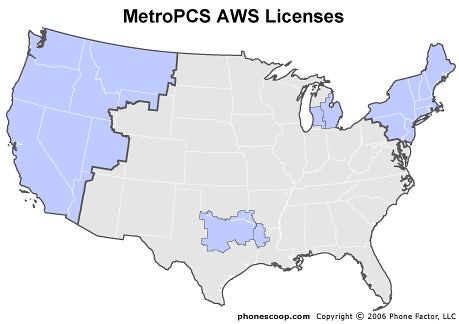
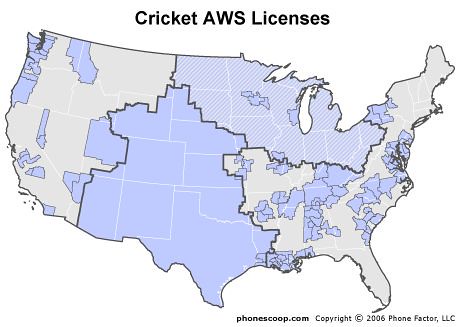
To understand it roughly, rewind back to the ongoing speculation that a then independent MetroPCS and Leap were a perfect fit since both had the same prepaid business models and did not compete against each other for the most part. The results of the 2006 AWS auction (see graphics below) helped fuel this speculation as the AWS  MetroPCS and Leap spectrum fit provided an uncannily perfectly complement. Time has passed and some AWS licenses changed hands. 


Graphics from Phonescoop.com
But with the AT&T-T-Mobile merger breakup, T-Mobile received some AWS licenses and in 2012, Leap and T-Mobile traded some licenses. While the T-Mobile-MetroPCS coverage map looks empty in some areas of the country, that is not to say that the company lacks spectrum in those areas. 
As seen in the spectrum holdings graphic, the company does indeed have spectrum nationally and can expand if so desired.  


With the June purchase of Mississippi Valley AWS spectrum from US Cellular (Barat) Wireless) and a future rumored purchase of Leap, the T-Mobile AWS portfolio would be formidable. Aside from T-Mobile, archrival Verizon Wireless' SpectrumCo AWS deal completed in August 2012 and building out this AWS to add LTE network capacity.  


This competitive landscape would put AT&T in an AWS coverage disadvantage relative to T-Mobile and Verizon Wireless. Therefore, AT&T needed to stay in the AWS LTE game and keep T-Mobile from growing a stronger AWS portfolio. For AT&T, AWS will not only to serve to add LTE capacity customers but also tap into future AWS LTE roaming revenue. T-Mobile, AT&T and Verizon Wireless are logical future roaming partners.  


Which companies will feel the most impact?

  • For T-Mobile, with Leap as a unit of AT&T, its MetroPCS geographic expansion will be challenged by AT&T's resources.  T-Mobile seemingly has a year or two lead as it is integrating MetroPCS and working on migrating the CDMA base to HSPA+/LTE but the stated goal of 2015.
  • Sprint will lose 3G data wholesale revenue from the agreement forged in August 2010 that expires in Dec 2015. But now Sprint (Clearwire's owner) loses another wholesale arrangement that Clearwire announced in March 2012 though nothing really started.  It's clear now that Sprint's prepaid segmentation strategy was the correct in the long run but Aio Wireless and Cricket are going up against Virgin, Boost, Assurance, respectively. Cricket's logical national (or specific target market) expansion may spell trouble. 
  • Verizon Wireless now sees a stronger AT&T rival with new found AWS and PCS spectrum from Leap. In the long term, it needs additional spectrum to thwart impending capacity brought on with WCS and Channel 55 (700 from Qualcomm) frequencies. In terms of prepaid, its branded prepaid is holding its own but without any flanker brands, competitors will take almost all the future prepaid growth.
  • In infrastructure, AT&T LTE equipment suppliers, Alcatel and Ericsson now have more of an order pipeline than before.

Last Word

  • The biggest question in this deal is whether the acquisition will pass regulatory hurdles. The sting of the failure to acquire T-Mobile is still fresh in everyone's minds. Like any major deal, it should have been gamed out by M&A internal and external resources taking into account the regulatory environment before it makes the light of day. 
  • If regulatory hurdles are overcome, what conditions will there be? AT&T has proactively said that the Chicago 700 MHz A Block will be sold. (It doesn't like the A block anyway). Will the company need to divest in other markets (planned or unplanned)? 

Monday, March 11, 2013

4Q2012 Prepaid Carrier Trends – Be Warned – It’s A Long One

Now that the Q4 2012 earnings are done, let’s look at the segment that had been driving a lot of the wireless growth in the past few years – prepaid. Rewind back to 2007/2008, Leap and MetroPCS were strongly acquiring subscribers with their unlimited propositions. The subsequent years saw similar flat rate introductions from the likes of Boost, Virgin Mobile, Tracfone’s StraightTalk and NET10. With the pressure from the monthly prepaid plans, Tier 1 carriers Verizon Wireless, AT&T and T-Mobile also joined the mix. The commonality in competition is for the high-value user. The traditional pay-as-you-go (PAYG) user’s contribution is far less. These users range from ‘glove box’ (low use) to moderate users. They also tend to be highly price sensitive and have a higher churn profile. The opposite is true to monthly plan users. These users while also price sensitive are heavier users and are fine with a flat rate model for predictability. They often have a lower churn profile relative to the PAYG user. That’s not to say they’re in the postpaid sub 2% churn territory. But for the prepaid segment, these monthly users are lower churn. 

Smartphones have been appearing in the prepaid segment for the last two years. While the companies want to offer the same capabilities as the postpaid segment, the prepaid model calls for low to no subsidies on devices. Of course companies strive to find low cost providers (e.g., Huawei and ZTE) to fill that niche and to leverage price against existing suppliers (e.g., Samsung, LG, Kyocera, HTC, etc.). The goal of course is to drop the smartphone price so that buyer can perceive that they’re affordable. However, prepaid providers walk a fine line for inexpensive devices because if a device is perceived as almost a throwaway, the likelihood of churn increases. For those reasons, expensive halo devices like a Samsung Galaxy S3 or the Apple iPhone keep the carrier sticky. 
With this as a backdrop, let’s look at how the players fared? Purely on net addition numbers, we can see that the regional unlimited players that ruled the day back in 2007/2008 are in trouble with Leap Wireless in the poorest shape with over 300K in subscriber losses. In Leap’s earnings call they noted that they are de-emphasizing their pay-as-you-go and mobile broadband business. There is logic in this as mobile broadband users eat more bandwidth (leaving less for monthly users) and PAYG are less revenue generating. MetroPCS though with less subscriber loss follows the same loss trend that has plagued Leap for many quarters. The company claims that they’re de-emphasizing CDMA growth but this tactic has resulted in an overall 5% loss in the base. This meshes with the long term strategy anyway once T-Mobile integrates and eventual use the 1900 CDMA to convert to 1900 HSPA+. By contrast, Tracfone’s net additions are by far the most impressive. The company buys wholesale from many carriers and has a large mix of PAYG and a growing base of monthly users. Presumably StraightTalk is doing well for the company as evident in ARPU. Several years ago, Tracfone ARPU was 10. In Q4 2011, it was 16 and in Q4 2012, it is now 18. APRU just doesn’t jump like this by growing a purely PAYG product. 


While Verizon Wireless had a tremendous Q4 in the postpaid side with over 2.1M net adds, the positive prepaid numbers indicate their competitiveness. Despite a down from a year ago and the previous quarter, it speaks to their premium brand messaging and perhaps a new November double data plan promotion. This is pretty decent for a predominately postpaid company. AT&T on the other hand is on a steeper downward slide. In Q3 2012, the company added 77,000 users with those gains erased with the 166K lost in Q4. AT&T is still a postpaid company with prepaid making up around 7% of the total subs. It will be interesting to see which way the direction turns for AT&T in Q1 2013. Another predominately postpaid carrier doing well in prepaid is US Cellular. Though the regional carrier continues to shed postpaid subscribers, the new U Prepaid plans that it has partnered with Alltel may be helping the cause. 

Moving onto the rest of the carriers, Sprint’s prepaid numbers have been down relative to previous quarters because the Assurance brand that had been driving huge subscriber count has been slowed due to FCC’s revamping of the subsidized Lifeline program in 2012. The company has already warned of a 1.2-1.3M subscriber loss possibly in Q2 2013 due to the revamping of rules. Regardless, the company indicated that the Boost and Virgin Mobile brands have contributed to the positive numbers. At the same time, the company is actively trying to migrate older Boost iDEN users off ahead of the iDEN network decommissioning. Finally, T-Mobile’s prepaid business is offsetting continued losses (550K) on the postpaid side. Again the above numbers are branded prepaid. T-Mobile counts MVNO (wholesale) net additions as prepaid as well. Branded prepaid at end of year 2012 represented 17% of the overall T-Mobile base. Looking ahead with the combination of MetroPCS’ prepaid subs, branded prepaid will transform to 45% of T-Mobile’s subscriber count. Given the higher churn profile of prepaid and lower revenue, it’ll looks challenging for future higher revenue contribution. But that’s months away…. Q1 2012 typically continues Q4 sales momentum. We’ll visit that to see what develops.