Showing posts with label US Cellular. Show all posts

Monday, June 17, 2019

AT&T's Prepaid Growth Story

If one looks at the last couple of quarters of net add performance, the prepaid market seems to be flattening. Powerhouses Metro by T-Mobile and Cricket which had dominated with large net additions have dropped from their high go-go growth past days.  Prepaid competition has always been tough and will certainly continue.  The drama in the T-Mobile/Sprint deal where uncertainty and change has brought concern to the dealer networks and employee bases, AT&T is standing out as the stable ship.  

To appreciate the AT&T's prepaid growth story, it began with the Leap acquisition announced in July of '13 and closed in March of '14.  Between the acquisition announcement and the close, Leap's subscriber base shrunk from about 5 million to over 4.5 million.  With Leap, AT&T's prepaid base moved to about 10 million subscribers at the close.  The Leap brand, Cricket, though known was declining and had an impact on AT&T's results in 2014. However, with brand expansion beyond Leap's regional footprint and AT&T's national coverage, the new Cricket began its growth story.   Increasing the 'doors' or distribution was central in this effort. This included expanding its dealer network and big box retail.


From 2015 to 2018, the AT&T prepaid net add annual run tallied over a million subscribers, negating 2014's growing pains which included decommissioning the Leap CDMA network and subscriber device migration.  


As prepaid evolved, it's still attracting a price sensitive segment but low plan price and free/discounted phones are just but several buying considerations. Embedding value is now mirroring postpaid plans. For example, Metro by T-Mobile is including mobile hotspot capability, music, generous Google storage and even Amazon Prime in higher tier plans. For Cricket's part, because of AT&T's Mexican network assets and Canadian roaming agreements, unlimited plan users can roam without charge in those countries.     


Recently, I had the opportunity to chat with John Dwyer, President of AT&T Prepaid on the state of his business.  A couple of Cricket highlights came up namely in the area of customer satisfaction triggered by comments made on the 1Q19 earnings call.  Though these were selected for the best PR, Chairman Stephenson revealed some important data points: 1) churn was under 3% and 2) Cricket subscribers accounted for 10 of the 17 million base, and had more than doubled since the Leap acquisition close.

Low churn is a key indicator of customer satisfaction and John reinforced that notion with JD Power wins in purchasing experience and customer satisfaction. As the former head of customer experience, he said that Cricket's net promoter score (NPS) moved from a -7 to now 43. By the way, NPS ranges from -100 to 100.  The 10 million Cricket subs suggest that there are 7 million prepaid subs to be share between branded prepaid and prepaid IoT.             

Branded prepaid took a shellacking in 4Q18 negating most of Cricket's 240K net adds. Observers checking the AT&T branded plans would note a double data promotion on its $50 ($40 with autopay) that runs until the end of July that suspiciously counters a similar promotion at Verizon, which isn't a surprise as each company have been longtime postpaid rivals for the same demographic.  This should hold true for each's branded prepaid offerings.

Back to the growth story - the last two quarters are shockingly lower than the previous 14 quarters.  The question is has the growth engine stalled because of overall market trends? Indeed, competitors' previous quarter net addition numbers were comparably lower.  One possibility could be on the coat tails of the FirstNet buildout wherein AT&T claims a positive trajectory for postpaid growth.  While they cite promotional activity for FirstNet accounts to include families, FirstNet is also going to rural communities in which AT&T has planned on new distribution. While the focus is on postpaid growth, it's logical that prepaid distribution would also follow. It's unclear whether we'll see 300K+ net additions but at least there is a runway.  A caveat is that with T-Mobile's 600 MHz expansion, their rural coverage will also increase and prepaid could also follow in increasing distribution, if there is commitment from Seattle (the new power center) versus formerly the MetroPCS HQ of Dallas.  In the next year, we'll see how the AT&T prepaid growth engine performs, firing on all cylinders or sputtering.         

Tuesday, February 26, 2019

Sprint's 5G Launch Potentially Gives It the 'Yellow Jersey"

At Mobile World Congress, Sprint announced its intention to launch 5G in May  with initial markets in Chicago, Atlanta, Dallas and Kansas City, along with Houston, LA, NYC. Phoenix and Washington, DC.


In support of the 5G foray, the company has lined up vendors to create and make available complementary halo devices LG (V50 ThingQ 5G), Samsung (Galaxy S10 5G) and HTC (5G Hub).   

The big picture: Sprint is finally realizing the advantage of its 2.5 GHz spectrum. While most of rivals were deploying LTE with FDD spectrum, Sprint's 100+ MHz TDD is a blessing as it can use that same wide bandwidth dynamically (split mode) to serve LTE and 5G. Therefore, it can add more downlink where market conditions require in contrast to a defined chunk of bandwidth as in competitors' FDD modes.

  • On the technology side, Sprint has been very vocal about investing in Massive MIMO radios and antennas, either when upgrading existing sites or building new ones. This technology is foundational as a 5G enabler and is ramping up in the first 5 months of 2019.  
  • Sprint's LTE Advance should be well over 220M POPs covered. But in late 2018, the company claims 225 gigabit LTE cities. This is important as it can provide a similar customer speed experience along side 5G. 

Why it matters:  To take a page out of the Tour de France where the leader wears the 'yellow jersey' as the winner in the stage, the 5G race seems to line up with Sprint.  While larger competitors AT&T and Verizon are deploying fatter mmW spectrum for fixed and quasi mobile service, it's unclear how they will get a national 5G footprint (It can bring in its discontinued 3G spectrum).  T-Mobile is banking on its FDD 600 MHz to provide the national coverage layer that could win the 5G geographic race down the line but it currently is still deploying and waiting for television station clearing. Moreover, it's unclear how much of its limited spectrum that it shares with LTE can provide a meaningful 5G experience. 

To be sure, Sprint's 2.5 5G coverage cannot provide a fully filled-inn national map. Physics makes it just too expensive to do so. However, using the 2.5 GHz in already built out markets and Massive MIMO upgrades along with the trend of vendor modularity (software and 5G 'cards'), Sprint can provide more 5G POP coverage than competitors in 2019.  
Tour de France observers will note that the race is multi-stage and with each stage there could be different leaders wearing the yellow jersey.  For now, in the first stage of the domestic 5G, it's looking like Sprint.

Extra content: John Saw, Sprint CTO at Mobile World Congress 2019 talking about its 5G network plans.

Monday, February 29, 2016

A Quick Take: Sprint's Retail Expansion w/Euro Company - Dixons Carphone

Sprint announced a joint venture with UK company Dixons Carphone Connected World Services (CWS) division to expand its retail footprint up to 500 stores.  


This follows the initial foray announced July 2015 where 20 test stores were to be opened. 
Particularly notable in the distribution of 'skin in the game" was the following:

Sprint stores will operate similarly to the third-party retailers who operate Sprint-branded wireless stores across the U.S. Sprint will own and staff the stores while CWS will manage them. CWS will also apply its expertise and best practices across all of Sprint’s sales channels.

Fast forward almost eight months and ostensibly the partnership was successful enough that warranted further stores - up to 500 nationally. However, no time table to meet the number was communicated. 

Quick Take:

Pros

  • This is about increasing the gross additions to offset subscriber defections that happen to all carriers. The more gross adds to offset defections yields a better churn metric. Simplistically , this will help the net addition and corporate turnaround story that Softbank and Sprint has been promising. 
  • Sprint further expands on its retail footprint following a deal with General Wireless in which Sprint was the lead brand and operating 1,435 to 1,700 stores. As Sprint of the RadioShack announcement in Feb 2015, the company had about 1,100 company owned retail stores. At the high range, Sprint will have about 3.300 stores. 
  • Sprint limits its risk and the cost of expansion as it is spread to Dixons which supposedly may have a hand it implementation on top of whatever monetary agreement there may be.
  • Presumably, this may help prepaid distribution since each retail store can also push prepaid brands Boost Mobile and Virgin Mobile (if they ever delineate each's niche and value).
  • Not that we're tracking Dixons from the US, it gives that company another U.S. foothold after a joint venture with Best Buy for Best Buy Mobile and Geeksquad.  As in this iteration, the partner operates the stores and provides the personnel.
Cons
  • For such a decent and impactful announcement, there was no mirror release on Dixons Carphone Media Centre/News Release site.  Doesn't the US expansion of a line of business warrant notice, particularly to he UK financial and mainstream press?

  • There is the 'out' language in the press release of 'up to 500' stores - no promises. There could be less, not realizing the full purported distribution impact. 
  • Sprint cost cutting may not be over. Any insider knows (regardless of carrier) that cost cutting/containment is constant. If things get bad, the 500 expansion number could be a pipe dream. A indicator could be the RadioShack partnership store traffic and sales metrics. 
  • T-Mobile has more Un-carrier announcements planned for '16. At this point, Sprint is competing with T-Mobile for the attacking large Verizon postpaid base.  A strong T-Mobile offering could impinge on Sprint's recovery momentum (albeit very small for now).
  • Honestly, this is an upside story. The heavy lifting of what to sell and get customers into the store has partially been answered with the successor of the long running 'Cut Your Bill in Half' promotion. 

Friday, February 6, 2015

Bullet Point Analysis: Sprint's RadioShack Store Deal - A Lot of Positives

What is it?

RadioShack's bankruptcy allowed Sprint to partner with General Wireless Inc., a subsidiary of Standard General LP, RadioShack’s largest shareholder (a hedge fund), to increase Sprint branded retail distribution by approximately 1,750 stores, more than doubling Sprint's current 1,100 company store count. The transaction is subject to approval by the bankruptcy court.

The plan at that point will be to establish co-branded (Sprint and RadioShack) stores where Sprint and RadioShack would sell their separate services. 

Analysis

Although it didn't make company's FY3Q14 earnings call deck, it's better late than never.  

The deal has many wins for Sprint since:
  • Above all, the company expands their distribution base to help with gross additions (postpaid and prepaid brands) and get potential subscribers in the door interested in the much campaigned "Cut Your Bill in Half Event" that will continue into 2015.
  • Distribution count will exceed surging rival T-Mobile. In the FY3Q14 earnings call, CEO Claure stated that Sprint was 500-600 less than T-Mobile. With the new stores, gets T-Mobile's count in one swoop, bringing the total Sprint count to over 2,800 retail points of distribution.  
  • Those 1,750 stores have been cherry picked.  Logically, these new stores would not cannibalize existing Sprint retail traffic, and serve the right Sprint target demographic - Verizon and AT&T prime customers.
  • The stores will be co-branded but Sprint is the primary brand. Sprint and RadioShack says that each brand's customers may be cross-marketed to but the ability to share lease space costs should not be overlooked. Sprint will only occupy a third of the store space so relative to operating a full store, Sprint in theory has lower costs.
  • With all the negativity of a declining brand and controlling costs, headcount cuts have been an unfortunate tool. However, Sprint will need employees to operate these stores. RadioShack employees who are already trained at selling mobile devices and plans are logical candidates. In theory, it's an easy transition as reps will only need to focus on Sprint plans versus the many prepaid MVNO options and those of Verizon and AT&T. In fact, because of the breadth of knowledge, these reps will know what competitors' plan weak points may be. 
Yet there are questions. 
  • Like many deals, the financial and commitment terms were not divulged so it's undetermined how good of a long term financial deal this is.  
  • The deal needs the blessing of the bankruptcy court and if that is given in short order, this doesn't mean that Sprint can move in immediately.  The store rep human resources process will need to be address, planning the look and buildout of a third of every store will need to be done.  Given this, the impact of the 2015 gross additions look to be in the back half of the year.
  • This last point can be both a positive and negative.   By taking over these 1,750 stores, Sprint takes out the same number of distribution points for postpaid rivals AT&T and Verizon (no T-Mobile) and Tracfone prepaid brands (US Cellular in some markets).  The big "BUT" is the amount of wireless business a declining RadioShack generated for competitors. If it's immaterial, then it's not that great of a loss for those competitors.
Overall, this deal is one of the best moves Sprint has jumped on since the beginning of CEO  Claure's tenure. 

Thursday, June 19, 2014

Bullet Point Analysis: T-Mobile's Un-carrier 5.0 & 6.0

WHAT IS IT?

On the evening of June 18, T-Mobile announced the latest Un-carrier initiatives – 5.0 and 6.0. Beyond these next levels of iteration that address customers’ ‘pain points,’ the network progress story provides the foundation for these and future T-Mobile moves. 
  • The T-Mobile Network (specifically its LTE capability) has been expanding aggressive. T-Mobile stated that by the end of June 2014, The LTE network will cover 230 million POPs and by the end of the year, reach 250 million POPs. T-Mobile counts 16 markets with 15 + 15 MHz (AWS) spectrum – T-Mobile’s uses the moniker Wideband LTE for these markets. To take advantage of LTE, Voice over LTE (VoLTE) is in 15 markets (not the all the same markets above) covering 107 million POPs and national coverage by the end of 2014.
  • Un-carrier 5.0, known as T-Mobile Test Drive allows consumers to receive (specifically) an Apple iPhone 5s for 7 (marketing tag – 7 Night Stand) days to use for free. After the test period (they return the iPhone to a T-Mobile store). Test Drives are limited to 1 time per year, per credit card, per customer. For business customers, instead of registering online and receiving the phone by mail, these customers will get their (up to 3) iPhone 5s units by a T-Mobile representative. Instead of one week, the business test drive period is two weeks. Both new and existing customers may participate.
  • Un-carrier 6.0 is music focused. Coined Music Freedom, Simple Choice customers with 1, 3, and 5 GB allowance plans may stream audio without drawing from their data buckets. The initial ‘over the top’ music brands include Pandora, Rhapsody, iTunes Radio, Slacker, Samsung’s Milk Music, and yet to be launched Beatport. With customer input, additional music services may be added to list.
  • Without an Un-carrier designation, T-Mobile partnered with Rhapsody to build an ad-free unlimited streaming music service known as unRadio. For Simple Choice customers get it for free or $4/month for other T-Mobile customers, and open for $5/month for non-T-Mobile customers.

ANALYSIS

  • The Network (marketing tag – Data Strong) – It’s well known within the industry that a strong network and public perception is foundational to customer acquisition and retention. Coupled with competitive pricing and a strong device portfolio, customers are unlikely to churn. Both Verizon Wireless and AT&T have strong network perception, partly due to the reach of their lowband spectrum. T-Mobile’s approach is to fully take advantage of its spectrum portfolio piecing together its AWS properties using carrier aggregation and advanced MIMO antennas. In some markets, it has 15 + 15 MHz (FDD) and 20 + 20 MHz (in 90% of the top 25 markets) in others. What this all translates to theoretical ~147 Mbps DL/ 40 Mbps UL. Of course on a loaded network, customers will likely experience less. At the announcement, it reprised its America’s Fastest LTE Network claim. It’s a certainty that this will continue be a central marketing value proposition.
Bragging: Legere shared that T-Mobile’s consumers are the industry’s biggest data users with the following stats: T-Mobile users use 69% more data than the Verizon customer, 61% more against Sprint, and 100% more against AT&T. A network engineering person would initially cringe but these consumption stats speaks to how Neville Ray’s (CTO) team work – creating a network to specifically address speed and capacity. From a marketer’s lens, a fast network embraces the explosive trend of data consumption, particularly the growing millennial segment.
  • Un-carrier 5.0 addresses two points and cements a partnership. Customer acquisition and dispelling bad network perception is behind the 7 (or 14 day for business customers) Test Drive. The postpaid market is furiously in a switching game as the number of these type of subscribers reaches saturation. Every Un-carrier move is about customer acquisition. 1.0 was about low priced no-contract plan, 2.0 (JUMP) addressed the ability to upgrade a phone, 3.0 paid the termination fees for switching and 4.0 gave 200 MB of LTE tablet data for life. With 5.0, a free ‘try before you buy’ is a huge marketing bet - specifically use iPhone 5s for competitors’ customers to try the network, without obligation. Engaged them daily with giveaways, contests and other promotions. The brilliant part of this is at the end in which the target customer enters a T-Mobile store to engage in a switching dialog. On the business side, it provides a strong lead generation tool for its infant business group. At the end of the two week test period, the business rep has a stronger position to talk about T-Mobile’s network and plans. T-Mobile is projecting over 1 million Test Drives over the next year.


Using an iPhone 5s gives Apple the opportunity to drive additional volume at T-Mobile. While T-Mobile finally got the iPhone in April 2013, it has set publicly that Android devices drove most of its sales. There is synergy here as Apple also benefits with Test Drive as a tool to convert Samsung customers with its halo device. Apple’s skin in the game is that it is providing all the iPhones. The logical psychology is that the target customer will be smitten with the 5s, benefiting T-Mobile’s iPhone volume commitments, helping to increase equipment revenues and fortifying the business relationship for future promotions.

  • Un-carrier 6.0 is essentially T-Mobile zero-rating audio data. This is a good gamble as audio data is tiny compared to the popular data hog video. Legere claims that even if a T-Mobile customer exhausts their data bucket, they will continue to listen to audio without penalty. There are two messages here – to millennials (mostly) use streaming music to your heart’s content and a general one, our network can withstand this anticipated music deluge. In addressing net neutrality, T-Mobile states the zero-rating is unilateral and aside from technical integration cooperation, there aren’t any commercial agreements. However, customer voting on which future music services will be included, some may argue an exclusion and favoritism against emerging companies. 

  • unRadio provides an alternative to the over the top streaming music services. For its young (and young at heart) subscriber base, it’s a ‘cherry’ on top of the continuing attractive features of being in the T-Mobile community. unRadio features differentiate from other internet music with features including ad-free listening, unlimited skips, customized stations, and a song ID (called TrackMatch) for music discovery. Therefore, unRadio blatantly provides an anti-churn tool for T-Mobile more so than a primary customer acquisition tool. 

COMPETITIVE IMPACT?

History has shown that most Un-carrier moves responsible for T-Mobile’s formidable subscriber growth and met by competitors in some cases.

- Un-carrier 1.0 - Simple Choice
Response: AT&T Mobile Share Value and Verizon More Everything

- Un-carrier 2.0 JUMP
Response: AT&T Next coupled with Mobile Share Value, Sprint Easy Pay, and Verizon EDGE coupled with More Everything

- Un-carrier 3.0 – Free unlimited international texting and data roaming (EDGE), Stateside International Talk & Text $10 Add-on

Response: AT&T Mobile Share & Mobile Share Value plans w/included unlimited stateside international messaging and $5 World Connect Value add-on and Verizon More Everything plans with free unlimited stateside international messaging

- Un-carrier 4.0 – Contract Freedom (Paying ETF &; Value of Phone)
Response: Limited time AT&T promotion, On-going Sprint switching promotion

Of the two announcements, 5.0 is more threatening as it couples a high-end iPhone with a no-obligation try before you buy opportunity. Fence sitters who are drawn to T-Mobile’s low pricing but concerned about network robustness are likely defectors. As Verizon’s and AT&T’s networks are proven robust, T-Mobile’s play will be pushing Test Drive participants towards the speed angle. As all carriers are in the next phase of LTE progress – carrier aggregation (to increase speed), the vulnerability will be customers with older and less capable 3G or LTE handsets and featurephones.

Monday, May 12, 2014

Video: Trends in 1Q14 US Carriers' Results

Dan Meyer, Editor-in-Chief from RCR Wireless and I talk 1Q14 US carrier results and any trends happening from the big 4. RCR Story Link


Wednesday, March 12, 2014

RCR Wireless Webinar on Spectrum (U.S.)

I took part in an RCR Wireless Webinar entitled : Spectrum Economics - The Emerging New Paradigm of Spectrum Use

Spectrum is the lifeblood of the wireless telecommunications space, and with a finite resource straining to serve an increasingly data-hungry consumer base, the pressure is on to free up new assets, for carriers to get their hands on what’s available and for equipment vendors to find more efficient ways to use what’s available. RCR Wireless News will take a look at the current spectrum market, from the ways the federal government is trying to free up spectrum, to the importance of current spectrum auctions and looking at developments in technology and small cells designed for greater efficiency.


What You Will Learn: 
How the wireless industry values wireless spectrum and ways in which vendors and wireless carriers are trying to squeeze more efficiency out of current supplies. Also a view on how the federal government is looking to free up more spectrum for non-conventional uses.

Who Should Watch: 
Those involved with network planning, including small cells and non-traditional networks. Also, those involved with roadmap planning for wireless carriers, vendors and equipment providers. 

Moderator: Dan Meyer, Editor-in-Chief, RCR Wireless News 
Analyst Angle: William Ho, Principal Analyst, 556 Ventures
Panelist: Jeffrey S. Silva, Sr. Policy Director, Telecommunications, Medley Global Advisors
Panelist: Steve Berry, President and CEO, Competitive Carriers Association

Register at RCR Wireless here to hear it.

Tuesday, February 25, 2014

Bullet Point Analysis: AT&T Domestic International Messaging & Calling Move - Responding to Verizon Wireless & T-Mobile

WHAT IS IT?


AT&T announced it is proactively baking in unlimited international messaging (text and picture) from the US to the 'world' for its Mobile Share and Mobile Share Value customers. The feature will be available on Friday, February 28th.

AT&T is also introducing a new international calling package called World Connect Value where a customer can call 'over' 35 countries from the U.S. for one cent per minute. This package is priced at $5 per month.   


ANALYSIS

Just like that, AT&T's single move addresses vulnerabilities brought about by competitors' moves last week and the week before.
  • Domestic based international benefits are becoming table stakes in the subscriber retention/acquisition war. Though it overtly benefits consumers with friends and family abroad, other beneficiaries are business/enterprise users who choose to use their smartphones for immediate international contact instead of standard email and landlines.
  • All mobile carriers' unlimited stateside international messaging fights, to some extent, the free OTT applications that perform voice and messaging including, WhatsApp, Skype and Tango.  
  • AT&T Mobile Share & Mobile Share Value plans are now at stateside international messaging parity against Verizon Wireless' More Everything plans. However, it is still at a $5 pricing disadvantage at the 1 & 2 GB options when looking for Verizon Wireless switchers. Additionally, if it looks for further plan parity, it is missing 500 MB and 3 GB options.  
  • The international calling changes the playing field against T-Mobile. T-Mobile's plan is looking for a $15 price point that provides unlimited mobile-to-mobile calling to 30 countries, unlimited landline calling to 70 countries coupled with unlimited text messages. AT&T offers a lower $5 price with 1 cent/minute to mobile and landlines in 35 countries. Clearly it's difficult to do an apples-to-apples comparison and the benefits are user dependent. 
  • AT&T's World Connect Value plan meets the same $5 price point as Verizon Wireless' International Long Distance Value plan though Verizon claims 230 destinations.  Note that destinations as a code word may not include country.   

 COMPETITIVE IMPACT?
  • Verizon Wireless really doesn't need to do anything as AT&T is just reaching international messaging parity against the More Everything plans. One possible decision is whether to proactively give its Share Everything subscribers this feature or just move them to the new More Everything plans without fees.
  • T-Mobile just made a move and competitors' responses don't really undercut it. This may or may not be an issue as it tries to acquire multinational business customers.
  • Sprint already has a $15 International Freedom Call and Text.  It now needs to decide whether meet larger competitors' $5 price point and include unlimited messaging as part of its domestic plan structure or stay the course to be on par with T-Mobile.  
  • These Tier 1 carrier moves are at a brisk pace that may impinge on regional carriers, chiefly US Cellular. Can they keep up?
Unlike the old days where it took a month or more to react to competitive vulnerabilities, large carriers have shown that it can react rather quickly. In this case, AT&T did it in about 11 days.  But AT&T still seems to be mulling over the 500 MB, 1, 2 and 3 GB options, whether to match its long standing rival or let it ride for a while. Let's see what happens.  

Sunday, July 14, 2013

Bullet Point Analysis: The AT&T-Leap Buyout


What is it?


AT&T is buying prepaid player Leap Wireless for $15 per share in cash. Under the terms of the agreement, AT&T will acquire all of Leap’s stock and wireless properties, including licenses, network assets, retail stores and approximately 5 million subscribers. AT&T expects the transaction to complete in 6-9 months (1H 2014).

What is in it for Leap?


  • For shareholders and management, they can exit the cut throat prepaid business with money. Leap and similar regional prepaid player, MetroPCS, had once enjoyed strong growth until a couple of years ago. National competitors and prepaid MVNOs ate into their marketshare and growth. T-Mobile's acquisition of MetroPCS that closed in May 2013 logically put a brighter spot light on Leap. 
  • For Leap operations, the Cricket brand expands its geographical reach beyond Leap's limited regional footprint and can go head-to-head against MetroPCS and can tap into AT&T's distribution resources.
  • For the Leap network, it has a clearer LTE path. Operating CDMA (96M POPs) and LTE (21M POPsin the same limited AWS spectrum bands doesn't work well.   

What is in it for AT&T?


Spectrum:  

  • Complementary PCS and AWS bands covering 137M POPs, some of AWS is not in service (41M POPs).
  • Proceeds from the Leap 700 A Block spectrum goes into the deal calculus.


Subscribers and Doors: 
  • Leap has 5 million prepaid subscribers but the company has been trying to right itself after steady customer losses that began in Q2 2012. AT&T increases its prepaid customer base to roughly 12 million, roughly 11% of the AT&T total subscriber base.
  • Leap's distribution channel numbers a little less than 9,000 doors.  
  • Commentary: Leap's business needs a turnaround that Leap's management has been trying to accomplish for more than a year. In that time, Leap lost about 900K customers. Leap's distribution also slimmed down from over 11K doors in a bid to focus customer acquisition.  AT&T's own branded prepaid is not growing. The launch of the Aio brand in May allows for the company to enter the prepaid market aggressively without diminishing the AT&T brand. Now that Leap joins the AT&T prepaid fight, the strategy is shaping up to match the segmentation strategy pioneered by Sprint (Boost, Virgin, Assurance) and Tracfone (Tracfone, StraightTalk, Net10, Simple Mobile, PagePlus, and Safelink). T-Mobile also joins in the prepaid segmentation fight with its own GoSmart and MetroPCS).  All this Tier-1 competition and the plethora of MVNOs out there vying for the prepaid share of wallet will make for thin margins.  
Strategic Positioning:

Keeping T-Mobile Away: There are many who say this is a spectrum deal. That is true that additional PCS and AWS spectrum enhances the AT&T network, I argue that a large element is to neutralize a growing T-Mobile threat. Fresh off the May close of MetroPCS, T-Mobile supplemented its AWS spectrum with a $308M deal with US Cellular at the end of June.  
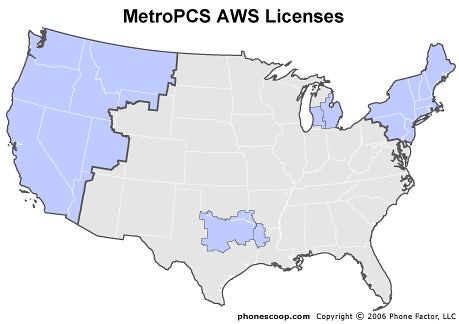
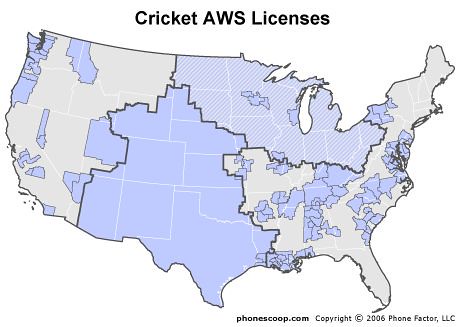
To understand it roughly, rewind back to the ongoing speculation that a then independent MetroPCS and Leap were a perfect fit since both had the same prepaid business models and did not compete against each other for the most part. The results of the 2006 AWS auction (see graphics below) helped fuel this speculation as the AWS  MetroPCS and Leap spectrum fit provided an uncannily perfectly complement. Time has passed and some AWS licenses changed hands. 


Graphics from Phonescoop.com
But with the AT&T-T-Mobile merger breakup, T-Mobile received some AWS licenses and in 2012, Leap and T-Mobile traded some licenses. While the T-Mobile-MetroPCS coverage map looks empty in some areas of the country, that is not to say that the company lacks spectrum in those areas. 
As seen in the spectrum holdings graphic, the company does indeed have spectrum nationally and can expand if so desired.  


With the June purchase of Mississippi Valley AWS spectrum from US Cellular (Barat) Wireless) and a future rumored purchase of Leap, the T-Mobile AWS portfolio would be formidable. Aside from T-Mobile, archrival Verizon Wireless' SpectrumCo AWS deal completed in August 2012 and building out this AWS to add LTE network capacity.  


This competitive landscape would put AT&T in an AWS coverage disadvantage relative to T-Mobile and Verizon Wireless. Therefore, AT&T needed to stay in the AWS LTE game and keep T-Mobile from growing a stronger AWS portfolio. For AT&T, AWS will not only to serve to add LTE capacity customers but also tap into future AWS LTE roaming revenue. T-Mobile, AT&T and Verizon Wireless are logical future roaming partners.  


Which companies will feel the most impact?

  • For T-Mobile, with Leap as a unit of AT&T, its MetroPCS geographic expansion will be challenged by AT&T's resources.  T-Mobile seemingly has a year or two lead as it is integrating MetroPCS and working on migrating the CDMA base to HSPA+/LTE but the stated goal of 2015.
  • Sprint will lose 3G data wholesale revenue from the agreement forged in August 2010 that expires in Dec 2015. But now Sprint (Clearwire's owner) loses another wholesale arrangement that Clearwire announced in March 2012 though nothing really started.  It's clear now that Sprint's prepaid segmentation strategy was the correct in the long run but Aio Wireless and Cricket are going up against Virgin, Boost, Assurance, respectively. Cricket's logical national (or specific target market) expansion may spell trouble. 
  • Verizon Wireless now sees a stronger AT&T rival with new found AWS and PCS spectrum from Leap. In the long term, it needs additional spectrum to thwart impending capacity brought on with WCS and Channel 55 (700 from Qualcomm) frequencies. In terms of prepaid, its branded prepaid is holding its own but without any flanker brands, competitors will take almost all the future prepaid growth.
  • In infrastructure, AT&T LTE equipment suppliers, Alcatel and Ericsson now have more of an order pipeline than before.

Last Word

  • The biggest question in this deal is whether the acquisition will pass regulatory hurdles. The sting of the failure to acquire T-Mobile is still fresh in everyone's minds. Like any major deal, it should have been gamed out by M&A internal and external resources taking into account the regulatory environment before it makes the light of day. 
  • If regulatory hurdles are overcome, what conditions will there be? AT&T has proactively said that the Chicago 700 MHz A Block will be sold. (It doesn't like the A block anyway). Will the company need to divest in other markets (planned or unplanned)? 

Monday, March 11, 2013

4Q2012 Prepaid Carrier Trends – Be Warned – It’s A Long One

Now that the Q4 2012 earnings are done, let’s look at the segment that had been driving a lot of the wireless growth in the past few years – prepaid. Rewind back to 2007/2008, Leap and MetroPCS were strongly acquiring subscribers with their unlimited propositions. The subsequent years saw similar flat rate introductions from the likes of Boost, Virgin Mobile, Tracfone’s StraightTalk and NET10. With the pressure from the monthly prepaid plans, Tier 1 carriers Verizon Wireless, AT&T and T-Mobile also joined the mix. The commonality in competition is for the high-value user. The traditional pay-as-you-go (PAYG) user’s contribution is far less. These users range from ‘glove box’ (low use) to moderate users. They also tend to be highly price sensitive and have a higher churn profile. The opposite is true to monthly plan users. These users while also price sensitive are heavier users and are fine with a flat rate model for predictability. They often have a lower churn profile relative to the PAYG user. That’s not to say they’re in the postpaid sub 2% churn territory. But for the prepaid segment, these monthly users are lower churn. 

Smartphones have been appearing in the prepaid segment for the last two years. While the companies want to offer the same capabilities as the postpaid segment, the prepaid model calls for low to no subsidies on devices. Of course companies strive to find low cost providers (e.g., Huawei and ZTE) to fill that niche and to leverage price against existing suppliers (e.g., Samsung, LG, Kyocera, HTC, etc.). The goal of course is to drop the smartphone price so that buyer can perceive that they’re affordable. However, prepaid providers walk a fine line for inexpensive devices because if a device is perceived as almost a throwaway, the likelihood of churn increases. For those reasons, expensive halo devices like a Samsung Galaxy S3 or the Apple iPhone keep the carrier sticky. 
With this as a backdrop, let’s look at how the players fared? Purely on net addition numbers, we can see that the regional unlimited players that ruled the day back in 2007/2008 are in trouble with Leap Wireless in the poorest shape with over 300K in subscriber losses. In Leap’s earnings call they noted that they are de-emphasizing their pay-as-you-go and mobile broadband business. There is logic in this as mobile broadband users eat more bandwidth (leaving less for monthly users) and PAYG are less revenue generating. MetroPCS though with less subscriber loss follows the same loss trend that has plagued Leap for many quarters. The company claims that they’re de-emphasizing CDMA growth but this tactic has resulted in an overall 5% loss in the base. This meshes with the long term strategy anyway once T-Mobile integrates and eventual use the 1900 CDMA to convert to 1900 HSPA+. By contrast, Tracfone’s net additions are by far the most impressive. The company buys wholesale from many carriers and has a large mix of PAYG and a growing base of monthly users. Presumably StraightTalk is doing well for the company as evident in ARPU. Several years ago, Tracfone ARPU was 10. In Q4 2011, it was 16 and in Q4 2012, it is now 18. APRU just doesn’t jump like this by growing a purely PAYG product. 


While Verizon Wireless had a tremendous Q4 in the postpaid side with over 2.1M net adds, the positive prepaid numbers indicate their competitiveness. Despite a down from a year ago and the previous quarter, it speaks to their premium brand messaging and perhaps a new November double data plan promotion. This is pretty decent for a predominately postpaid company. AT&T on the other hand is on a steeper downward slide. In Q3 2012, the company added 77,000 users with those gains erased with the 166K lost in Q4. AT&T is still a postpaid company with prepaid making up around 7% of the total subs. It will be interesting to see which way the direction turns for AT&T in Q1 2013. Another predominately postpaid carrier doing well in prepaid is US Cellular. Though the regional carrier continues to shed postpaid subscribers, the new U Prepaid plans that it has partnered with Alltel may be helping the cause. 

Moving onto the rest of the carriers, Sprint’s prepaid numbers have been down relative to previous quarters because the Assurance brand that had been driving huge subscriber count has been slowed due to FCC’s revamping of the subsidized Lifeline program in 2012. The company has already warned of a 1.2-1.3M subscriber loss possibly in Q2 2013 due to the revamping of rules. Regardless, the company indicated that the Boost and Virgin Mobile brands have contributed to the positive numbers. At the same time, the company is actively trying to migrate older Boost iDEN users off ahead of the iDEN network decommissioning. Finally, T-Mobile’s prepaid business is offsetting continued losses (550K) on the postpaid side. Again the above numbers are branded prepaid. T-Mobile counts MVNO (wholesale) net additions as prepaid as well. Branded prepaid at end of year 2012 represented 17% of the overall T-Mobile base. Looking ahead with the combination of MetroPCS’ prepaid subs, branded prepaid will transform to 45% of T-Mobile’s subscriber count. Given the higher churn profile of prepaid and lower revenue, it’ll looks challenging for future higher revenue contribution. But that’s months away…. Q1 2012 typically continues Q4 sales momentum. We’ll visit that to see what develops.

Sunday, February 3, 2013

Substantive Switching Credit

I just caught this switching ad from Sprint. I found it through a Facebook ad.  The promise is to receive $400 credit for switching a family plan with 3-5 lines. It reprises a similar $400 effort reported in August 2012. While switching credits are nothing new, the $400 figure is notably high to entice. 

Sprint Switching Ad 


Sprint isn't the only carrier in the switching game for Q1 2013. US Cellular at the end of January launched a $300 switching promotion.   


What is the motivation?

  • Postpaid Penetration - Carriers have long talked about the near saturation of the postpaid marketplace. In this world, organic growth has slowed and the only way to get net additions will be to steal it away from other carriers. 
  • Quarterly (Q1) Performance - Both Sprint and US Cellular have been losing customers at a rapid rate.  Sprint's iDEN customer defections have been a thorn in its side for 3+ years.  US Cellular as a regional carrier has not been effectively competing against Tier 1 competitors despite upgrading to LTE and upgrading its device portfolio.
  • Families are Low-churn & High ARPU-bearing - The promotion grabs 3-5 subscribers and the carrier locks them in for two years. The promotions specifically push customers into smartphones and data plans. Data is the monetary upsell and the sticky value-prop. 
  • Promotion Credit Sunk Marketing Cost - In business, there needs to be promotion to draw interest to your product. Some companies have different tolerances for the cost to acquire a customer.  At the end of the day for Q1, Sprint and US Cellular need to beef up their gross adds.  

Friday, January 25, 2013

Spectrum Win-Win for Two Giants

Today AT&T agreed to acquire spectrum in the 700 MHz B band from Verizon Wireless for $1.9 billion in cash and Advanced Wireless Services (AWS) spectrum licenses in several markets, including Phoenix, Ariz., Los Angeles and Fresno, Calif. and Portland, Ore.


The 700 MHz licenses to be acquired by AT&T cover 42 million people in 18 states — California, Colorado, Florida, Idaho, Illinois, Louisiana, Montana, New Mexico, New York, Ohio, Oklahoma, South Dakota, Tennessee, Texas, Utah, Virginia, Washington and Wyoming.  Here are the following CMAs (Cellular Market Areas):

·         California: Los Angeles
·         Colorado: Park, Fort Collins-Loveland, Pueblo,
·         Florida: Miami, West Palm Beach, Bradenton
·         Idaho: Butte
·         Illinois: Chicago
·         Louisiana: De Soto, Claiborne, Morehouse, Lake Charles, Alexandria
·         Montana: Billings, Beaverhead, Great Falls, Carbon
·         New Mexico: Grant
·         New York: Rochester
·         Ohio: Cincinnati, Youngstown
·         Oklahoma: Oklahoma City
·         South Dakota: Rapid City, Harding
·         Tennessee: Memphis
·         Texas: Texarkana, Edwards, Waco, Tyler, Longview-Marshall
·         Utah: Box-Elder, Carbon, Beaver, Piute
·         Virginia: Frederick
·         Washington: Okanogan
·         Wyoming: Sheridan, Casper

Yet another interesting sideline is the involvement of a Sarasota, FL private equity firm, Grain Management.  Verizon is selling spectrum in several North Carolina markets to Grain Management. Grain is also acquiring an AWS license covering Dallas from AT&T—and Verizon will lease that license from Grain.
Recall in Auction 73, the Lower 700 Band was up for grabs.  

How did Verizon do?


  • Block A – Verizon Wireless and U.S. Cellular both bought 25 licenses each. In this block, Verizon targeted urban areas, while U.S. Cellular bought licenses primarily in the northern portion of the U.S. 
  • Block B – AT&T Mobility was the biggest buyer in the B block, with 227 licenses totaling $6.6 billion. U.S. Cellular and Verizon bought 127 and 77 licenses, respectively. AT&T Mobility and Verizon Wireless bought licenses around the country, while U.S. Cellular continued with its strategy to buy licenses in northern regions. 
  • Block C – Of the 10 licenses in the C Block, Verizon Wireless bought the 7 that cover the contiguous 48 states (and Hawaii). Those seven licenses cost Verizon roughly $4.7 Billion. 


Why? It's a win-win because Verizon Wireless wanted to unload the 700 MHz bands (A and B Block) as its C Block and its recent AWS spectrum acquired from Cable Company partners gave a sufficient footprint nationally.  AT&T needed it to fill B Block holes nationally.  It was almost a given that AT&T would be the buyer. As an aside, earlier this month,  Verizon sold some A Block licenses to US Cellular. 

The interesting go-between of a private equity firm is notable.  It's clear that PE firms do not operate networks but a licensing/leasing arrangement from these big carriers will bring in recurring revenue.