Showing posts with label iPhone. Show all posts

Thursday, October 29, 2020

AT&T Handset Supercycle and Retaining the iPhone base?

AT&T has veered from its long time conservative promotional activity, relative to its peers.  With so many M&A and then integration irons in the fire, the gross add wireless business seemed to take a back seat. However with the Apple iPhone 12 launch, AT&T has made its most aggressive move to date.  That is an iPhone 12 can be obtained for free, a $800 value. Of course the conditional unlimited plan, minimum trade-in and 30 month installments apply. Moreover, the $800 can be applied against the 12 Pro and likely the 12 Pro Max model. To be sure, in a switcher world, the best promotions are reserved for those who jump carriers, or existing users adding a new line.

What's different this year is that this promotion is opened to existing subscribers without a new line condition. Though this seemed to be widely noted with the iPhone 12 launch,  a similar flagship device promotion happened in September with the Samsung Note 20 5G where a subscriber may get that device for free with similar conditions. Still, it wasn't an iPhone.


Why It Matters

AT&T's multi-year iPhone exclusivity deal allowed it to build a large high-value base. Despite losing that exclusivity in 2011 and 2013 to competitors, iPhone customer accounts generate higher ARPA bearing revenue. Yet despite formidable switching attacks from T-Mobile over the years, AT&T has determined 4Q20 as its time to fight back.  Why?

The device "supercycle" moniker speaks to the 5G rollouts across the domestic landscape in that carriers needed to move their older device base to upgrade. In doing so, they would realize a better user experience from all the network improvements in the past and future year(s).  AT&T's tangible benefits include reduced postpaid churn (i.e., 30 month installment) and higher ARPU/ARPA (i.e., requisite unlimited plan). 

In terms of timing, AT&T has been a leader(?) in with the lowest postpaid upgrade rate for over 20 quarters. This speaks to its conservative promotional activity. By contrast, its conservative peer, Verizon reported higher upgrade rates.  To be sure, the combination of AT&T conservative approach and competitors' aggressive promotions resulted in poor gross/net add performance and even net losses in some quarters.   


On its 3Q20 earnings call, AT&T CEO Stankey noted that the iPhone promotion is a means to reward the longtime iPhone customer base.  It's clear that Apple jumping on the 5G bandwagon was a key factor in the promotion calculation.  If all goes well, Stankey stated with HBO Max adoption, new mobile unlimited plans coupled with a 5G handset cycle would be a key wireless service revenue driver for the backhalf of 2020.  My own retail and customer care checks suggest this iPhone promotion is incredibly popular with desired color variants backlogged until December. 

It's unclear when the promotion will end as reps didn't have any end date in their systems.  If successful, we can expect to see AT&T's device upgrade rate for 4Q20 spike higher than many previous 4Qs. Promotions are of course a part of the business and it will be interesting to see when the promotion ends, traditionally before Black Friday or keep the momentum throughout to the end of the year.  There are likely AT&T business case people who have gamed the right threshold of promotion tied to new and existing subscribers counts, expected plan upsell and device subsidy levels.  Looking ahead, it appears AT&T has a lot of retention momentum for 4Q20.   


Thursday, January 31, 2019

4Q18 Sprint Prepaid Tanks

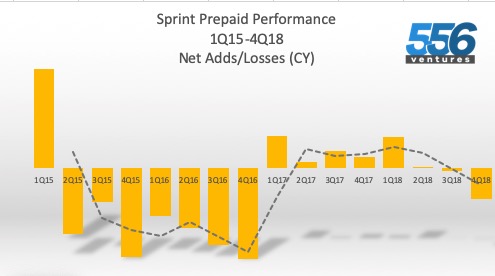
Just when you thought Sprint prepaid turned the loss corner in 2017, it started sputtering in 2Q18 and then totally tanked in 4Q19 with 174K net losses.  Sprint bet big on prepaid in the Dan Hesse days and embarked on a multi-brand strategy.  Then, Assurance, a lifeline brand created to counter America Movil's Safelink greatly added to the prepaid base. Then with the fallout of lifeline investigations, those numbers quickly went away. Meanwhile in 2017, under then CEO Claure, Sprint announced the re-launch of its limbo brand, Virgin Mobile.  The new Virgin Mobile was supposed to be an "industry game-changer" with an iPhone only bent. It hasn't moved the needle in prepaid competition.


Why it matters: Essentially, Sprint prepaid is a one brand pony - Boost.  In the CY4Q18 earnings call and material, Sprint noted that Boost continues to be a strong contender. In the previous quarter, Boost accounted for <200K net additions. For this quarter, rather than provide a definitive number, Sprint CEO Combes only stated that Boost delivered eight consecutive quarters before "migration."

Migration? What's that? In a nutshell, Sprint has identified high-value and stable Boost or Virgin Mobile subscribers and offer them a non-branded Sprint postpaid plan and device financing.  For this quarter they totaled 100K, which also classified them in the Sprint postpaid subscriber base.  

In CY3Q18, Combes managed expectations that this quarter would be negative.  One can only assume that Virgin Mobile is the brand that is in a freefall since Sprint no longer reports Lifeline (Assurance) subs due to regulatory constraints. However, Sprint expects a return to growth in CY1Q19/FY4Q18. Even if Sprint prepaid bounces back, it will be a while before it matches the momentum of AT&T Cricket or Metro by T-Mobile.

Monday, April 13, 2015

Can't Knock Sprint for Trying Hard, Now Direct 2 You

WHAT IS IT?

Direct 2 You is the company's latest action at building differentiation to stand apart against competitors.


 In a In a nutshell, it's concierge and personalized direct to the customer fulfillment of a previously placed order for customers who are upgrading.  Though it's positioned as a national program, only Kansas City, Chicago and Miami were announced.  As part of the announcement, Sprint notes a fleet of 5,000 branded cars and job creation numbers of 5,000.ANALYSISThere is no doubt that Sprint is trying out a lot of ideas to get itself out of the hole. CEO Claure deserves much of the credit in lighting a fire and compounding a sense of employee urgency in the company's restoration journey. Direct 2 You comes at the heels of the free unlimited international data (albeit 2G & only 15 countries)/text roaming announcement and RadioShack distribution deal in which immediately after the bankruptcy decision,  Sprint soon opened some sales doors.  Intertwined was a very 'political' announcement in a important spotlight market, Chicago where infrastructure investment and job creation (300) led the headlines. Here are some Direct 2 You pros:
  • The effort is for only upgrades, which means that this is a customer retention effort. There is no minimum bill spend on attaining this concierge service.  Rewarding and cementing loyalty directly impacts churn. While 'Cut Your Bill in Half' and RadioShack store distribution expansion is about acquiring gross adds, Sprint needs better ways to fight against T-Mobile's switching momentum.
  • The markets are important and 'friendly.' Starting off in the home HQ market, it gives Sprint some political capital for local job creation, rather than the very visible downsizing in recent past. Chicago as a market has been long discussed as a revitalization of the company story even in the Hesse era. Continuing that on top of meeting public commitments to re-elected Mayor Emanuel only makes sense. Finally, Miami is Claure's old home and obviously heavily Hispanic (a segment Sprint is heavily courting).  
  • The effort is through an outsourced partnership, one that has a long history of residential/office fulfillment. There are no Sprint employees in the mix but ostensibly, the job creation is non-direct and there should not be any Sprint CapEx spend.
  • Direct 2 You fulfillment is on the customer's schedule, seven days a week during business hours, and subject to where the customer decides to meet.  If customers cannot work around doing fulfillment around this flexibility, there's something wrong.  
  • Sprint is working with a delivery zone structure where the representative can be dispatched productively according to meeting customers' time requirements. Further, there's linkage to Sprint systems and additional devices in case there is a customer's change of heart in a device.
  • Finally, the fleet of 5,000 Sprint branded vehicles serve to further the company's brand awareness, much like everyone knows a Best Buy Geek Squad car or telephone or cable company truck.
Yet some cons and questions bug me:
  • How much does this cost and how will this effort hit the bottom line? Clearly, it's a retention effort that hits the marketing and cost of goods sold line. This may be a wildcard from the financial standpoint but will market goodwill (e.g., Sprint for Chicago) pay off in terms of business and government accounts?
  • Sprint says that in the delivery zone concept, it may not be economically feasible to meet a customer who may be outside a delivery zone. Financially, it makes sense but there may be the odd ball cases of high-value customers outside of those zones. Of course, marketing and public perception will be tested once those cases have media focus.
  • Is this a beta effort? How long will the commitment be there? Yes, it's national but unlike T-Mobile that can paint itself in a corner with an Un-Carrier X.0 moniker, Sprint can get out if it gets too expensive and suffer ridicule. I supposed this could be a double-edge sword.
Competitive response may not be forthcoming as the big two of AT&T and Verizon Wireless does not have to do anything as they're still in the driver's seat.  T-Mobile has always prided itself as a leader of innovative things (i.e. Un-Carrier) and they have market momentum.  It's likely that competitors will paint this effort as a desperation gambit.  For Sprint, to its credit, they're trying things and cannot be faulted for that. But what's the cost and anticipated churn impact? We'll have to wait to see in calendar year 3Q and 4Q15 to see, won't we?


Wednesday, September 24, 2014

The Addictive and Competitive Nature of Speed

Many in the industry assume that LTE is pretty much done and moved onto the next big thing.  Verizon Wireless and AT&T have messaged that their networks exceed 300 million people covered and T-Mobile and Sprint both have declared national LTE footprints.  At the CTIA Mobile Con convention in Las Vegas, panels were already talking up what’s next – LTE Advance and “5G.” In truth, LTE continues to be rolled out in the U.S. and globally. In contrast, at the CCA (Competitive Carriers Association) Convention, smaller carriers were grappling with LTE buildouts, launches, device access, and roaming issues in order to serve their markets and remain competitive.  

Still LTE has been a boon for the wireless industry. On the network side, the technology is more operationally efficient than 3G; it can deliver more bits and at faster rates to users with the same amount of spectrum resources.  On the customer acquisition and retention end, LTE has been instrumental in switching users’ rate plan decisions from voice to data.  Witness the movement from tiered minute bucket rate plans to tiered and unlimited data plans.  Data is sticky and competitive. This has been validated by carriers’ decreasing churn rates, the markedly increased data allowances in plan changes, and limited time data promotions in the first three quarters of 2014. Once users taste what they can do with data whether it’s browsing or through apps, they remain hooked.   Though data has been around since the 3G days, it’s speed and low latency that enhances our user experience. This phenomenon is similar to fixed line evolution. 56K modems gave way to DSL, which gave way to fiber-based internet access. In some lucky markets, Google and AT&T are going to offer 1 Gbps service.  Over time, we’ve become more productive with speed, we depend on it and now we expect it, not only in the fixed line but also in wireless.   

Yet in the U.S., we’re often reminded about how slow our mobile broadband speeds are relative to Asia.  There have been incendiary articles how we lag the Japanese or Koreans perhaps to ignite emotion and also action. Softbank Chairman Masayoshi Son said as much in his talk to the U.S. Chamber of Commerce in March.  There, he presented a slide that put the U.S. second to last with an average 6.5 Mbps LTE download speed (By the way, Australia was #1 with 22.5 Mbps).   To U.S. carriers’ credit, they continue to invest in their mobile networks to fortify capacity and speed out of necessity and to ultimately provide market differentiation.     

Speed has always been used as a competitive differentiation, aside from the usual network coverage.  In 2013, AT&T claimed the Fastest LTE Network based on some publications and drive tests. Remember the tagline “Faster is Better?” In early 2014, T-Mobile self declared that it of America’s fastest nationwide LTE network based on crowd sourced data. Its aggressive network buildout allowed for presentation of a “Data Strong” tagline and introduced “Wideband LTE” into the marketing lexicon.  Verizon Wireless has also entered with their own brand– “ XLTE” that runs on its AWS spectrum assets with the tagline “The Need for Speed.” For its part, Sprint Spark has potential but yet to be realized.  

Outside the carriers, publications such as PCMag and PC World conduct their own speed tests and declare winners. RootMetrics has been gaining carrier marketing credibility with its own independent drive tests.  In JD Power fashion, it awards winners in many categories including speed, which carriers happily have cited in their own public relations
releases.  The marketing speed card will never let up. Though we hear about network reliability, it’s speed that we can easily discern as we use our smartphones to watch the YouTube video, pull up a weather app or visit a webpage.  We have a multitude of speed test app choices including those from Ookla, OpenSignal, Sensorly and even the FCC to make our own validations. 

Carriers again continue to push the speed envelope as they employ different network and device techniques to improve the user experience.  Specifically, an exciting feature to be rolled out is carrier aggregation with other complementary alphabet soup hardware and current and future techniques such as CoMP, MIMO, and FeICIC.   If we use spectrum/channels as a roadway lane analogy, carrier aggregation allows for piecing different lanes into a superhighway. That may sound like hyperbole, complex, and fraught with execute challenges but it’s in the 3GPP standards releases and carriers say they’re committed.  For example, both AT&T and Verizon Wireless are looking to aggregate their 700 bands with their AWS bands in the future.  Down the road, T-Mobile may eventually aggregate their AWS and PCS bands.  However, in the near term, Sprint (under the Spark banner) says it’s implementing “2X carrier aggregation” on its 2.5 GHz band by end of year 2014 and 3X in 2015 with expected speeds of 100 and 150 Mbps, respectively.  We, of course, shall see since a whole host of factors can including distance from the signal source, network congestion, and physical terrain or blockage affect speed. The point is that the user’s speed experience is going to go up dramatically.  These speeds will exceed fixed line offerings and some Wi-Fi hotspots. In fact, it’s already happening.  

While attending the CCA Convention and CTIA, I routinely abandoned the hotel and airport Wi-Fi for a faster and lower latency LTE experience.  I was addicted to speed.   Recently, my not so fast follower friend, Bob upgraded to an iPhone 5s from a 4s (non-LTE) a couple of weeks ago. He said, “Wow! I can’t believe how fast LTE is.”  He moved to an increased data plan and setting to add his six grader son on soon with an iPhone 5c.  He and his son too quickly become speed addicts.

Monday, August 4, 2014

Video: Key Points in Q2 2014 Tier 1 Carrier Results

Once again, I get together with Dan Meyer, Editor-in-Chief of RCR Wireless to talk about Q2 2014 carrier performance and key take aways from their earnings calls.

Thursday, June 19, 2014

Bullet Point Analysis: T-Mobile's Un-carrier 5.0 & 6.0

WHAT IS IT?

On the evening of June 18, T-Mobile announced the latest Un-carrier initiatives – 5.0 and 6.0. Beyond these next levels of iteration that address customers’ ‘pain points,’ the network progress story provides the foundation for these and future T-Mobile moves. 
  • The T-Mobile Network (specifically its LTE capability) has been expanding aggressive. T-Mobile stated that by the end of June 2014, The LTE network will cover 230 million POPs and by the end of the year, reach 250 million POPs. T-Mobile counts 16 markets with 15 + 15 MHz (AWS) spectrum – T-Mobile’s uses the moniker Wideband LTE for these markets. To take advantage of LTE, Voice over LTE (VoLTE) is in 15 markets (not the all the same markets above) covering 107 million POPs and national coverage by the end of 2014.
  • Un-carrier 5.0, known as T-Mobile Test Drive allows consumers to receive (specifically) an Apple iPhone 5s for 7 (marketing tag – 7 Night Stand) days to use for free. After the test period (they return the iPhone to a T-Mobile store). Test Drives are limited to 1 time per year, per credit card, per customer. For business customers, instead of registering online and receiving the phone by mail, these customers will get their (up to 3) iPhone 5s units by a T-Mobile representative. Instead of one week, the business test drive period is two weeks. Both new and existing customers may participate.
  • Un-carrier 6.0 is music focused. Coined Music Freedom, Simple Choice customers with 1, 3, and 5 GB allowance plans may stream audio without drawing from their data buckets. The initial ‘over the top’ music brands include Pandora, Rhapsody, iTunes Radio, Slacker, Samsung’s Milk Music, and yet to be launched Beatport. With customer input, additional music services may be added to list.
  • Without an Un-carrier designation, T-Mobile partnered with Rhapsody to build an ad-free unlimited streaming music service known as unRadio. For Simple Choice customers get it for free or $4/month for other T-Mobile customers, and open for $5/month for non-T-Mobile customers.

ANALYSIS

  • The Network (marketing tag – Data Strong) – It’s well known within the industry that a strong network and public perception is foundational to customer acquisition and retention. Coupled with competitive pricing and a strong device portfolio, customers are unlikely to churn. Both Verizon Wireless and AT&T have strong network perception, partly due to the reach of their lowband spectrum. T-Mobile’s approach is to fully take advantage of its spectrum portfolio piecing together its AWS properties using carrier aggregation and advanced MIMO antennas. In some markets, it has 15 + 15 MHz (FDD) and 20 + 20 MHz (in 90% of the top 25 markets) in others. What this all translates to theoretical ~147 Mbps DL/ 40 Mbps UL. Of course on a loaded network, customers will likely experience less. At the announcement, it reprised its America’s Fastest LTE Network claim. It’s a certainty that this will continue be a central marketing value proposition.
Bragging: Legere shared that T-Mobile’s consumers are the industry’s biggest data users with the following stats: T-Mobile users use 69% more data than the Verizon customer, 61% more against Sprint, and 100% more against AT&T. A network engineering person would initially cringe but these consumption stats speaks to how Neville Ray’s (CTO) team work – creating a network to specifically address speed and capacity. From a marketer’s lens, a fast network embraces the explosive trend of data consumption, particularly the growing millennial segment.
  • Un-carrier 5.0 addresses two points and cements a partnership. Customer acquisition and dispelling bad network perception is behind the 7 (or 14 day for business customers) Test Drive. The postpaid market is furiously in a switching game as the number of these type of subscribers reaches saturation. Every Un-carrier move is about customer acquisition. 1.0 was about low priced no-contract plan, 2.0 (JUMP) addressed the ability to upgrade a phone, 3.0 paid the termination fees for switching and 4.0 gave 200 MB of LTE tablet data for life. With 5.0, a free ‘try before you buy’ is a huge marketing bet - specifically use iPhone 5s for competitors’ customers to try the network, without obligation. Engaged them daily with giveaways, contests and other promotions. The brilliant part of this is at the end in which the target customer enters a T-Mobile store to engage in a switching dialog. On the business side, it provides a strong lead generation tool for its infant business group. At the end of the two week test period, the business rep has a stronger position to talk about T-Mobile’s network and plans. T-Mobile is projecting over 1 million Test Drives over the next year.


Using an iPhone 5s gives Apple the opportunity to drive additional volume at T-Mobile. While T-Mobile finally got the iPhone in April 2013, it has set publicly that Android devices drove most of its sales. There is synergy here as Apple also benefits with Test Drive as a tool to convert Samsung customers with its halo device. Apple’s skin in the game is that it is providing all the iPhones. The logical psychology is that the target customer will be smitten with the 5s, benefiting T-Mobile’s iPhone volume commitments, helping to increase equipment revenues and fortifying the business relationship for future promotions.

  • Un-carrier 6.0 is essentially T-Mobile zero-rating audio data. This is a good gamble as audio data is tiny compared to the popular data hog video. Legere claims that even if a T-Mobile customer exhausts their data bucket, they will continue to listen to audio without penalty. There are two messages here – to millennials (mostly) use streaming music to your heart’s content and a general one, our network can withstand this anticipated music deluge. In addressing net neutrality, T-Mobile states the zero-rating is unilateral and aside from technical integration cooperation, there aren’t any commercial agreements. However, customer voting on which future music services will be included, some may argue an exclusion and favoritism against emerging companies. 

  • unRadio provides an alternative to the over the top streaming music services. For its young (and young at heart) subscriber base, it’s a ‘cherry’ on top of the continuing attractive features of being in the T-Mobile community. unRadio features differentiate from other internet music with features including ad-free listening, unlimited skips, customized stations, and a song ID (called TrackMatch) for music discovery. Therefore, unRadio blatantly provides an anti-churn tool for T-Mobile more so than a primary customer acquisition tool. 

COMPETITIVE IMPACT?

History has shown that most Un-carrier moves responsible for T-Mobile’s formidable subscriber growth and met by competitors in some cases.

- Un-carrier 1.0 - Simple Choice
Response: AT&T Mobile Share Value and Verizon More Everything

- Un-carrier 2.0 JUMP
Response: AT&T Next coupled with Mobile Share Value, Sprint Easy Pay, and Verizon EDGE coupled with More Everything

- Un-carrier 3.0 – Free unlimited international texting and data roaming (EDGE), Stateside International Talk & Text $10 Add-on

Response: AT&T Mobile Share & Mobile Share Value plans w/included unlimited stateside international messaging and $5 World Connect Value add-on and Verizon More Everything plans with free unlimited stateside international messaging

- Un-carrier 4.0 – Contract Freedom (Paying ETF &; Value of Phone)
Response: Limited time AT&T promotion, On-going Sprint switching promotion

Of the two announcements, 5.0 is more threatening as it couples a high-end iPhone with a no-obligation try before you buy opportunity. Fence sitters who are drawn to T-Mobile’s low pricing but concerned about network robustness are likely defectors. As Verizon’s and AT&T’s networks are proven robust, T-Mobile’s play will be pushing Test Drive participants towards the speed angle. As all carriers are in the next phase of LTE progress – carrier aggregation (to increase speed), the vulnerability will be customers with older and less capable 3G or LTE handsets and featurephones.

Thursday, April 4, 2013

T-Mobile Takes PR Advantage of Early Q1 2013 Metrics

T-Mobile is probably the earliest to report Q1 2013 numbers, over a month ahead of the May 8, 2013 Deutsche Telekom formal release date. Only after 4 days since the first quarter closed, they reported some specific subscriber and churn data through their press release.

Here's a full look (2012 and Q1 2013) at the metrics on a table (click on the graphic for a bigger view). 


Why So Early?

T-Mobile needs to show that its strategy is succeeding. A key part of the 2013 goal/strategy is to stabilize the postpaid subscriber base.  By all accounts, Q1 2013 is going well in the ~ 60% range decrease in postpaid losses sequentially and year-over-year.  Though the company is still bleeding postpaid subs, the trend is positive. Q2 will be a crucial quarter as the iPhone goes on sale and the marketing to push AT&T switchers increase.  The trajectory looks good and the question for T-Mobile is which quarter the company crosses a positive net addition.

Wholesale to the Rescue

The pickup in MVNO and machine-to-machine subscribers have been saving the company's bacon for several quarters. Both categories account for 576K net adds.  The irony is that the MVNO partners such as Tracfone's StraightTalk and SimpleMobile are vying for the same price sensitive prepaid base is in the running for.  However this is likely to be a similar prepaid segmentation strategy that Sprint is employing.  When MetroPCS is complete, there will likely be additional rejiggering of the strategy.

Missing Data

We'll all have to wait for the financial numbers to be released in May. Aside from overall revenue and EBITDA margins, ARPU will be somethings that I'm looking for include the direction of CPGA and ARPU for postpaid and prepaid.   

Thursday, February 7, 2013

Tier 1 Q4 2012 Smartphone Growth and the iPhone

Now that three Tier 1 carriers have reported their Q4 results, here are some observations and commentary on smartphone growth.  As most industry people know, smartphones are the hot user commodity. Smartphones serve many purposes from a churn reduction tool, to ARPU uplift (offsetting voice revenue decline) to increasing operational efficiency (move data consumption to a more data efficient (capacity and throughput to the LTE network). But the old 3G network also has legs so for now, wholesale (MVNOs & M2M) and prepaid can extend return on old investment there.

iPhones have been a catalyst for increased carrier data revenue. AT&T's past  iPhone exclusivity has allowed it to accumulate a massive customer base that proven to be low-churn and loyal. With the exclusivity gone, other carriers (through Apple's deal-making and carriers' realization that an iPhone is competitive table stakes) also jumped on the iPhone bandwagon.  The notion that iPhone is such a powerful sales acquisition and retention tool has played out again in Q4 2012.

For the big three, AT&T, Sprint, and Verizon Wireless, smartphones sales/activations continue to be on a positive track.  AT&T reported 10.2 million smartphone sales in Q4, while Verizon Wireless came close at 9.8 million, and Sprint posting 6.1 million. These added up to 26.1 million smartphones.  The interesting observation is how many of these smartphones were iPhones.

  • AT&T - 8.6 million
  • Verizon Wireless - 6.2 million
  • Sprint 2.2 million

As a percentage of the overall Q4 smartphone sales, iPhones activations accounted for:

  • AT&T - 84%
  • Verizon Wireless - 63%
  • Sprint - 36%
On the whole among the three Tier 1 carriers, the iPhone accounted for 65% of smartphone activations. 


Impressive stats for sure. With contenders from BlackBerry (BB10 OS), Microsoft (Windows Phone 8) and Android, can the iPhone in the U.S. continue its run?  I submit that this hinges on Apple innovation.  As I've said previously, Apple needs to innovate, as its user interface (UI) is aging with incremental innovation.  Customers have a lofty expectation of radical things for each iPhone (and iPad) model.   Apple needs to deliver in 2013 or the early adopters (and then the mainstream) will move on.