Showing posts with label ATT. Show all posts

Tuesday, March 9, 2021

T-Mobile’s WFX Enterprise Growth Opportunity


Macroview: WFX is the first major move since the integration of the Sprint’s and T-Mobile’s Business groups.  Perhaps by design, the business activities from the pre-new T-Mobile centered solely on small business growth. This segment wasn’t a stretch as there are overlapping profiles between consumer and small business. Therefore the retail playbooks looked similar.  

As the merger moved positive, T-Mobile was banking on Sprint’s business expertise in complex services and its enterprise accounts as a jumping off point to tackle competitors AT&T and Verizon.  In an analyst call, T-Mobile’s EVP for Business, Mike Katz stated that those competitors controlled 91% of the enterprise market. 


Opportunity: T-Mobile’s aggressive network buildout with Sprint spectrum assets set the table for enterprise conversations that never could have happen as standalone Sprint or legacy T-Mobile. T-Mobile’s marketing messaging of its aggressive 5G geographic footprint and increase capacity is now the calling cards to those premium enterprise accounts and leads, those who favor geographic breadth and reliability over price. Yet the company's consumer and small business price leadership reputation doesn’t hurt either, as cost is a key factor for procurement managers.


The Next Big 5G-Powered Move: There are three components for this WFX business focused announcement.  WFX (work from anywhere) as opposed to WFH (work from home) is a nod to the change in forced work due to the pandemic. The three components offer an opportunity to bundle a sale to those business or government entities who look to shift from an office workforce to a partial or fully remote one.  While competitors may have the same piece parts, a bully baked and coherent portfolio offering helps the perception of corporate focus and credibility.  There is also the unaddressed minor adoption approach - corporate or individual liable.  Ideally, a corporate liable approach alleviates out of the pocket expenses and control for procurement managers and mostly employees.

  1. Enterprise Unlimited Plans - unlimited 4G and 5G data is no big deal in the consumer and small business world but in corporate and governments accounts, competitors' plans   centered on pooled data plans. The clear benefit is not worrying and managing data thresholds for managers, employees and intangibly reduce overall internal OpEx. 
     
  2. T-Mobile Home Office Internet - While many companies are ok with co-mingling an employee's internet, perhaps with a bolt-on VPN, the pandemic and pandemic era collaboration tools have, in some cases, taxed the up and downlink throughput of a consumer grade internet connection.  T-Mobile claims this offering comes with enterprise grade SLAs where specific work-related data is prioritized. To be clear, this is a fixed wireless access offering with an included router. The big unknown for the subscriber will be T-Mobile's build out, LTE or 5G and what the associated up and downlink expectations may be.               
  3. T-Mobile Collaborate -  To round out the offering, a unfiied communications cloud -based platform play is in order. While UC is tablestakes in any enterprise portfolio, bundling it into WFX  is a necessary holistic solution to address competitors’ similar offerings.  With Dialpad (a TMobile Ventures investment), there should be some owner's economics and control in Dialpad's future refinements.   
The Path Forward: With the consumer side launching Magenta Max and WFX launched in 1Q21, the company is positioning itself to be a more premium carrier as articulated in previous earnings calls. Unlike the more transactional nature of the consumer business, every enterprise lead is a give and take to win the business which may include device subsidies or for free, depending on the deal.  

Similar to starting from scratch in the business (read small business segment), T-Mobile had claimed amazing growth. Somewhat the same can be said in the enterprise space as T-Mobile is getting its legs together in these easier to understand WFX connectivity solutions to complement more complex service (e.g., MDM, security, contact center, etc.) sales. It will still come down to the enterprise sales teams to make the case, rebuff competitors and close the deals.


Thursday, October 29, 2020

AT&T Handset Supercycle and Retaining the iPhone base?

AT&T has veered from its long time conservative promotional activity, relative to its peers.  With so many M&A and then integration irons in the fire, the gross add wireless business seemed to take a back seat. However with the Apple iPhone 12 launch, AT&T has made its most aggressive move to date.  That is an iPhone 12 can be obtained for free, a $800 value. Of course the conditional unlimited plan, minimum trade-in and 30 month installments apply. Moreover, the $800 can be applied against the 12 Pro and likely the 12 Pro Max model. To be sure, in a switcher world, the best promotions are reserved for those who jump carriers, or existing users adding a new line.

What's different this year is that this promotion is opened to existing subscribers without a new line condition. Though this seemed to be widely noted with the iPhone 12 launch,  a similar flagship device promotion happened in September with the Samsung Note 20 5G where a subscriber may get that device for free with similar conditions. Still, it wasn't an iPhone.


Why It Matters

AT&T's multi-year iPhone exclusivity deal allowed it to build a large high-value base. Despite losing that exclusivity in 2011 and 2013 to competitors, iPhone customer accounts generate higher ARPA bearing revenue. Yet despite formidable switching attacks from T-Mobile over the years, AT&T has determined 4Q20 as its time to fight back.  Why?

The device "supercycle" moniker speaks to the 5G rollouts across the domestic landscape in that carriers needed to move their older device base to upgrade. In doing so, they would realize a better user experience from all the network improvements in the past and future year(s).  AT&T's tangible benefits include reduced postpaid churn (i.e., 30 month installment) and higher ARPU/ARPA (i.e., requisite unlimited plan). 

In terms of timing, AT&T has been a leader(?) in with the lowest postpaid upgrade rate for over 20 quarters. This speaks to its conservative promotional activity. By contrast, its conservative peer, Verizon reported higher upgrade rates.  To be sure, the combination of AT&T conservative approach and competitors' aggressive promotions resulted in poor gross/net add performance and even net losses in some quarters.   


On its 3Q20 earnings call, AT&T CEO Stankey noted that the iPhone promotion is a means to reward the longtime iPhone customer base.  It's clear that Apple jumping on the 5G bandwagon was a key factor in the promotion calculation.  If all goes well, Stankey stated with HBO Max adoption, new mobile unlimited plans coupled with a 5G handset cycle would be a key wireless service revenue driver for the backhalf of 2020.  My own retail and customer care checks suggest this iPhone promotion is incredibly popular with desired color variants backlogged until December. 

It's unclear when the promotion will end as reps didn't have any end date in their systems.  If successful, we can expect to see AT&T's device upgrade rate for 4Q20 spike higher than many previous 4Qs. Promotions are of course a part of the business and it will be interesting to see when the promotion ends, traditionally before Black Friday or keep the momentum throughout to the end of the year.  There are likely AT&T business case people who have gamed the right threshold of promotion tied to new and existing subscribers counts, expected plan upsell and device subsidy levels.  Looking ahead, it appears AT&T has a lot of retention momentum for 4Q20.   


Monday, September 14, 2020

A New Verizon - Embracing Prepaid with a Tracfone Acquisition

Verizon announced its intention to acquire America Movil's US Tracfone property which includes not only the Tracfone brand but also nine other prepaid brands.  The Tracfone property brings ~21M subscribers, 90K distribution doors and 850 employees.  


The transaction will include $3.125 billion in cash and $3.125 billion in Verizon common stock and also includes up to an additional $650 million in future cash consideration related to the achievement of certain performance measures and other commercial arrangements.  Expected deal close is 2H21.


Why It Matters

The old Verizon of old is gone in which it eschewed or minimized its prepaid operations for the chase of higher ARPU bearing postpaid users.  Surprisingly after 10 quarters of net prepaid losses, 2Q20 showed a positive net adds. 


As of 2Q20, prepaid only accounted for ~4M users (~4%) of the ~94M retail base. Tracfone by far has been the largest prepaid player and (if closed by 2H21), Verizon will be the largest prepaid player with ~25M subs. As of 2Q20, competitors' prepaid bases:
  • AT&T (~18M)  
  • T-Mobile (~11+M) 
  • DISH (~9M)   
Moreover, the Tracfone unit reported >$8B in revenue which helps to provide a purely wireless growth story even when the other strategic bets didn't pan out (e.g., Yahoo/AOL, Oath, Terremark, etc). But Verizon could be in the driver's seat as Tracfone's America Movil parent has been absorbing years of net losses with the only bright spot in 2Q20 in which the unit beat out its competitors in net adds with 214K.


Looking Ahead

Verizon could work the new acquisition in ARPU to drive greater revenue as Tracfone's ARPU has been steadily increasing to $28 partly due to the strength of Straight Talk. There is room to grow with peers' prepaid ARPU in the mid to high $30s.  Going forward, it remains to be seen in 2H21 what Verizon will do with the multitude of value brands, whether to shrink and focus or leave under the notion that each value segment is important.  My bet is consolidation as 10 brands on to of Verizon Prepaid, Visible and Yahoo Mobile is quite the stuffed portfolio.   


Thursday, August 1, 2019

2Q19 America Movil Prepaid - Still Bleeding but Moving Some KPIs

For eleven quarters now, America Movil USA has been losing subscribers.  For 2Q19, it was 164,0000.  To be sure that is a big number and with a half glass full view, it's better than the same quarter a year ago with 635,000 losses.  As usual, its Safelink brand brought the most headache with 95,000 followed by 42,000 at the other brands. Surprisingly, the positive Straight Talk growth engine lost 30,000. This speaks to the competitive environment within the prepaid segment.

Still, the company's subscriber base is still formidable with 21.4 million subscribers but T-Mobile with 21.3 million will likely surpass America Movil as the largest US prepaid provider next quarter or the following. For those who are keeping track, AT&T is less than 4 million behind T-Mobile. 


One can argue these new losses have shrunk relative to the massive numbers in 2017 and 2018. Yet to the company's credit, there some some positive key performance indicators (KPI), churn and ARPU.  Churn has moved from mid-4% to a decent 3.7% level this quarter. ARPU has risen to $26 now from $20 at EOY '15, $24 at EOY '17 and somewhat stable at $26 at EOY '18.  Overall quarterly revenue has wavered slightly above and below the $2B mark.  

Why It Matters

It's clear that the big, no huge, loss quarters are slowly going away but Safelink continues to be an albatross around the company's neck. Straight Talk growth to offset some loss isn't assured as prepaid competition continues to be a two horse race between T-Mobile and AT&T. Based on trends, America Movil USA will cede its position as the 2nd largest US prepaid player. 

The company may be allowing the shedding of customers to trade for ARPU and revenue lift by focusing on its flagship Straight Talk brand. Looking ahead as a '19 goal, crossing from negative to positive growth would be a momentous milestone. 

Thursday, July 11, 2019

2019 SHAPE-ing 5G + Other Things

The annual AT&T Shape event at the Warner Brothers Studio in Burbank, California promised to be one that explored the convergence of technology and entertainment.  This was my second Shape (first write-up here) visit.  There were differences and similarities. My view last year was that AT&T was finally showing off the content side of the acquisition that was approved in June 2018.  

As Shape is open to the public, it is positioned to be a nice public relations event where the AT&T can show off its service and content wares, provide an outlet for hopeful content creators to reallize their dreams and to further its brand. 

The big areas that pervaded in 2018 and this year were: VR/AR (or XR), content and 5G.  Some content and XR demos were complementary (duh) but 5G demos have move a bit closer to reality.  

The longest lines were for the blockbuster franchise Game of Thrones AR demo. The organizers anticipated long lines and displayed a sign indicating a 1.5 hour wait from that point.  Still, people waited for the ~5 minute demo that allowed the Magic Leap gear wearing attendee to dispatch some GOT baddies with weapons.  


And Magic Leap was a big presence in the demos beyond GOT. Magic Leap had their own area demoing several AR possibilities.  I have to say that the graphics and demos weren't overly impressive BUT in '18, there were no public demos.  Magic Leap (with help from AT&T investment) has come a long way to actually producing product and delivering something tangible.


To be fair, tech follows an evolutionary path and there should be no hesitation that future demos will get better and more compact.   And with the AT&T investment, it makes sense that Magic Leap gets a spotlight session. AT&T's Communications CEO John Donovan and Magic Leap CEO Rony Abovitz talked about Abovitz's vision on what he coined as Magicverse. The description is "... a large scale canvas for creatives, with Magic Leap merging the digital and the physical worlds to create a new reality with 5G"


The embedded video should be watched for what this man's ideas are.  It's worth it. I look forward to next year's update.

As previously noted, some of the 5G exhibits (powered by a 39 GHz base station) have some more meat on them. Where in the mainstream press and carrier marketing have been pushing high throughput speeds with every 5G launch, it was refreshing to see AT&T focus on latency as a benefit.  However, it's tough to get this concept across to a consumer audience.  There was a colleague who had an AT&T Samsung Galaxy S10 5G and he showed off some >1 Gbps speeds and everyone who saw this was already conditioned to expect that. AT&T and some other exhibits showed off some simple latency demos, not as any product or service but as more of education.


Ericsson's arcade games provided a reference between 5G and LTE latency.  In my view, the industry is now using speed as a crutch for 5G because it's what the public has been conditioned to over the 8-9 years of LTE usage.  The industry needs to move towards latency education somehow.


The consumer use case is likely AR/VR and cloud gaming but that won't be here for a couple of years.  Lastly, the content and empowerment message was live and well with several sessions. I pick two that stood out for me as excellent. First, it was The Scully Effect - I Want to Believe in STEM that discussed the role that Gillian Anderson's X-File's character, Agent Scully came to inspire a generation of women to enter Science Technology Engineering and Math.


Second, Technology and Future of Sports, though focused on the NBA can extrapolate into other sports with the vision of moving a couch spectator to one that is seemingly immersed is phenomenal.


While other carriers have their 5G vision demos here and there, AT&T's Shape sits uniquely to open up a wide stage for the public to see where content and tech are going. Here's to the 2020 Shape where my expectation is that the tech demos will go beyond educational.

Monday, June 17, 2019

AT&T's Prepaid Growth Story

If one looks at the last couple of quarters of net add performance, the prepaid market seems to be flattening. Powerhouses Metro by T-Mobile and Cricket which had dominated with large net additions have dropped from their high go-go growth past days.  Prepaid competition has always been tough and will certainly continue.  The drama in the T-Mobile/Sprint deal where uncertainty and change has brought concern to the dealer networks and employee bases, AT&T is standing out as the stable ship.  

To appreciate the AT&T's prepaid growth story, it began with the Leap acquisition announced in July of '13 and closed in March of '14.  Between the acquisition announcement and the close, Leap's subscriber base shrunk from about 5 million to over 4.5 million.  With Leap, AT&T's prepaid base moved to about 10 million subscribers at the close.  The Leap brand, Cricket, though known was declining and had an impact on AT&T's results in 2014. However, with brand expansion beyond Leap's regional footprint and AT&T's national coverage, the new Cricket began its growth story.   Increasing the 'doors' or distribution was central in this effort. This included expanding its dealer network and big box retail.


From 2015 to 2018, the AT&T prepaid net add annual run tallied over a million subscribers, negating 2014's growing pains which included decommissioning the Leap CDMA network and subscriber device migration.  


As prepaid evolved, it's still attracting a price sensitive segment but low plan price and free/discounted phones are just but several buying considerations. Embedding value is now mirroring postpaid plans. For example, Metro by T-Mobile is including mobile hotspot capability, music, generous Google storage and even Amazon Prime in higher tier plans. For Cricket's part, because of AT&T's Mexican network assets and Canadian roaming agreements, unlimited plan users can roam without charge in those countries.     


Recently, I had the opportunity to chat with John Dwyer, President of AT&T Prepaid on the state of his business.  A couple of Cricket highlights came up namely in the area of customer satisfaction triggered by comments made on the 1Q19 earnings call.  Though these were selected for the best PR, Chairman Stephenson revealed some important data points: 1) churn was under 3% and 2) Cricket subscribers accounted for 10 of the 17 million base, and had more than doubled since the Leap acquisition close.

Low churn is a key indicator of customer satisfaction and John reinforced that notion with JD Power wins in purchasing experience and customer satisfaction. As the former head of customer experience, he said that Cricket's net promoter score (NPS) moved from a -7 to now 43. By the way, NPS ranges from -100 to 100.  The 10 million Cricket subs suggest that there are 7 million prepaid subs to be share between branded prepaid and prepaid IoT.             

Branded prepaid took a shellacking in 4Q18 negating most of Cricket's 240K net adds. Observers checking the AT&T branded plans would note a double data promotion on its $50 ($40 with autopay) that runs until the end of July that suspiciously counters a similar promotion at Verizon, which isn't a surprise as each company have been longtime postpaid rivals for the same demographic.  This should hold true for each's branded prepaid offerings.

Back to the growth story - the last two quarters are shockingly lower than the previous 14 quarters.  The question is has the growth engine stalled because of overall market trends? Indeed, competitors' previous quarter net addition numbers were comparably lower.  One possibility could be on the coat tails of the FirstNet buildout wherein AT&T claims a positive trajectory for postpaid growth.  While they cite promotional activity for FirstNet accounts to include families, FirstNet is also going to rural communities in which AT&T has planned on new distribution. While the focus is on postpaid growth, it's logical that prepaid distribution would also follow. It's unclear whether we'll see 300K+ net additions but at least there is a runway.  A caveat is that with T-Mobile's 600 MHz expansion, their rural coverage will also increase and prepaid could also follow in increasing distribution, if there is commitment from Seattle (the new power center) versus formerly the MetroPCS HQ of Dallas.  In the next year, we'll see how the AT&T prepaid growth engine performs, firing on all cylinders or sputtering.         

Friday, May 3, 2019

1Q19 T-Mobile Prepaid -– Slipping and Sliding in the Postpaid Shadow


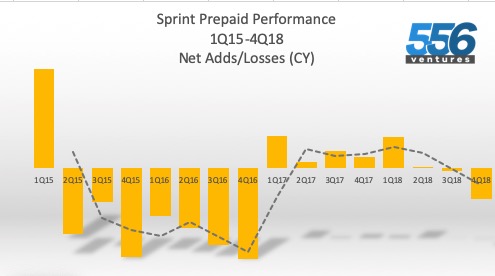
T-Mobile has outperformed its rivals for many quarters. Postpaid growth has been its consistent flagship that many focus on. To complement the postpaid rocket ship, MetroPCS’ expansion perhaps put the cherry on top. Today, postpaid is still growing but prepaid has been slipping since 2Q17, when AT&T prepaid pushed ahead. Throughout the quarters, questions were asked about why prepaid has slowed. Many times, the corporate answer is that the lines are blurring between prepaid and postpaid. However, T-Mobile had made it easier for those who were deemed less than prime customers to access postpaid plans, thereby adding them to the postpaid count.  Those prepaid to postpaid migrations have been highlighted consistently for many quarters. We all get it, postpaid customers bear higher revenue, they tend to churn less and more are more stable.  To be sure, the goodies of T-Mobile Tuesdays and free Netflix are also nice value draws.

Still, prepaid to postpaid migration takes away from the Metro by T-Mobile subscriber base and its posted revenues.  With this, there has to be tension between Dallas-based Metro (and its dealers) and corporate in Seattle.  The halcyon monster growth quarters from 2Q15 to 1Q17 are over while postpaid continues its march. In 1Q16, the prepaid group posted a record high 807,000 net adds but in 3Q18, it had dropped to a low of 35,000.  By the way, at the end of that quarter, Metro by T-Mobile rebranding was rolled out.   Perhaps reinforcing MetroPCS was T-Mobile would help.    4Q18 was ‘okay’ but 1Q19’s 69,000 contrasted starkly against 1M+ postpaid net adds. To add salt to the wounds, 120,000 net prepaid customers migrated to branded postpaid.


Is the prepaid group slipping?  From the growth view, yes. Yet the argument in a decreasing churn trend could be pointed as progress. In the last 4 quarters, the highest churn at 4.12% (3Q18) has dropped to 3.85%, lower sequentially (3.99%) and even YoY (3.94%).  That’s progress, right? BUT, AT&T’s Cricket Wireless is sub 3%, an astounding feat for prepaid. 

However, ARPU has slipped to $37.65 from $38.90 YoY and also sequentially.  Some can argue this is inconsequential yet from an overall prepaid revenue contribution, 1Q19’s $2.38B contrasts with 1Q18s $2.4B.  But postpaid continues to deliver with upward trends in net additions, revenue and low churn. 

Why it matters:  Perhaps the company is paying attention.  There is that thorny prepaid group integration task if and when the Sprint acquisition happens. To that end, longtime MetroPCS head Tom Keys is moving out of that role to work on the integration and transition task. After that, Mr. Keys will be retiring (likely with a non-compete).      Metro staff will have  new corporate EVP bosses in the form of Jon Frier (sales) and Matt Staneff (marketing) based in Seattle.  This is a rub for dealers as they’ve had deep and trusting relationships with the Dallas-based Keys.  How will their voices be heard when these EVPs have a bigger ball of wax to run, given the corporate focus on postpaid?   

Dealer performance and happiness in the end affects T-Mobile’s prepaid numbers.  T-Mobile corporate will have to navigate their distribution’s discontent and concern in making or losing money.  Presumably Mr. Keys will advocate for the brand that he has helped built and we shall see what develops.  Will Seattle drive new prepaid (non-loss leader) promotions to bring the prepaid group back?  We shall see. 

Afterthought: What if the Sprint deal fails? What will Tom Keys do and will the Dallas to Seattle reporting and control structure remain in place?


Tuesday, April 30, 2019

1Q19 AT&T Prepaid Returns to the Pole Position

Last quarter, AT&T ceded its prepaid net add position to T-Mobile. AT&T had led five out of the last eight quarters.  With the acquisition Leap Wireless and its Cricket brand, AT&T slowed the MetroPCS juggernaut that had been dominating the prepaid sector since T-Mobile bought them. Both companies had a similar playbook, de-commission the old CDMA network and expand brand and distribution beyond the old regional footprints.  For people playing wireless industry Trivial Pursuit, MetroPCS’ kickoff expansion was coined “Apollo 15.”  To put it in a competitive context, from 1Q15-4Q18, AT&T and T-Mobile accounted for over 10 million net additions while competitors were in negative territory.  

Company
Prepaid Net Additions / Losses
AT&T
5.24M
T-Mobile
5.14M
Sprint
-1.66M
Verizon
-1.48M
America Movil
-4.33M

Fast forward to 1Q19 results, we find that even with 96,000 net adds (85,000 were phone net adds), AT&T won out against T-Mobile’s 69,000.  This is a recovery of sorts against a shocking 4Q18 in which AT&T seemed to have lost its growth mojo


Looking at the drop in growth seems somehow disturbing after so many go-go quarters.  Is prepaid plateauing, especially since all other prepaid competitors have loss subscribers (Sprint hasn’t reported yet as of this writing)?  It may be but there are some silver linings: 1) Some solace for the prepaid group as their 85,000 phone adds beat their postpaid brethren.
2) In his prepared remarks, Chairman Stephenson reiterated the company’s strategy to focus on the high-value prepaid segment but divulged (for the first time in my recollection) that Cricket had its lowest ever quarterly churn rate of less than 3%, down more than 60 basis points year-over-year. Prepaid revenue growth was solid, up more than 6%. We now have more than 10 million Cricket subscribers, double what we had when we acquired the company in 2014 with more than 17 million total prepaid customers under the umbrella of AT&T.”

Why it matters:  Chairman Stephenson’s unveiling of prepaid metrics (prepaid churn and ARPU are not publicly available metrics) suggest tremendous stability in the Cricket base.  For long-time industry watchers, prepaid churn ranged in the mid 4% to 5%. Therefore, churn less than 3% is a tremendous achievement. Moreover, stating there are over 10 million Cricket subscribers since the 2014 acquisition, out of the over 17 million prepaid base gives context on Cricket’s explosive performance.

Growth and acquiring switchers is an expensive game. For 4Q18 earnings, AT&T cited a competitor’s loss-leading handset promotion which took a toll on its branded prepaid. With its debt paydown targets from the Time-Warner acquisition, the company is unlikely to respond to any loss-leading promotion. This has been articulated in both the prepaid and postpaid side. As a result, explosive growth may not be on the horizon in the near term, barring extreme competitive circumstances. 

Caveat: If postpaid distribution will expand under FirstNet, prepaid may ride its coat tails.

Monday, April 29, 2019

1Q19 Verizon Prepaid – Sustained Losses but It’s OK?

It’s almost like a broken record that the Verizon prepaid group continues to lose subscribers quarter after quarter. In fact,  the company has lost subscribers for the last six quarters. In tracking over 17 quarters, 14 have been losses.  


Here’s the breakdown for year ending:

2015 – 551,000
2016 – 133,000
2017 – 43,000
2018 – 757,000

These for years total over 1.48 million lost subscribers.  Add 1Q19’s 176,000 losses and the tally is over 1.6M. In late January, following the Verizon earnings call, I noted these continued losses and CFO Ellis then paid lip service to note that they’re going to evolve their offerings over time. For this quarter, CFO Ellis noted that the quarter’s losses were better than 1Q18’s -355,000, seemingly putting a "it's not that bad" spin on things.  The party line had always been allowing the shedding of low (profit) and price sensitive customers with the retention of high-value monthly plan subscribers who don’t mind paying premium for the Verizon brand/coverage.  That thought is also goes hand in hand with migrating the voice/text phone-only people off or help transition them to smartphone plans.

Why it still doesn’t matter: Verizon is first and foremost a postpaid company with marketing and retention dollars better served on the postpaid side. Prepaid is highly contested as two  players have dominated prepaid over last 3 years years, AT&T (Cricket) and T-Mobile (Metro by T-Mobile). The two have taken the lion’s share of the prepaid net additions and they will continue to do so as their distribution into non-urban areas expand.    At the end of 1Q19, Verizon’s retail base was close to crossing 118M.  The 4.48M prepaid count is just 3.8% overall. Then there’s the revenue.  If Verizon’s prepaid ARPU is in mid-high 30s and its postpaid ARPA in the $130s (no apples-to-apples, I know), one can see why prepaid just isn’t a huge priority.     

Monday, March 25, 2019

2019 Prepaid - What Do Trends From Previous Years Say?

1Q19 Earnings season is about a month away.  Postpaid gets much of the focus because it brings in revenues and because it's a big chunk of the bread and butter revenue of many carriers.  However, though prepaid is a minor asterisk on many carriers, it doesn't mean that competition isn't just as formidable.

Trends could be a good predictor of future performance.  For every earnings call, I try to display a couple of years worth of net additions or losses on Twitter and occasionally, I write a blog or two. Let's look at the previous years' aggregate results and see if anything is interesting.

2017


It's clear the biggest loser was America Movil (Tracfone) as a huge loss factor was the lifeline brand, Safelink.  Tracfone was once a huge prepaid force to be reckoned with and to be fair it still is.  At the end of 2017, it had over 23 million customers.

Verizon didn't have a bad 2017. As the company is over 90 some odd percent postpaid. It didn't seem like a huge impact, as the carrier stated its intent to move feature phone subs off its 3G network and onto higher ARPU bearing smartphone plans.

Sprint looked like it was recovering and turned the corner from abysmal years '15 and '16 due to Assurance Wireless losses, their lifeline brand.  The Sprint prepaid group's flagship Boost Mobile continued to contribute as Virgin Mobile seemingly didn't help the cause.

Lastly, the T-Mobile and AT&T fight was the most competitive.  The real story behind those two companies' momentum is the respective purchases of regional players MetroPCS and Leap Wireless (Cricket).  T-Mobile dominated all of '15 and '16 as it expanded its distribution doors beyond the MetroPCS footprint.   AT&T used the same playbook in revamping and expanding Cricket's distribution nationally. Within the weeds, 2Q17 was the inflection point in which AT&T led for the remainder of the year.   This is important as AT&T and T-Mobile are emerging as the dominant prepaid forces.

2018


America Movil continued to lose!  Persistent blame was cast on its lifeline brand.  Corporately, it appeared an underlying industry strategy was to embrace the higher ARPU bearing and flagship Straight Talk brand for sub growth and revenue.  Straight Talk now makes up ~9.1 million out of its overall 21.7 million base.  The higher ARPU strategy yielded positives as its overall corporate end of year ARPU hit $26 vs '17's $24 vs '16's $23.  In addition, the overall corporate churn trend continues to improve.

While Verizon '17 prepaid looked encouraging, '18 saw significant prepaid losses.  Its sub base is barely 4 million and while there are some who point to the semi-linked Visible brand to address its prepaid ambition, it's a tough and price sensitive market.    

Sprint was supposed to have turned the corner in '17 but you would have been wrong for '18. 1Q18 saw some good momentum but in the end, 4Q18 tanked.  Clearly Sprint is more focus on good postpaid numbers, as it even categorized some Boost Mobile users with a good payment record and moving them into the overall postpaid count.

Again, the AT&T and T-Mobile dynamic proved to show the most interesting outcomes, as the two continue to battle it out for growth. Throughout '18 prepaid adds slowed with T-Mobile claiming that the prepaid-postpaid lines have blurred significantly.  There are a combination of factors perhaps, like any competitor, the carrier would rather spend its resources into higher-ARPU bearing postpaid users AND AT&T's Cricket has put the competitive screws on Metro by T-Mobile.  The big BUT is in 4Q18 where unexpectedly, T-Mobile came roaring back, besting AT&T. With its positive momentum, AT&T should have dominated 4Q18 but its branded prepaid tanked the numbers.    Still, overall in '18 AT&T was the net prepaid winner.

2019?

With abundant losses behind it, America Movil may cross into positive territory in 2019 as its losses were ~100K in 4Q18.  The first quarter trend for each year typically carries over some of the 4Q momentum.  If that is true, then American Movil may potentially see '19 as a turnaround year, barring overwhelming competition.  The increasing ARPU trend should continue as it's likely the company will add more resources into getting more Straight Talk traction.

Though Verizon 4Q18 losses only amounted to 90K, nearly 600K of its overall '18 losses happened in 1H18. Seemingly, it could be on the upswing.  Yet, the jury is still be out as Verizon doesn't really seem to address its offerings competitiveness to grow or retain its prepaid base.

Sprint is a big unknown.  Through earnings calls, filings and market looks, Boost Mobile seems to be holding its own while Virgin Mobile is a non-contributor.  The trend is negative as Sprint, which once was a significant prepaid player is inconsequential as far as marketshare.  All the indicators are going in the wrong direction, their churn is up and their prepaid ARPU is declining.

The growth money still in on AT&T's side as its prepaid momentum is greater than T-Mobile's.  If one extracts the 4Q18 glitch, AT&T continues to be the growth leader, barring additional AT&T branded prepaid losses.  The bottom line is that both companies would continue to shape 2019 prepaid growth.

Finally, here's how the prepaid business units shape up versus the overall branded base to note who is shrinking and contracting.
       

Tuesday, February 26, 2019

Sprint's 5G Launch Potentially Gives It the 'Yellow Jersey"

At Mobile World Congress, Sprint announced its intention to launch 5G in May  with initial markets in Chicago, Atlanta, Dallas and Kansas City, along with Houston, LA, NYC. Phoenix and Washington, DC.


In support of the 5G foray, the company has lined up vendors to create and make available complementary halo devices LG (V50 ThingQ 5G), Samsung (Galaxy S10 5G) and HTC (5G Hub).   

The big picture: Sprint is finally realizing the advantage of its 2.5 GHz spectrum. While most of rivals were deploying LTE with FDD spectrum, Sprint's 100+ MHz TDD is a blessing as it can use that same wide bandwidth dynamically (split mode) to serve LTE and 5G. Therefore, it can add more downlink where market conditions require in contrast to a defined chunk of bandwidth as in competitors' FDD modes.

  • On the technology side, Sprint has been very vocal about investing in Massive MIMO radios and antennas, either when upgrading existing sites or building new ones. This technology is foundational as a 5G enabler and is ramping up in the first 5 months of 2019.  
  • Sprint's LTE Advance should be well over 220M POPs covered. But in late 2018, the company claims 225 gigabit LTE cities. This is important as it can provide a similar customer speed experience along side 5G. 

Why it matters:  To take a page out of the Tour de France where the leader wears the 'yellow jersey' as the winner in the stage, the 5G race seems to line up with Sprint.  While larger competitors AT&T and Verizon are deploying fatter mmW spectrum for fixed and quasi mobile service, it's unclear how they will get a national 5G footprint (It can bring in its discontinued 3G spectrum).  T-Mobile is banking on its FDD 600 MHz to provide the national coverage layer that could win the 5G geographic race down the line but it currently is still deploying and waiting for television station clearing. Moreover, it's unclear how much of its limited spectrum that it shares with LTE can provide a meaningful 5G experience. 
To be sure, Sprint's 2.5 5G coverage cannot provide a fully filled-inn national map. Physics makes it just too expensive to do so. However, using the 2.5 GHz in already built out markets and Massive MIMO upgrades along with the trend of vendor modularity (software and 5G 'cards'), Sprint can provide more 5G POP coverage than competitors in 2019.  
Tour de France observers will note that the race is multi-stage and with each stage there could be different leaders wearing the yellow jersey.  For now, in the first stage of the domestic 5G, it's looking like Sprint.

Extra content: John Saw, Sprint CTO at Mobile World Congress 2019 talking about its 5G network plans.

Thursday, February 7, 2019

4Q18 T-Mobile Prepaid Recovers A Bit

T-Mobile took back net additions leadership for the quarter amid a slowdown in 2017 and 2018 from monstrous growth in 2015 and 2016.  With 135K adds, the company beats continued prepaid nemesis AT&T which posted 26K but only 13K phone net additions


Why it Matters: 

T-Mobile needed to slow the AT&T prepaid momentum a bit as it has been moving towards prepaid leadership in terms of additions since 2Q17.  Were it not for AT&T branded prepaid losses, Cricket's 240K net adds would have continued AT&T's domination.  A quarterly win is a nice reversal of 2018 fortune.


It's no secret that postpaid has better revenue upside than prepaid and in the 3Q18 earnings call, President Mike Sievert explained that their focus had been converting competitors' prepaid users to T-Mobile postpaid.   Data point: Prepaid makes up 33% of its branded base and 30% of the revenue.

Despite how the company and others in the industry have been stating that the prepaid/postpaid plan lines have blurred, T-Mobile postpaid hovers at ~$46 while its prepaid ARPU is in the mid $38 range. So Mike's argument holds water. What is unique is that in 4Q, T-Mobile admitted that its gains were from lower churn but also plan and handset promotions.  The promotions are a sharp contrast to not responding to 3Q AT&T promotions.  Will T-Mobile by Metro continue its  promotional run or is the AT&T branded prepaid losses a quarterly anomaly? Though with the 4Q win, AT&T safely won the 2018 leadership. What will '19 look like?   

Thursday, January 31, 2019

4Q18 Sprint Prepaid Tanks

Just when you thought Sprint prepaid turned the loss corner in 2017, it started sputtering in 2Q18 and then totally tanked in 4Q19 with 174K net losses.  Sprint bet big on prepaid in the Dan Hesse days and embarked on a multi-brand strategy.  Then, Assurance, a lifeline brand created to counter America Movil's Safelink greatly added to the prepaid base. Then with the fallout of lifeline investigations, those numbers quickly went away. Meanwhile in 2017, under then CEO Claure, Sprint announced the re-launch of its limbo brand, Virgin Mobile.  The new Virgin Mobile was supposed to be an "industry game-changer" with an iPhone only bent. It hasn't moved the needle in prepaid competition.


Why it matters: Essentially, Sprint prepaid is a one brand pony - Boost.  In the CY4Q18 earnings call and material, Sprint noted that Boost continues to be a strong contender. In the previous quarter, Boost accounted for <200K net additions. For this quarter, rather than provide a definitive number, Sprint CEO Combes only stated that Boost delivered eight consecutive quarters before "migration."

Migration? What's that? In a nutshell, Sprint has identified high-value and stable Boost or Virgin Mobile subscribers and offer them a non-branded Sprint postpaid plan and device financing.  For this quarter they totaled 100K, which also classified them in the Sprint postpaid subscriber base.  

In CY3Q18, Combes managed expectations that this quarter would be negative.  One can only assume that Virgin Mobile is the brand that is in a freefall since Sprint no longer reports Lifeline (Assurance) subs due to regulatory constraints. However, Sprint expects a return to growth in CY1Q19/FY4Q18. Even if Sprint prepaid bounces back, it will be a while before it matches the momentum of AT&T Cricket or Metro by T-Mobile.

Wednesday, January 30, 2019

4Q18 AT&T Prepaid Momentum Stunted but Cricket is OK

After a monster run at huge net additions, the prepaid group somehow fell off a cliff. It's not a pretty sight, is it?  After its Leap Wireless acquisition, the company completed the acquisition in 1Q14, the company began to ramp up to expand the Cricket brand beyond the legacy region footprint.  T-Mobile's MetroPCS had a similar ramp in growth from 1Q15 to 1Q17.  By 2Q17, AT&T prepaid started taking the industry prepaid net add leader.  Therefore, AT&T 4Q18 prepaid numbers were a jaw dropper.


What happened:  Many industry watchers have become accustomed to Cricket as the net addition driving force.  However in the traditional cut-throat holiday selling quarter, promotions abounded.  Detailed in the earnings call Q&A, Chairman Randall Stephenson assured analysts that Cricket still had growth momentum with 240K net adds but the branded prepaid side suffered these losses. He pointed to two factors: 1) Branded prepaid subs were moving to competitors' postpaid and 2) AT&T did not want to counter a loss leading handset promotion (A $250 device was offered at $100).  As a result the prepaid phone net adds only amounted to 13K.  


Why it Matters:  While AT&T has been disciplined about not getting into promotions that hurt margin, it does impact the view that growth and competition is hurting them in the very visible net addition metric. It's likely that the AT&T branded prepaid loss could factor in the gains at T-Mobile, perhaps both pre and postpaid.  Unless the competition can sustain a loss leader strategy and Cricket growth stagnates, AT&T 1Q19 prepaid net additions should climb out of that cliff. Stephenson has noted glowingly in the past about Cricket's ARPU (~$35) being close to postpaid.  Prepaid has been a bright spot over the last two years of growth and revenue contribution, offsetting the declining and handcuffed postpaid side. With more of the same postpaid performance anticipated in '19, prepaid needs to get its mojo back.  


Tuesday, January 29, 2019

Axios Type Posts Going Forward

When I spent time at my old company, Current Analysis, the value to the customer base on quick analysis was brevity and competitive impact. We wrote (at the time) very short but meaningful opinions and analyses on events (announcements, plan changes) on the competitive landscape.

Fast forward to 2019 and a news website has taken brevity to the extreme with similar goals but less words.  I'll try this format from now on....

   FTW

Tuesday, June 26, 2018

WatchTV - Building the Base to Enable Future Revenue Growth

Is it still price competitive as in the old days? Yes and no.  The price leaders continue to be Sprint and T-Mobile while AT&T and Verizon continue to position themselves as the premium carriers.  Of course the big two's legacy network perception continues to play an integral role both in high-value customer retention and seemingly record low churn.  Despite T-Mobile's continuous poaching, the sky hasn't fully fallen at AT&T and Verizon.

Make no mistake, T-Mobile was "the" catalyst that stimulated postpaid price wars and brought unlimited back at the big two.  Network and price continues to drive service provider selection but with over 120% wireless penetration, the game for several years has been one of switching. Number 3 and 4 players, T-Mobile and Sprint have been marketing their networks to be equivalent to that of the bigger two. Combined with price advantage, T-Mobile has seen greater success in building up its subscriber base.  However, the days of widespread price slashing at T-Mobile has stabilized.  While Sprint continues its price value leadership to acquire new customers and offset churn, the three other providers are moving to maintain or increase profitability.

Now the shift is moving to embedded value, beyond pricing.  At T-Mobile, higher data thresholds on data prioritization, hotspot capability, texting and data abroad, T-Mobile Tuesdays and free Netflix are just examples for retention and acquisition.  To offset content, Sprint cut a deal with Hulu while AT&T rolled in HBO as a benefit of subscribing.  Verizon content play is Go90 but it's not a subscriber benefit as Go90 is an open to all.  However, AT&T's strategic vision is one that centers around content and the ability to deliver and monetize that.  AT&T's acquisition of DirecTV produced the over the top (OTT) DirecTV Now.  Now with quickly closing the Time-Warner acquisition, AT&T announced two new postpaid rate plans that bundle content value, anchored by WatchTV.

WatchTV is a 'skinny bundle' that features well known video channel brands.  Customers on the new Unlimited &More and Unlimited &More Premium receive the base channels.   Premium users will be able to add HBO, Cinemax, SHOWTIME or STARZ as well as music streaming services like Amazon Music Unlimited and Pandora Premium.  For non-AT&T customers, the price is $15.


When DirecTV Now launched, many knocked the limited content available but as the progressed, more channels were added; it's likely to follow a similar playbook to further WatchTV's value proposition. WatchTV is based on the same DirecTV Now platform which may borrow key features including a similar navigation guide, multi-platform access and cloud DVR.   This immediately conjures up the cannibalization issue of current DirecTV franchise of users. To offset this, a $15 credit is available to upsell or tamp down any video churn.

The Rate Plan Comparison

Surprisingly, a new portfolio swap comes in just over three months since the last price change. Inevitably the conversation moves to price.  This introduction is supposed to be on the week of June 24th yet as of this writing, the new plans have yet to be launched.  With some preliminary details on the new Unlimited &More and Unlimited &More Premium plans, they seek relative parity with the previous Unlimited Choice and Unlimited Plus Enhanced.  What has been shared so far is that Choice and &More is the same at 4 lines ($160) but $5 more with lines 1 to 4.


For Unlimited &More Premium, the pricing remains with Plus Enhanced with lines 1-4 ($190) but $5 more for lines 5+.  To me, it's clear that AT&T covets the 4 line account as the 'bread and butter' profile of its users.  Still, there has been no price cuts so T-Mobile and Sprint remain the price leaders while Verizon remains the most expensive, especially withe introduction of the third aboveunlimited tier.  With some price increases, AT&T's challenge is to convert older unlimited and Unlimited Choice & Plus Enhanced account holders to these new plans with the feature value.

Looking Ahead

In the near term, WatchTV is about enhancing competitive postpaid plan value. It comes at the end of the second quarter and ready for steady promotion going into holiday selling. In the long term, the goal is to increase the video viewer base.  To help this, AT&T promises that WatchTV is but the beginning of many new offers to come as the result of the Time Warner acquisition.  Given the rapid pace of WatchTV rollout, there should be many of those promise offers should come by the end of the year.

As AT&T has publicly stated, its long term strategy is to leverage its advertising and analytics business unit to drive future revenue.  A larger subscriber base certainly helps the cause but that advertising and analytics unit is making its own moves to create the necessary foundation to expand its ad tech expertise. The AppNexus acquisition valued at $1.6B is expected to close in the third quarter brings further global capability, something I believe wants to further expand its international portfolio.    CEO Randall Stephenson promised more smaller acquisitions to come after the Time-Warner close.  With the impressive pace of announcements and execution, it'll be interesting where the now media company will bolster its business units.  My money is on further content and ad tech.