Showing posts with label Q3 2012 earnings. Show all posts

Monday, March 25, 2019

2019 Prepaid - What Do Trends From Previous Years Say?

1Q19 Earnings season is about a month away.  Postpaid gets much of the focus because it brings in revenues and because it's a big chunk of the bread and butter revenue of many carriers.  However, though prepaid is a minor asterisk on many carriers, it doesn't mean that competition isn't just as formidable.

Trends could be a good predictor of future performance.  For every earnings call, I try to display a couple of years worth of net additions or losses on Twitter and occasionally, I write a blog or two. Let's look at the previous years' aggregate results and see if anything is interesting.

2017


It's clear the biggest loser was America Movil (Tracfone) as a huge loss factor was the lifeline brand, Safelink.  Tracfone was once a huge prepaid force to be reckoned with and to be fair it still is.  At the end of 2017, it had over 23 million customers.

Verizon didn't have a bad 2017. As the company is over 90 some odd percent postpaid. It didn't seem like a huge impact, as the carrier stated its intent to move feature phone subs off its 3G network and onto higher ARPU bearing smartphone plans.

Sprint looked like it was recovering and turned the corner from abysmal years '15 and '16 due to Assurance Wireless losses, their lifeline brand.  The Sprint prepaid group's flagship Boost Mobile continued to contribute as Virgin Mobile seemingly didn't help the cause.

Lastly, the T-Mobile and AT&T fight was the most competitive.  The real story behind those two companies' momentum is the respective purchases of regional players MetroPCS and Leap Wireless (Cricket).  T-Mobile dominated all of '15 and '16 as it expanded its distribution doors beyond the MetroPCS footprint.   AT&T used the same playbook in revamping and expanding Cricket's distribution nationally. Within the weeds, 2Q17 was the inflection point in which AT&T led for the remainder of the year.   This is important as AT&T and T-Mobile are emerging as the dominant prepaid forces.

2018


America Movil continued to lose!  Persistent blame was cast on its lifeline brand.  Corporately, it appeared an underlying industry strategy was to embrace the higher ARPU bearing and flagship Straight Talk brand for sub growth and revenue.  Straight Talk now makes up ~9.1 million out of its overall 21.7 million base.  The higher ARPU strategy yielded positives as its overall corporate end of year ARPU hit $26 vs '17's $24 vs '16's $23.  In addition, the overall corporate churn trend continues to improve.

While Verizon '17 prepaid looked encouraging, '18 saw significant prepaid losses.  Its sub base is barely 4 million and while there are some who point to the semi-linked Visible brand to address its prepaid ambition, it's a tough and price sensitive market.    

Sprint was supposed to have turned the corner in '17 but you would have been wrong for '18. 1Q18 saw some good momentum but in the end, 4Q18 tanked.  Clearly Sprint is more focus on good postpaid numbers, as it even categorized some Boost Mobile users with a good payment record and moving them into the overall postpaid count.

Again, the AT&T and T-Mobile dynamic proved to show the most interesting outcomes, as the two continue to battle it out for growth. Throughout '18 prepaid adds slowed with T-Mobile claiming that the prepaid-postpaid lines have blurred significantly.  There are a combination of factors perhaps, like any competitor, the carrier would rather spend its resources into higher-ARPU bearing postpaid users AND AT&T's Cricket has put the competitive screws on Metro by T-Mobile.  The big BUT is in 4Q18 where unexpectedly, T-Mobile came roaring back, besting AT&T. With its positive momentum, AT&T should have dominated 4Q18 but its branded prepaid tanked the numbers.    Still, overall in '18 AT&T was the net prepaid winner.

2019?

With abundant losses behind it, America Movil may cross into positive territory in 2019 as its losses were ~100K in 4Q18.  The first quarter trend for each year typically carries over some of the 4Q momentum.  If that is true, then American Movil may potentially see '19 as a turnaround year, barring overwhelming competition.  The increasing ARPU trend should continue as it's likely the company will add more resources into getting more Straight Talk traction.

Though Verizon 4Q18 losses only amounted to 90K, nearly 600K of its overall '18 losses happened in 1H18. Seemingly, it could be on the upswing.  Yet, the jury is still be out as Verizon doesn't really seem to address its offerings competitiveness to grow or retain its prepaid base.

Sprint is a big unknown.  Through earnings calls, filings and market looks, Boost Mobile seems to be holding its own while Virgin Mobile is a non-contributor.  The trend is negative as Sprint, which once was a significant prepaid player is inconsequential as far as marketshare.  All the indicators are going in the wrong direction, their churn is up and their prepaid ARPU is declining.

The growth money still in on AT&T's side as its prepaid momentum is greater than T-Mobile's.  If one extracts the 4Q18 glitch, AT&T continues to be the growth leader, barring additional AT&T branded prepaid losses.  The bottom line is that both companies would continue to shape 2019 prepaid growth.

Finally, here's how the prepaid business units shape up versus the overall branded base to note who is shrinking and contracting.
       

Monday, January 20, 2014

Bullet Point Analysis: Verizon Wireless' Share Everything Plan Minor Adjustment

WHAT IS IT?

Several tech news and blogger outlets have reported that Verizon Wireless will add a new 250 MB plan (at $20) level to its Share Everything plans as of January 21, 2014.

ANALYSIS

Big data users invariably dismiss this 250 MB level as miniscule, and it is. But there are two  areas why this makes sense. 


  • First - Migrate the featurephone base to Smartphones and Share Everything Plans.  The Share Everything plan is now the only postpaid plan vehicle to migrate customers off legacy voice-centric plans (e.g., America's Choice - remember that?).  The new data-centric plan is also inexplicably linked to smartphone penetration.  Since 1Q2013, an Share Everything plan slide has been every quarterly earnings presentation deck.   


In 2Q 2013


In 3Q 2013


Verizon Wireless wants steeper curves on smartphone penetration and postpaid Share Everything account migration.  Here are the illustrative results since 3Q 2012. 


Since 4Q 2013 earnings is around the corner, it's likely to assume that smartphone penetration should cross 70% given the company's track record.  We can also safely assume that once Verizon Wireless nears the 100% Share Everything plan goal, there will be another more important growth slide to take its place. 
 
  • Second - Provide a lower price point for featurephone users to convert to data. Previously, the lowest data price point was at $40 and provided 500 MB. Logically and in sales positioning, $20 and 250 MB is half.  While veteran smartphone users cringe at the low data level, Verizon Wireless is betting that once a non-data user starts to use data, they will get hooked and move up subsequent next tiers.  Increasing data usage is closely linked with helping increase Verizon Wireless' average revenue per account (ARPA) metric.
COMPETITIVE IMPACT?

Some may believe that this is Verizon Wireless' action against AT&T revamping its Mobile Share plans back in December 2013.  When laid out, we find that the new plan is in fact less competitive to AT&T. AT&T still has the advantage for Verizon Wireless switchers at the low data levels.    Given the above logic, the new $20/250 MB level will not get featurephone switchers. Those who are making the smartphone jump are likely to have explored T-Mobile or Sprint.


Still Verizon Wireless' opportunity may be in the existing range of data bucket choices with more price points and advantage in addressing the small business and high data use consumer accounts.   

Looking ahead, if history repeats itself, Verizon and AT&T users will start getting a handle of monthly data consumption and adjust accordingly. Once that happens, the number of data levels should shrink and (ideally for customers) price points will decrease.

Thursday, October 10, 2013

Bullet Point Analysis: T-Mobile's Un-carrier 3.0 - The International Card


WHAT IS IT?

T-Mobile announced its Un-carrier 3.0 initiative. The 3.0 portion follows the Un-carrier strategy that the company unveiled in March 2013 to address "customers' pain points" and ultimately set the company on track to retain and grow marketshare.

As a recap, this slide from the 2013 Q2 earnings release summarizes the company's Un-carrier moves thus far.


Un-carrier 3.0 in a nutshell:
 
 
WHAT'S IN IT FOR T-MOBILE?

  • Strategic Promise, Disruption and Differentiation: T-Mobile is delivering on a strategy that addresses customers' pain points. Previous iterations were doing away with contracts, early handset upgrades and lower service pricing by decoupling the overt handset subsidy. From a marketing viewpoint, this provides more advertising fodder to drive customer acquisition attack ads.
  • Growing the Business Subscriber Base: Let's face it, T-Mobile has always been a consumer centric brand. Prior to its network buildout thrust, its network could not compete against larger competitors AT&T, Verizon Wireless, and Sprint, who had the business sector sewn up, especially globe trotting enterprises. In the 2Q 2013 earnings call, CEO John Legere subtlely telegraphed B2B as an area of 'coming attractions.'  Legere even admitted that the "percentage of gross additions were too small to get concerned with..." With this as a backdrop, the international roaming angle of Un-carrier 3.0 is a boon to target globe trotting business customers to grow its B2B business.
  • Driving International Calling: While stateside international calling can be costly for T-Mobile, one should be reminded that its prepaid brand, MetroPCS announced unlimited stateside "international" calling for $5 back in 2009. So a cost-effective (some believe VoIP-based) infrastructure is already in place.
  • Impacting Profitability?: One would think before any of these moves gets off the ground, there are business cases supporting the effort. While unlimited data roaming may sound like a money loser, it's all relative for several reasons. First, the roaming impact may be thought as the cost to acquire a coveted business subscriber base that is less price sensitive than the consumer segment. The business base and the additional lines (and the overall customer spend) may offset the cost of data roaming.  Second, there are parallels to the introduction of unlimited calling where a steady state and predictable monthly consumption develops. It's unlikely to think business travelers are constantly streaming video abroad - more consumer behavior. For consumers, a slower abroad data experience may provide frustration and curtail that behavior. Finally, the $10/month stateside international calling tacks helps offset some of the overall costs. Besides, as the slide above states, T-Mobile is targeting to have the lowest cost structure in the industry.

WHICH COMPANIES WILL FEEL THE MOST IMPACT?

  • Clearly T-Mobile is going after its bigger competition, AT&T, Verizon Wireless and Sprint to grab business switchers.  This segment tend to have higher ARPU/ARPA than consumers. The proposition is formidable as anyone who has traveled and paid for roaming can attest. Magnify this to multinational enterprises in which roaming is a substantial expense and expense managers will quickly look at T-Mobile's Uncarrier 3.0 option.  T-Mobile business sales teams now have this and a growing domestic LTE national network to provide credibility in sales calls.  
  • It's likely that competitors will see some business subscriber leakage with a compelling offer as unlimited international data and text roaming.  Competitors are already playing up slower roaming data experiences but unless they can prove that a T-Mobile roaming customer receives a slower experience than their own roaming partners, they're in the same boat (held hostage as the destination's partner network). Yet the percentage of global travel will determine an organization's business case for switching. Further, it will depend on the generation of handset for higher speed support abroad.  LTE roaming is almost non-existent so the default will be HSPA+ (in some countries dual carrier HSPA+ is possible) or EDGE roaming.
  • A possible scenario may be that T-Mobile 'lines' will be purchased for international business. This approach will provide a known US number for easy contact rather than to purchase an in-country SIM card. So the customer may have both a domestic and international phone/line.  Either way, T-Mobile stands to gain subscriber lines and if they can prove domestic network parity in the long term, total switching will become a viable scenario.
  • On the stateside international calling front, VoIP providers such as Skype may feel some impact as the simple ability to direct dial can trump launch an OTT app on a computer or handset.    

COMPETITIVE RESPONSE?

It remains to be seen if competitors will match T-Mobile's unlimited data and text roaming offer. To some extent, they are handcuffed as their enterprise bases are large and international roaming revenue, decently profitable. Loyalty and network breadth (domestic and international) will be a piece of the counter argument. However, Un-carrier 3.0 is a formidable challenge that will need to be addressed. Key indicators will be customer inquiry for a competitive response, roaming revenue declines and customer voluntary churn.  What form it will take and how quickly a solution rolls out depends on customer defection.  Regardless, product planners will be in meetings to figure out their company's response alternatives. 

Thursday, November 8, 2012

T-Mobile USA Q3 2012 - Postpaid Trouble Continues, Reliance on Prepaid

T-Mobile released their Q3 2012 numbers along with commentary through the Deutsche Telekom parent.  Some of my thoughts ahead of this release were substantiated and some were not.  The US unit earnings slide touches on four areas, two financial and two operational performance metrics. From a broad view, the financial indicators are on a downward trend. Service revenue, earnings revenue and margin are all down.  Let's dissect the two important operational areas - net additions and ARPU. 


Net Additions: Though there were 160K net additions, the glass half empty side looks at the postpaid losses.  With nearly 500K of postpaid subscriber losses, it's alarming.  The company blames the iPhone 5 as a key element for the decline.  So where are these people going? AT&T had record iPhone 5 activations and Sprint's iPhone 5 with an unlimited data proposition are the likely culprits.  How does the company reverse its postpaid slide?  Q3 2012 represents the ninth quarter  of postpaid losses.  Its shift to promoting Value plans as part of the greater postpaid strategy may help its margins and lower device subsidy costs but really, is it working?  To deflect this, DT Chairman Rene Obermann cited that there are now 1.5 million iPhones running on the T-Mobile USA network. The last iPhone count was 1 million back in June 2011.  Pushing the glass half full view, the prepaid and wholesale business is contributing to the company's growth.  While wholesale should be positive across the industry, the MVNO business is a consistent performer that makes up almost 12% of the customer base.  The machine-to-machine side represents about 9% of the company.  These two areas should be all accounts continue to add to the customer count throughout the quarters. The prepaid additions are on a very good positive slope, beating previous quarter additions handily.  The introduction of the Monthly4G plans that offer alternatives to Boost, MetroPCS and Leap plans.  Going into Q4 and with the company increasing its customer acquisition spend, can T-Mobile sustain a 300K+ net addition run?


ARPU:  One take away on the postpaid ARPU is that it's going down.  While the chart shows data ARPU increasing, the subscriber base was traditionally more voice centric.  Minutes of use came in at 899 compared to 986 a year earlier.  This follows the industry trend. The quandary for the company is that it will continue to see a decline in overall ARPU as it pushes its value plans. That may be OK if the business case shows that margins are better in the long run. On prepaid ARPU, the $21 mark was flat sequentially. If the higher ARPU bearing Monthly4G plans take hold en masse this should go up slightly. 

Churn:   Overall and postpaid churn increased for obvious reasons. The postpaid churn went from 2.2% the previous quarter to 2.3%. Closest rival Sprint has turned its churn fortunes around but its highest postpaid churn rate was 2.01%. Verizon Wireless and AT&T are near 1% as a gauge. 

T-Mobile USA Q3 2012 Highlights - The Five Core Areas

The T-Mobile USA Q3 earnings release comes in two forms. One is folded in the parent, Deutsche Telekom's overall earnings.  The second is directly through the US unit.  Surprisingly, the expected Five Core Areas of Focus slide that had been a mainstay in the parent's earnings deck didn't make it.  


However, this was addressed in the US release.   There is no doubt that positive notes will be slotted in any PR/earnings release. Here's what the company had to say and my takeaways in relation to the Q3 earnings news:

Amazing 4G Services Highlights:

  • T-Mobile continues to advance its $4 billion 4G network modernization plan, which includes installing new advanced equipment that paves the way for the launch of Long Term Evolution (“LTE”) service in 2013.  <<This reinforces the obvious that T-Mobile is spending the necessary money to make it possible for AWS LTE. While the company is aggressive, a 2013 launch is still nebulous. Is it Q1, 1H, 2H? >>
  • Las Vegas and Kansas City were the first cities where T-Mobile customers benefited from the launch of HSPA+ on 1900 PCS spectrum, which delivers enhanced voice and data coverage, as well as faster speeds on unlocked devices such as the iPhone; just yesterday, Washington DC, Baltimore, and Houston also went live.  The Company expects to announce further network strengthening in many additional cities in the coming months.  <<Refarming the PCS spectrum to enable HSPA+ is the foundation for its BYOD (read iPhone switcher - as blatantly stated) strategy. It's tough to fully market speedy iPhone HSPA+ service when the national network isn't there.  When it gets there, the company will certainly make a big splash.>>  
  • In the third quarter of 2012, T-Mobile completed the transaction announced in June 2012 with Verizon Wireless for the purchase and exchange of AWS spectrum licenses in 218 markets across the U.S.  This transaction improved T-Mobile’s spectrum position in 15 of the top 25 markets nationwide. <<Getting more AWS spectrum allows the company to increase its capacity to continue its unlimited data proposition.  An unknown is whether the additional spectrum may be shifted to increase T-Mobile's long term LTE data throughput speed as a marketing differentiation.   With an LTE-Advanced capable network, that's certainly possible to achieve.>> 
  • T-Mobile continued to expand its compelling 4G smartphone portfolio, including adding more devices under the popular Samsung Galaxy lineup, such as the Samsung Galaxy Note 2, and announcing the upcoming availability of two Windows Phone 8 smartphones, including the exclusive Nokia Lumia 810. <<This is a necessary PR item - to continue to show that new and cool halo devices are coming into the portfolio.  In theory, these should be the halo devices being pushed in the Q4 holiday selling season.>>

Value Leader Highlights:
  • T-Mobile is a champion of “bring your own device (BYOD)” wireless, with affordable value plans that separate the cost of wireless service from the purchase of a new phone. << Value plans are important to court BYOD iPhone users as they get typically a $5 monthly break off 'Classic' subsidized handset plans.  Honestly, this BYOD plan has been around for many years. T-Mobile sees a plus in this since they don't have to subsidize handsets and get better margin from Value customers.  Of course financing new phones continues to be an option for Value plan users. To the customer, it's usually a wash but clearly there are bigger financial benefits for T-Mobile.>>  
  • In early September, T-Mobile launched a new Unlimited Nationwide 4G Data plan that is a key differentiator in the marketplace. <<These prepaid plans provide a compelling alternative to Boost, MetroPCS and Leap plans. With a better national brand, T-Mobile can exploit these plans to take back customers from those rivals.  With 365K branded prepaid net additions in Q3, these plans have to have had an impact in light of MetroPCS' and Leap's Q3 massive net subscriber losses.>>  
Trusted Brand Highlights:
  • As part of its brand re-launch program, the Company increased investment in advertising to highlight its fast and reliable nationwide 4G network and its blazing fast data speeds in the U.S. <<In the past analyst conferences, T-Mobile and Sprint have always talked about how much their marketing budgets are dwarfed by Verizon Wireless' and AT&T's spend.  Shifting spokeswoman Carly Foulkes from girl next door to woman in control will continue. Honestly, T-Mobile needs to assert its brand to stay relevant in the consumer mindset as Q4 holiday selling begins.  Over the years, we always look forward to what T-Mobile will do for Black Friday. Recall the 'free airline ticket' promotion?>>

 Multi-Segment Player Highlights:
  • In the Business-to-Business (B2B) segment, T-Mobile looks to serve as a trusted communications advisor, helping businesses develop cost-effective, high-value communications programs that meet their business objectives –through bring-your-own-device (BYOD), and mobile device management (MDM) programs as well as attractive international mobility and mobile broadband data plans.  The Company continues to aggressively expand its B2B sales force. << This is a very important area for T-Mobile. As it was consumer-focused for many years, it largely ignored the business space.  Now the company finds itself starting from scratch to build an effective B2B sales force. It's a tough sell as national rivals Sprint, AT&T and Verizon Wireless are very entrenched.  What is T-Mobile's differentiation in this area?  It's not that clear other than the same proposition on the consumer side - value.>>  
  • T-Mobile launched three new Mobile Virtual Network (MVNO) partnerships during the quarter: Spot Mobile, Solavei, and UltraMobile, adding to its existing partnerships with TracFone/SIMPLE Mobile and Roam Mobility. <<MVNOs represent almost  41% of the company's prepaid business and 12% of the customer base. These should have been technically counted as wholesale. >>  
 Challenger Business Model Highlights:
  • The Company continues with its efforts to drive operational efficiencies through the Reinvent program and is on track to achieve $900 million in annual gross cost savings, which the Company has started reinvesting in customer acquisition programs. << The first part of the rather long sentence is about the cost containment is emblematic of every other wireless carrier. But the details on reinvigorating customer acquisition may suggest further marketing spend, whether targeted or more broadly. >>  


Wednesday, November 7, 2012

T-Mobile -Thoughts Ahead of the Q3 2012 Earnings Release

T-Mobile USA is set to release its Q3 earnings and performance metrics on Thursday , November 8th as part of its overall parent's (Deutsche Telekom) Q3 2012 release.  DT's US unit is fresh off an merger/acquisition announcement of MetroPCS in October  and that had grabbed much of the news around the carrier but the Q3 earnings numbers should reveal whether T-Mobile would continue key trends or reverse them.  The company has provided five focus areas throughout previous quarters and many of its Q3 progress points will fit again in these areas.


Under Amazing 4G Services, we should expect to hear about network progress (LTE buildout) and new halo devices. Under the Value Leader, we should expect to hear about any new services or marketing initiatives. In furthering the Trusted Brand, T-Mobile has been talking about expanding their distribution. For the last two quarters, the company has been putting a lot of effort into opening new 'doors', the first fruits of this may show up in Q3.  With the Multi-Segment Player focus, this is mostly about expanding wholesale (machine to machine/MVNOs) and ramping up the B2B efforts.   Finally the Challenger thrust should roll up cost control and churn containment.  Maybe there will be light shed on acquiring iPhone switchers. However, some performance metrics continue the bellwether of corporate direction. 

Net Additions:  The trend doesn't look good for the company as its postpaid base continues on a negative trajectory since Q3 2010. On the other hand, T-Mobile's prepaid business is the bright spot in preventing a totally bleak story. The fact that the company has been able to post positive net prepaid additions in an ultra competitive prepaid segment is notable. Throughout the years, prepaid has been on the rise and makes up more of T-Mobile's customer base. In Q2 2010, the prepaid business accounted for about 20% of the base. By Q2 2012, that percentage increased to over 27%.  Q3 looks to increase that percentage.  Switching over to postpaid, the company still needs to reverse the slide.  The unlimited data and plan value story should resonate and pits the company against Sprint's own unlimited data proposition.  How well the company markets to iPhone switching will be a key element in increasing its postpaid pool.
  
Any increase should signal somewhat to the traction of its expanded distribution strategy.

Churn:  Looking at prepaid churn, the company is doing a good job in stabilizing that base.  Q3 should continue the downward direction. However, the churn number currently at 6% is very high relative to rivals.  In contrast, Sprint's multi-branded prepaid group posted 3.37% for Q3 while dedicated prepaid plays MetroPCS and Leap are in mid-3% and mid-4%, respectively.  On the postpaid side, the magic threshold for Q3 should be sub 2%. Rival Sprint crossed that mark two quarters ago. T-Mobile remains the only national carrier to be above the 2% postpaid churn mark.

ARPU: The carrier is also behind in these metrics relative to its national rivals. The downward postpaid ARPU trend is in stark contrast to AT&T, Sprint and Verizon Wireless which has been sloping positively nicely. While AT&T is the postpaid ARPU leader at over $65, Verizon Wireless is T-Mobile's closest ARPU neighbor at $56 in Q2 before they moved to the new ARPA stat. On the prepaid side Sprint remained over the $26 mark in Q3 while regional Leap and MetroPCS are in the 40s.  To move the mark in prepaid, T-Mobile needs to focus on the high-value users. Of course this will be moot in 2013/2014 once MetroPCS starts to get integrated.


Finally Network: There will undoubtedly be discussion on how well the LTE buildout is progressing. T-Mobile while it pushes its 4G speed (AWS=based HSPA+), it should be stating how the well the PCS refarming is going. This refarming is central to moving ahead with its AWS LTE plans.  The PCS HSPA+ network also serves as the honeypot for additional unlocked GSM iPhone users. Given the jump that other national carriers have in LTE, there should be a mention or reiteration of when T-Mobile expects to launch LTE markets. 


Wednesday, October 24, 2012

AT&T Mobility - Q3 2012 Highlights

Quarterly Earnings performance releases are always half-full for some and half-empty for others.  AT&T's Q3 could be characterized as such because there were some shining areas but there were also areas where expectations were higher.  Inject the Verizon/Verizon Wireless comparison and things get tough.  There were plenty of highs associated with revenue and even remarked some of the growth percentages in a down economy "are pretty darn good."  While others can highlight revenue and expectations around those areas, I'll focus in areas where I had my own thoughts and expectations.

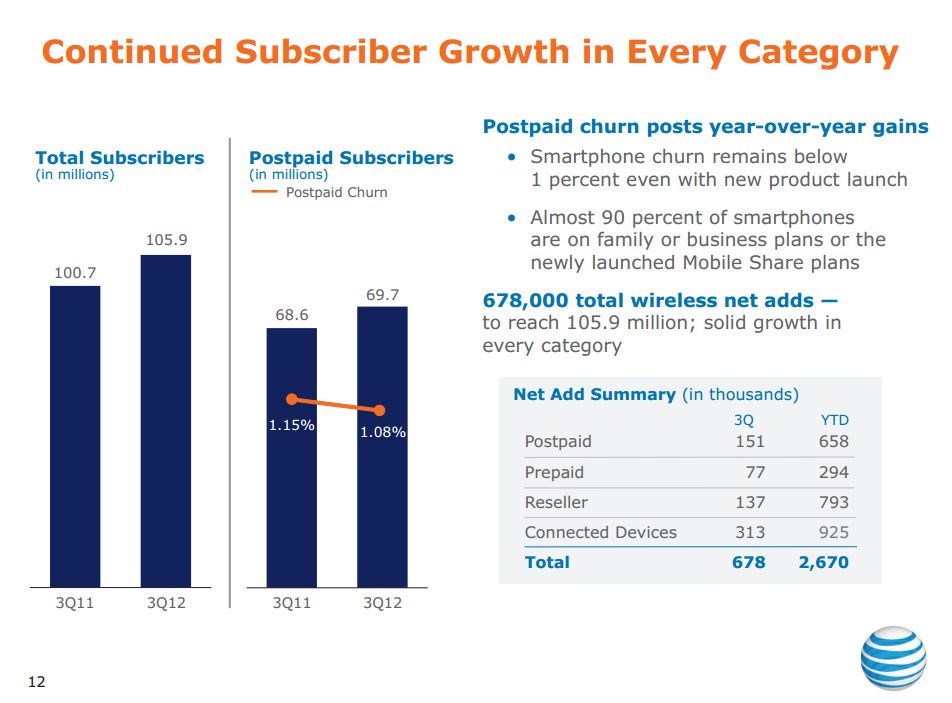
Overall Net additions of 678,000 were disappointing particularly in the postpaid segment with only 151,000. Mobility CEO Ralph de la Vega noted that iPhone 5 supply constraints limited the segment's performance and most of that inventory serviced the existing loyal iPhone base. However, it's hard to not compare to rival Verizon Wireless' Q3 1.535 million postpaid net add number. Nice stats thrown out:

  • Smartphones made up 81% of the postpaid sales. Followers should note that Q2 delivered 77% in comparison suggesting that the carrier is doing a good job in pushing the mobile data utility proposition. As a gauge with Verizon, smartphones made up 79% of its postpaid sales.  AT&T appears to be doing slightly better job in nailing down data users. 
  • 6.1 million smartphones activated, 4.7 million were iPhones leaving 1.4 million to be split among Android, Windows and BlackBerry platforms. Interestingly, AT&T did not provide the iPhone 5 breakdown that Verizon presented (650K). We can just assume that AT&T did well since they reported record iPhone 5 preorder/sales during launch weekend. 
  • About 64% of the postpaid base are smartphone users.  

Commenting in the Q&A for the future, Ralph mentioned two things that stuck: 


  1.  Q4 postpaid net adds should increase with help from tablets and the mobile share plan. To be fair, mobile share impact wasn't as AT&T expected. Verizon Wireless' data share plan was out of the gate sooner.  The thinking is that as new LTE tablets (iPad mini, Asus Vivo and Samsung Smart PC, Kindle Fire) become options (thinking promos here), subscribers would see the value in sharing data. 
  2. AT&T wasn't going to play the traditional net addition game. I assume this was in the context of driving revenue. Rather, revenue was going to be layered service such as Digital Life, a remote monitoring and automation platform that has consumer/business direct services and wholesale partnership opportunities.  The company showed a demo of what could be at a house during the spring CTIA 2012 in New Orleans.  


On the prepaid side, the trend continued downward for a year. The 77,000 net additions were the lowest since Q1 2011 which was 85,000. 

Again in comparison against Verizon Wireless which delivered 228,000 net additions this quarter, this should be a wake-up call to AT&T's prepaid group which represents over 7% of the 105 million base. Given the industry acknowledging that prepaid is a growth segment, AT&T should be playing stronger.

Churn trends were a bit upward. The important postpaid value of 1.08% didn't beat last quarter's sub 1%. Overall churn at 1.34% was higher than Q2's 1.18%; this may be attributed to prepaid and wholesale.   


ARPU (postpaid) continued an upward trend at $65.20 but didn't cross $66.  That may have been optimistic on my part.  Still AT&T continues to lead the industry in this category with a formidable cushion compared to Sprint and Verizon Wireless.  Though the mobile share plan didn't have much opportunity to take full traction in Q3, offering an Average Revenue per Account metric was premature.  Still, that should be the future path (2013?) if mobile share continues to gain subscriber traction.      

EBITDA margin did not match Q2's 45%, coming in at 40.8%. The company's annual guidance of 42.5% was reiterated in slides. Again with Verizon Wireless' 50% figure in comparison, the gap is formidable.  

The LTE Network is rolling out ahead of schedule.  There is no doubt that meeting the Verizon buildout challenge is key to negate any marketing advantage.  Though AT&T's LTE completion timetable is at the end of 2013, Verizon's revised mid-2013 completion provides some incentive to report further accelerations in coming quarters.

Investor Relations

Finally, one must give credit to AT&T Investor Relations for using social media in talking up quarterly earnings.  This is the second quarter that I recall that AT&T has done this.  Some may dismiss this as another element in public relations but that's the point - put an executive face and provide commentary to frame the quarter's messaging.


Hopefully, more IR websites will incorporate this approach and supplement the dry (but useful) presentation files, archived webcasts and 8K, 10Q/10K links.  

Tuesday, October 23, 2012

AT&T Mobility - Thoughts Ahead of the Earnings Release


AT&T is set to release its earnings and performance metrics, October 24th at 9:00 AM.   Its earnings has followed Verizon in the past and observers cannot help but compare the two.  Each carriers' wireless divisions are reaping the lions share of revenue growth while the landline business units continue to struggle.

Net Additions:  AT&T does a good job with net additions.  In previous quarters, these numbers had been boosted through the wholesale group.  Its postpaid organic growth is fine but has not had the tidal wave acquisition momentum as Verizon Wireless.  Q3 should be no different as the postpaid and prepaid net adds should fall in line with previous Q3s.  Q3 has usually trended up for the carrier. Wholesale should continue to bring in the lion's share of the net additions.


Previous Q3 postpaid net additions have been 745K in 2010 and 319K in 2011. With Q2 2012 coming in at 320K, the logic should be to trend up, also given the iPhone 5 factor. The iPhone has helped the carrier attain switchers in the past, what the percentage is for Q3 should be telling. At the height, the iPhone brought in mid-40% figures for activations that were new to AT&T. 


The prepaid trend is on a worrisome declining trend. Though additions are admirably positive, the trend is reverse to that of Verizon Wireless' prepaid.  Each carrier has a substantial postpaid base to protect to avoid rate plan cannibalization. Each is bleeding somewhat from the unlimited propositions from MetroPCS, Sprint prepaid brands (Virgin Mobile and Boost), Tracfone's Straight Talk and finally Leap's Cricket. A downward trend is obviously a bad thing but any upward trend suggests that AT&T has looked more aggressively at this segment and wants to play more aggressively.

Churn:  The trend is in a good direction, both overall and postpaid.  Though Verizon Wireless has been the industry leader for many years, AT&T is doing an admirable job in churn.  The magic mark of note in postpaid is when that value dipped below 1% last quarter. 
Continued downtrends are obviously desired.  As grabbing switchers has always been a big battleground issue, any reports of a upward voluntary churn indicator would raise eyebrows. However with the iPhone as a key anchor and its own reports of record iPhone 5 sales, expectations for postpaid churn should go down and buck previous Q2 trends of a rise/remain flat.

ARPU (Rather - Postpaid ARPU):    AT&T has been the leader in postpaid ARPU. In Q2, it neared $65. As a gauge, Sprint is closest with <$61 and Verizon Wireless changed the game in Q3 with shifting the conversation to Average Revenue Per Account (ARPA).  However, Verizon Wireless' Q2 postpaid ARPU came in a little over $56. 

For Q3, AT&T should break $66 and allow the carrier to continue to reign in postpaid ARPU. Also it may be that AT&T will continue to report ARPU as a metric since it wants to continue to tout that leadership role. Since Verizon Wireless is reporting ARPA, the carrier may bring also  offer their own ARPA calculation either this quarter or the next depending on how much pressure the investment community brings to bear.  A likely scenario may be that AT&T will report both ARPU and ARPA but eventually support ARPA-only down the line.  Since ARPU has been pretty standard in calculation and ARPA seemingly is straight forward, every carrier has to buy-in to make it work for the industry.

EBITDA Margin(The indicator for profitability): Since this figure is a company's indicator for success, it is an important competitive performance metric.  AT&T continues to chase its rival Verizon Wireless but the gap is decent as Verizon Wireless' whopping Q3 50% figure is rather impressive.  For Q2, AT&T came in at 45%, jumping almost 3% from the previous quarter. No doubt that EBITDA should increase but likely less than 50%. 

Friday, October 19, 2012

Carrier Q3 2012 Earnings Releases

The following are the US carrier Q3 2012 earnings release dates:


Carrier
Date
Time (ET)
Verizon
Thu, October 18
8:30 AM
AT&T
Wed, October 24
9:00 AM
Sprint
Thu, October 25
8:00 AM
Clearwire
Thu, October 25
4:40 PM
MetroPCS
Tues, October 30
9:00 AM
Leap
Wed, November 7
11:00 AM
T-Mobile
Thu, November 8
4:00 AM

Wednesday, October 17, 2012

Verizon Wireless Thoughts Ahead of the Earnings

Verizon Wireless is set to release its earnings and performance metrics tomorrow, October 18th at 8:30 AM. The wireless group has been a rock steady performer as evidenced by many quarters of impressive net additions and churn.    

What to hope for this year's Q3? 

Net Additions: Wholesale net additions have been helping out many carriers' numbers. This is a trend that should continue given emphasis on M2M.  The true test is how many new postpaid customers the carrier will bring on board. As Verizon Wireless is mainly a postpaid company and the postpaid market penetration increases, there are high expectations for the carrier to continue to crank out more customers.    


Verizon Wireless has never gone below 500,000 postpaid net adds since Q1 2010.  With Q2 2012 delivering 888,0000 postpaid, the expectations are high. Yet a shining light has emerged since Q2 2011 for the prepaid group, turning the ship from losing subs to greatly contribute to the overall numbers.


There are equally high expectations for Q3 from the prepaid side given the momentum over the previous quarters.

Churn: It's like a broken record. Verizon Wireless can do no wrong in terms of churn.  Their subscriber loyalty and network messaging has proven out quarter after quarter. Any spike would be alarming. Any drop only strengthens their operations.


ARPU (Rather - Postpaid ARPU):    Postpaid ARPU is likely to going up but the largest US carrier has a lot of catching up to AT&T and Sprint.


This could be the quarter that Average Revenue Per Account (ARPA) gets introduced.  Executives have been on the media and investor circuit arguing that ARPU would be dated and the true indicator should be by account, given its thrust into shared data plans.