Thursday, August 22, 2013

Tier One Carriers' Chief Marketing Officers

The U.S. wireless landscape continues to evolve with elevated competition. The stakes are higher now as postpaid subscriber growth of years past now declines. Postpaid switching (stealing subscribers) is the new battleground while, in parrallel, acquiring high-value prepaid customers has stepped up in urgency.  Add to this, increasing the wholesale customer base, which includes MVNOs and machine-to-machine (including the nascent automobile infotainment), is an added necessity.

While the Chief Executive Officers and Chief Financial Officers get the limelight of quarterly earnings calls and investor conferences, the Chief Marketing Officer (CMO) has the responsibility to further/preserve the corporation's brand equity, and create strategies to help grow the customer base.  With the ultra-competitive nature of the American wireless sector, let's see who is steering the Tier One carriers' marketing and directing campaigns against rivals. The following biographies are taken off the respective corporate websites:

AT&T Mobility - David Christopher 


David Christopher, chief marketing officer, AT&T Mobility, leads product strategy, marketing and execution across AT&T’s extensive portfolio of branded wireless communications services and devices.

His responsibilities include overall product direction and planning for branded wireless services, including voice, data and cloud products, devices and accessories and network marketing; national, channel and field marketing – including the marketing strategy and merchandizing for AT&T’s more than 2,400 company owned retail stores; youth and diversity marketing; market research; customer lifecycle management; promotions and pricing; and national advertising and strategic sponsorships.

Christopher also oversees the award-winning AT&T Developer Program and its more than 25,000 members, leading the team that determines and delivers the tools and training developers need to build new and innovative applications.

Previously, Christopher served as chief marketing officer for AT&T’s Mobility and Consumer Markets, which included leading all marketing and product functions that drove the company’s three-screen strategy across wireless, TV and broadband products. He also served as vice president of product management for AT&T’s wireless unit, Cingular Wireless.

Before joining AT&T, Christopher worked at Palm, serving most recently as vice president – Product Marketing and Management with responsibility for the team that defined, developed and managed all Palm-branded product lines worldwide from concept through end of life.

Prior to Palm, Christopher worked for Sara Lee Corporation in Barcelona, Spain and Gent, Belgium.A native of Winston-Salem, NC, Christopher earned a bachelor’s degree from the University of Virginia and a Masters of Business Administration from the Kellogg School at Northwestern University.

Christopher serves on the Ad Council’s board of directors and its executive committee and on the Facebook Client Council.

Sprint - Bill Malloy


Bill Malloy joined Sprint in September 2011 as chief marketing officer.
Malloy brings to Sprint more than 30 years of experience in senior operating roles with marketing, media and wireless companies ranging from start-up ventures to large corporate entities.
He has been involved in the wireless industry almost since its inception in the mid-1980s, holding key marketing and operational leadership positions with McCaw Cellular and AT&T Wireless.
Most recently he was a venture partner with Ignition Partners, a venture capital firm based in Seattle. He joined Ignition in 2002 and during the next seven years was a member of the firm’s wireless communications team. In addition to working on early-stage investments, he represented the firm from 2004 to 2009 as chairman and CEO of Sparkplug Communications, a company created from within Ignition that later merged with Airband Communications. Before Ignition, he served as CEO of two Internet companies, Peapod and Worldstream Communications.
 
During his tenure at McCaw Cellular and AT&T Wireless he served as executive vice president of U.S. operations for AT&T Wireless, leading the team that created and launched AT&T’s Digital One Rate, the first national wireless calling plan. Before that, he was president of the company’s central region and led the build-out and launch of AT&T PCS markets. He also served as regional vice president of McCaw Cellular’s operations in Oklahoma, Arkansas, Kansas and Missouri and led national marketing for the company during the launch of Cellular One, the first national wireless brand for independent carriers, and the North American Cellular Network (NACN), the first national wireless call delivery network.
Malloy began working with McCaw in 1985 when he was a partner with the company's advertising agency. Before joining McCaw Cellular, he had an 11-year career in senior operating and partner positions in advertising firms and media companies.

Malloy is a graduate of Washburn University and Northwestern University’s Kellogg Graduate School of Management where he graduated from the Kellogg Management Institute.

T-Mobile -  Michael Sievert


G. Michael (Mike) Sievert, age 44, serves as our Executive Vice President and Chief Marketing Officer. Mr. Sievert is responsible for strategic development and execution of all marketing, product development, and pricing programs and activities for the Company. Mr. Sievert has also served as Executive Vice President and Chief Marketing Officer of T-Mobile USA since November 2012. Prior to joining T-Mobile USA, Mr. Sievert was an entrepreneur and investor involved with several Seattle-area start-up companies, most recently serving as CEO of Discovery Bay Games, a maker of accessories and add-ons for tablet computers, from April 2012 to November 2012. From April 2009 to June 2011, he was Chief Commercial Officer at Clearwire Corporation, a broadband communications provider, responsible for all customer-facing operations. From February 2008 to January 2009, Mr. Sievert was co-founder and CEO of Switchbox Labs, Inc., a consumer technologies developer, leading up to its sale to Lenovo. He also served from January 2005 to February 2008 as Corporate Vice President of the worldwide Windows group at Microsoft Corporation, responsible for global product management and P&L performance for that unit. Prior to Microsoft, he served as Executive Vice President and Chief Marketing Officer at AT&T Wireless for three years. He also served as Chief Sales and Marketing officer at E*TRADE Financial and began his career with management positions at Procter & Gamble and IBM. He has served on the boards of Rogers Wireless in Canada, Switch & Data Corporation, and a number of technology start-ups. Mr. Sievert received a Bachelor’s degree in Economics from the Wharton School at the University of Pennsylvania.

Verizon Wireless - Ken Dixon


Ken Dixon is vice president and chief marketing officer for Verizon Wireless, the largest wireless company in the United States, with responsibility for all brand management and marketing initiatives for the company, including the management and development of mobile products and services, media buying, agency management and website integration. A premier technology company, Verizon Wireless operates the nation’s largest and most reliable 4G LTE network.

Previously, Dixon served as president, Midwest Area for Verizon Wireless, where he was responsible for the company’s operations in the Great Plains, Illinois/Wisconsin, Kansas/Missouri, Michigan/Indiana/Kentucky and Ohio/Pennsylvania/West Virginia regions.
Dixon has also served as region president for the company’s Georgia/Alabama, Upstate New York and New England Regions where he was responsible for overseeing general operations and sales leadership. He also served as vice president of Operations and Distribution in the Mid-Atlantic Area and managed business and indirect sales in the Upstate New York and New England Regions.
Dixon joined the wireless industry in 1992 and has since held several management positions in both sales and operations.  He earned a bachelor’s degree from Syracuse University in Syracuse, NY.
Observations
Tenures:
  • AT&T's Christopher has been at the helm since April 2007 when previous CMO Marc LeFar (now Vonage CEO) resigned. He has product, service and marketing stints in his past. From that perspective, he understands the mobility business as well as the fixed line consumer side. 
  • Sprint's Malloy became Sprint's formal CMO in April 2011. The position had been vacant ever since Dan Hesse took the helm in 2007. In the years running up to 2011, Hesse had not appointed anyone into the title. But Bill Morgan (now SVP - Marketing at Motorola Mobility) had the overall marketing responsibility until 2011. As an old AT&T Wireless, McCaw Cellular hand, he understands the services and products space. Moreover, his internet/start-up/VC and advertising background gives him well-rounded overall marketing credentials.
  • Mike Sievert, seemingly, is the newest CMO in this peer group also with product, services and software background.  The T-Mobile CMO job has relatively high turnover compared to other Tier Ones. He came on to the scene replacing acting-CMO Andrew Sherrard (still an SVP in Marketing and replaced Cole Brodman May 2012) in mid-November 2012, a month after CEO John Legere took the helm. 
  • Verizon Wireless' Ken Dixon replaced Marni Walden (now Chief Operating Officer who took the post in 2010). There aren't any news releases on when Dixon took the position. As late as February 2012, he was the President of the Midwest region so presumably, it was in 2012 or 2013. Ken Dixon's stints in multiple regional president roles give him both regional and national operational (sales and service) and marketing sensitivities, since regions have the autonomy to do complementary local marketing.  
Each companies' marketing organizations have their own strengths and challenges but that will be for another post.

Thursday, July 25, 2013

Bullet Point Analysis: MetroPCS's 15 New Market Expansion & New Handsets

MetroPCS had multiple announcements. The first announcement focuses on expanded its smartphone portfolio with the Nokia Lumia 521 ($99) and LG Optimus F3 ($149). While handset announcements are less than notable on a strategy, there are small tidbits that one can glean. They are:

  • The  smartphones are not CDMA. This is a step to migrate the subscriber base to the T-Mobile network (100% goal in 2015) .
  • The Lumia is an HSPA+ only device and comes from the T-Mobile prepaid device stable. Moreover, it give MetroPCS a Windows Phone choice.
  • The LG Optimus F3 is HSPA+/LTE. Other carriers have the F3 in CDMA configuration. The F3 has better processor specs than the postpaid Optimus L9 offering. So the prepaid version bests a postpaid offering, albeit a tad smaller (4" vs 4.5" screen).   

The second press release was more interesting.  MetroPCS announced 15 new markets, expanding their total market reach to 30 markets.  With this announcement, the company has opened up for business in those markets along with distribution.  However, Metro will wait until September 1 for their advertising push. 

Of the 15 markets, 8 are Leap markets. T-Mobile's CEO has talked up a head-to-head match up against Leap. Interestingly some are in Texas, a Leap stronghold. One symbolic market that stands out is San Diego - Leap's corporate headquarters.  Key to the success will obviously be distribution - big box stores such as Best Buy and third party retailers. The company is looking for 200 doors in August with more in the fall.
  • Baltimore, MD - Head-to head against Leap/Cricket
  • Birmingham, Ala. - New market without retail Leap presence; Next major city that links up with Atlanta market
  • Cleveland and Akron, Ohio - adds to Great Lakes coverage
  • Corpus Christi, TexasHead-to head against Leap/Cricket
  • Fresno, Calif. - Head-to head against Leap/Cricket
  • Houston, TexasHead-to head against Leap/Cricket
  • Memphis, Tenn. - Head-to head against Leap/Cricket
  • New Orleans, LA  - New market without retail Leap presence
  • Rio Grande Valley, Texas  - Head-to head against Leap/Cricket
  • San Antonio and Austin, TexasHead-to head against Leap/Cricket
  • San Diego, Calif. - In Leap's backyard (its headquarters)
  • Seattle and Tacoma, Wash. - In T-Mobile's HQ area, no brainer in opening up distribution in the parent's backyard; New market without retail Leap presence
  • Tallahassee, Fla. - Rounds out MetroPCS's Florida coverage. New market without retail Leap presence
  • Toledo and Sandusky, Ohioadds to Great Lakes coverage; New market without retail Leap presence
  • Washington, DCHead-to head against Leap/Cricket

Tuesday, July 16, 2013

AWS Spectrum Maps - Before and After: AT&T-Leap Buyout

In yesterday's post, we saw the results of a combined entity spectrum depth map that displayed the 700MHz, Cellular, PCS and AWS bands.  However, one of the points I brought up was AT&T staying in the AWS spectrum game for LTE capacity fill in (to 700) and to position itself from an AWS LTE roaming standpoint. In this post, we are fortunate to show the AWS holdings for Leap and AT&T. 

Leap AWS spectrum

AT&T AWS spectrum

Combined AT&T-Leap AWS spectrum


What have we concluded? Specifically, the AWS national footprint still far from filled as evidenced by the white on the map. Once AWS LTE roaming happens, AT&T has the option to fill those areas, if necessary.

Despite the AWS gaps, we can see that Leap will strength AT&T LTE in specific markets such as:
  • (West) Seattle, central California, San Diego, Salt Lake City, Denver
  • (Southwest) Las Vegas, Phoenix, Tuscon, Sante Fe, El Paso
  • (Midwest) Kansas City, Omaha, Chicago, Milwaukee, St. Louis, Cincinnati, Louisville, Nashville
  • (South-ish) San Antonio, Ok City, New Orleans, Little Rock, Memphis, Hashville   
  • (Mid-Atlantic) Baltimore, Philadelphia, Washington, DC, Richmond, Charlotte, Raleigh, Columbia
  • (East-ish) Buffalo, Pittsburgh
Again, the combined AT&T-Leap spectrum depth map (note this excludes WCS spectrum)


Thanks to Mosaik for their output.

Monday, July 15, 2013

The AT&T-Leap Spectrum Depth (A Map View)

Spectrum is indeed a prime factor in any wireless carrier acquisition. Spectrum maps play an important role in understanding deal motivation and what the resulting merged entities' national spectrum depth looks like.

The Leap spectrum view:
Though Leap's spectrum (mainly PCS and AWS (the 700 in Chicago is for sale)) goes beyond their operating regional markets, the company's business model focuses in on densely populated markets. 

The AT&T spectrum view:
The combined AT&T-Leap spectrum view:


With the Leap spectrum, AT&T is strengthened in some heavily contested markets including, the Mid-Atlantic, central California, Las Vegas (better AT&T service at CTIA?), Denver, KC (Sprint's backyard), St. Louis (Sprint's newest market acquisition from US Cellular), and Northwest (Seattle - T-Mobile's backyard). Of course, the big question is will spectrum need to be divested?  The Department of Justice uses the Herfindahl-Hirschman Index (HHI) to measure market concentration for purposes of antitrust enforcement.  

Note: Thanks to Mosaik for the use of their MapElements output. 

Sunday, July 14, 2013

Bullet Point Analysis: The AT&T-Leap Buyout


What is it?


AT&T is buying prepaid player Leap Wireless for $15 per share in cash. Under the terms of the agreement, AT&T will acquire all of Leap’s stock and wireless properties, including licenses, network assets, retail stores and approximately 5 million subscribers. AT&T expects the transaction to complete in 6-9 months (1H 2014).

What is in it for Leap?


  • For shareholders and management, they can exit the cut throat prepaid business with money. Leap and similar regional prepaid player, MetroPCS, had once enjoyed strong growth until a couple of years ago. National competitors and prepaid MVNOs ate into their marketshare and growth. T-Mobile's acquisition of MetroPCS that closed in May 2013 logically put a brighter spot light on Leap. 
  • For Leap operations, the Cricket brand expands its geographical reach beyond Leap's limited regional footprint and can go head-to-head against MetroPCS and can tap into AT&T's distribution resources.
  • For the Leap network, it has a clearer LTE path. Operating CDMA (96M POPs) and LTE (21M POPsin the same limited AWS spectrum bands doesn't work well.   

What is in it for AT&T?


Spectrum:  

  • Complementary PCS and AWS bands covering 137M POPs, some of AWS is not in service (41M POPs).
  • Proceeds from the Leap 700 A Block spectrum goes into the deal calculus.


Subscribers and Doors: 
  • Leap has 5 million prepaid subscribers but the company has been trying to right itself after steady customer losses that began in Q2 2012. AT&T increases its prepaid customer base to roughly 12 million, roughly 11% of the AT&T total subscriber base.
  • Leap's distribution channel numbers a little less than 9,000 doors.  
  • Commentary: Leap's business needs a turnaround that Leap's management has been trying to accomplish for more than a year. In that time, Leap lost about 900K customers. Leap's distribution also slimmed down from over 11K doors in a bid to focus customer acquisition.  AT&T's own branded prepaid is not growing. The launch of the Aio brand in May allows for the company to enter the prepaid market aggressively without diminishing the AT&T brand. Now that Leap joins the AT&T prepaid fight, the strategy is shaping up to match the segmentation strategy pioneered by Sprint (Boost, Virgin, Assurance) and Tracfone (Tracfone, StraightTalk, Net10, Simple Mobile, PagePlus, and Safelink). T-Mobile also joins in the prepaid segmentation fight with its own GoSmart and MetroPCS).  All this Tier-1 competition and the plethora of MVNOs out there vying for the prepaid share of wallet will make for thin margins.  
Strategic Positioning:

Keeping T-Mobile Away: There are many who say this is a spectrum deal. That is true that additional PCS and AWS spectrum enhances the AT&T network, I argue that a large element is to neutralize a growing T-Mobile threat. Fresh off the May close of MetroPCS, T-Mobile supplemented its AWS spectrum with a $308M deal with US Cellular at the end of June.  
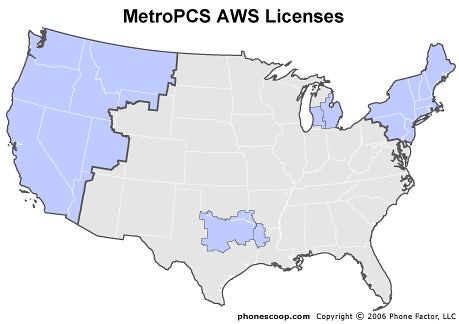
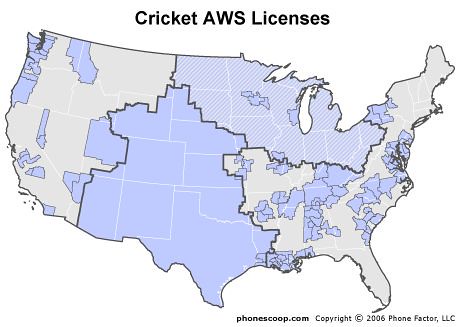
To understand it roughly, rewind back to the ongoing speculation that a then independent MetroPCS and Leap were a perfect fit since both had the same prepaid business models and did not compete against each other for the most part. The results of the 2006 AWS auction (see graphics below) helped fuel this speculation as the AWS  MetroPCS and Leap spectrum fit provided an uncannily perfectly complement. Time has passed and some AWS licenses changed hands. 


Graphics from Phonescoop.com
But with the AT&T-T-Mobile merger breakup, T-Mobile received some AWS licenses and in 2012, Leap and T-Mobile traded some licenses. While the T-Mobile-MetroPCS coverage map looks empty in some areas of the country, that is not to say that the company lacks spectrum in those areas. 
As seen in the spectrum holdings graphic, the company does indeed have spectrum nationally and can expand if so desired.  


With the June purchase of Mississippi Valley AWS spectrum from US Cellular (Barat) Wireless) and a future rumored purchase of Leap, the T-Mobile AWS portfolio would be formidable. Aside from T-Mobile, archrival Verizon Wireless' SpectrumCo AWS deal completed in August 2012 and building out this AWS to add LTE network capacity.  


This competitive landscape would put AT&T in an AWS coverage disadvantage relative to T-Mobile and Verizon Wireless. Therefore, AT&T needed to stay in the AWS LTE game and keep T-Mobile from growing a stronger AWS portfolio. For AT&T, AWS will not only to serve to add LTE capacity customers but also tap into future AWS LTE roaming revenue. T-Mobile, AT&T and Verizon Wireless are logical future roaming partners.  


Which companies will feel the most impact?

  • For T-Mobile, with Leap as a unit of AT&T, its MetroPCS geographic expansion will be challenged by AT&T's resources.  T-Mobile seemingly has a year or two lead as it is integrating MetroPCS and working on migrating the CDMA base to HSPA+/LTE but the stated goal of 2015.
  • Sprint will lose 3G data wholesale revenue from the agreement forged in August 2010 that expires in Dec 2015. But now Sprint (Clearwire's owner) loses another wholesale arrangement that Clearwire announced in March 2012 though nothing really started.  It's clear now that Sprint's prepaid segmentation strategy was the correct in the long run but Aio Wireless and Cricket are going up against Virgin, Boost, Assurance, respectively. Cricket's logical national (or specific target market) expansion may spell trouble. 
  • Verizon Wireless now sees a stronger AT&T rival with new found AWS and PCS spectrum from Leap. In the long term, it needs additional spectrum to thwart impending capacity brought on with WCS and Channel 55 (700 from Qualcomm) frequencies. In terms of prepaid, its branded prepaid is holding its own but without any flanker brands, competitors will take almost all the future prepaid growth.
  • In infrastructure, AT&T LTE equipment suppliers, Alcatel and Ericsson now have more of an order pipeline than before.

Last Word

  • The biggest question in this deal is whether the acquisition will pass regulatory hurdles. The sting of the failure to acquire T-Mobile is still fresh in everyone's minds. Like any major deal, it should have been gamed out by M&A internal and external resources taking into account the regulatory environment before it makes the light of day. 
  • If regulatory hurdles are overcome, what conditions will there be? AT&T has proactively said that the Chicago 700 MHz A Block will be sold. (It doesn't like the A block anyway). Will the company need to divest in other markets (planned or unplanned)? 

Wednesday, July 10, 2013

Analysis: T-Mobile’s "Boldest" Move - JUMP and Simple Choice forFamilies

What is it?

  • T-Mobile announced an equipment upgrade program known as  JUMP!™, which enables people to upgrade their phones when they want, up to twice a year as soon as six months from enrollment. The monthly outlay is $10/month with equipment warranty (theft, lost, broken, or when one wants another phone).
  • The Simple Choice for Family plan (4 lines of unlimited talk, text and web(500MB) for $100/month) was also announced allowing access to discounted  plans without a credit check. The caveat is that payment must be in advance (prepaid).


  • JUMP Details: 
    • Enroll in JUMP for $10/month. Have to wait for 6 months until the first 'JUMP' to get a new device. 
    • If in 'Good Working Order' (powers on, no screen cracks, no visible water damage), customer can get the next latest and greatest. If customer is financing it (Equipment Installment Plan (EIP)), remainder of payments are waived. Customer can enter a new EIP plan.
    • If not in 'Good Working Order,' a deductible will be paid ranging from $20-$170, depending on device,
    • Customer can upgrade twice a year. It could be as early as the next day. 

What it means for consumers:
  • For T-Mobile consumers who are early adopters and want the latest and greatest, Jump should be very compelling.
  • For T-Mobile customers who don't care for upgrading and are price-sensitive, they're not likely to enroll in JUMP as the enrollment tallies to $120 a year.  
  • For credit challenged family customers who want access to discounted postpaid rates, this should spur them on.
  • The JUMP plan should appeal for early adopters in other competitors. Since T-Mobile is targeting AT&T, it would be logical for T-Mobile to step up some anti-AT&T marketing as it has done so already.

 What it means for T-Mobile:
  • JUMP is an interesting anti-churn tool that appeals to a segment of customer who is willing to switch to get the latest and greatest. For this reason, it comports with T-Mobile's public comments stating that 2013 is going to be a year to stabilize.
  • JUMP may be an effective switching tool. If T-Mobile can convince potential switchers that the T-Mobile network is just as good as everyone else's that would help customer acquisition.  
  • The long term impact of JUMP 'trade-in' devices will help its MetroPCS unit.  These turned in devices will be refurbished and pushed into the MetroPCS portfolio as refurbished. For the MetroPCS customer who normally pays full priced for a phone, access to nearly the latest and greatest smartphone at a lower cost increases service stickiness. As T-Mobile wants to transition MetroPCS customers from their CDMA phones anyway, this move can potentially help accelerate the migration to the LTE/HSPA network and refarming of MetroPCS PCS spectrum. 
  • Depending upon the JUMP subscriber size, the $10 monthly fee may be a factor in lifting postpaid ARPU.
  • Simple Choice for Family should also help T-Mobile acquire subscribers. The price point is compelling. This plan could draw price sensitive postpaid family subscribers from competitors as well as transition families dealing with individual prepaid plans. How much this will hit Tracfone brands like StraightTalk and Simple Mobile remains to be seen. Of note, Simple Choice is LTE accessible whereas MVNO plans are still 3G/HSPA (okay 4G-ish). 

·          
Which companies will feel the most impact?


  • AT&T as the very public target should see the most marketing against its subscribers. Other competitors may experience some leakage from their early adopter community as well, especially those whose ending contracts. 
  • T-Mobile warranty companies should be busy depending upon how well JUMP is embraced.
  • Handset makers (likely with halo devices) will likely see more volume coming out of T-Mobile. With increased volume, T-Mobile may leverage this to attain more favorable pricing. 

Thursday, June 27, 2013

DISH Folds & Some DISH Options

Poker 

As the long multi-hand poker game with Sprint, DISH, Softbank and Clearwire dragged on with DISH upping the ante, forcing Sprint and Softbank to push, DISH folded on both deals in the end.

DISH's game to takeover Sprint ended on June 18, 2013 when they withdrew their offer. The press release language implied that they will devote their resources to win Clearwire. It didn't look bad when the Clearwire board recommended DISH's offer back on June 12. 
But with a higher Sprint offer on June 20, the coup de grace came several days later on June 24 when the Clearwire board reversed its DISH recommendation for Sprint's offer.  


DISH folded on its second poker hand with yesterday's June 26 announcement. Many including me, expected another run, upping the ante, given DISH's playing profile but what did it have to gain? Really - nothing.

DISH's Options

The near term scenario is that DISH needs to get service up and running. Any time you're delayed means lost future revenue opportunity. With its core business slipping, there is urgency to get into the mobile space. Given this line of thought, it needs to bury the hatchet with Sprint and move to spectrum hosting.

A long term scenario is that DISH can wait until an alternate hosting provider comes on line. T-Mobile has been bandied about as that partner.  But why not Verizon Wireless and AT&T? Everyone wants access to new spectrum and if the deal is right, anything is possible. 

Regardless of scenario, DISH and a partner(s) need to seed the mobile ecosystem on DISH's bands. Technically, it may not be a stretch. However, the lead times to quickly  create/productize the chipsets and integrate into production hardware (device and infrastructure) are still an issue. Once it joins the mobile service provider club, DISH can upsell its own customers on mobile broadband (either fixed or mobile) and wholesale its capacity.  

Looking ahead, DISH is looking for another game but it may not be poker. 


Friday, June 21, 2013

The Finish Line is Close for Sprint

No one expected the level of drama and the maneuverings among Sprint, Clearwire, Softbank and DISH. To be sure, the stakes were high for all parties. A poker game analogy is appropriate as this corporate soap opera has seen its share of raised bids and stare downs.


DISH with Charlie Ergen at its helm played the classical disruptor, raising the stakes on its bid on both Sprint and Clearwire. It's logical since the DISH core business is sliding and DISH has no access to any mobile opportunities (revenue).  Though DISH has its own spectrum, it doesn't have the ability to launch service on its own. With Sprint's Network Vision strategy, DISH can ride the Sprint host with lower capital expenditure than if it built a network from scratch. But Sprint has a revenue generating subscriber base and direct sales channels that DISH can tap into if it own Sprint.  However, with a deeper pocketed Softbank raising the ante, DISH needed to fold and focus on a less capital intensive deal - Clearwire.

However, Sprint "pulled a DISH" and raised its bid for Clearwire at the last minute $5/share vs $4.40.  This reversed a Clearwire board recommendation for DISH. Let's face it, money talks and with that, the activist investors were placated. After all, they were looking to maximize any bid anyway. What didn't hurt was Sprint's lawsuit against DISH and Clearwire citing the illegality of the DISH offer.   Sprint is near the finish line to realize 100% ownership of Clearwire, unless DISH "pulls another DISH." 

The real question if the Sprint-Clearwire deal makes it is what are DISH's options to get into the mobile space and monetize its spectrum? Will Sprint and DISH bury the hatchet? In my view, they have to. DISH still needs to make use of its spectrum and Sprint is the logical partner (at this moment) since Network Vision was created for spectrum hosting. Though Sprint said in the past, wholesale revenue wasn't totally baked into the Network Vision model, any wholesale money (a fleeting LightSquared) will help its return on investment. Of course DISH can court T-Mobile, but they're focusing on its own LTE buildout. Moreover, they haven't planned for spectrum hosting. We shall see............. 


Thursday, April 4, 2013

T-Mobile Takes PR Advantage of Early Q1 2013 Metrics

T-Mobile is probably the earliest to report Q1 2013 numbers, over a month ahead of the May 8, 2013 Deutsche Telekom formal release date. Only after 4 days since the first quarter closed, they reported some specific subscriber and churn data through their press release.

Here's a full look (2012 and Q1 2013) at the metrics on a table (click on the graphic for a bigger view). 


Why So Early?

T-Mobile needs to show that its strategy is succeeding. A key part of the 2013 goal/strategy is to stabilize the postpaid subscriber base.  By all accounts, Q1 2013 is going well in the ~ 60% range decrease in postpaid losses sequentially and year-over-year.  Though the company is still bleeding postpaid subs, the trend is positive. Q2 will be a crucial quarter as the iPhone goes on sale and the marketing to push AT&T switchers increase.  The trajectory looks good and the question for T-Mobile is which quarter the company crosses a positive net addition.

Wholesale to the Rescue

The pickup in MVNO and machine-to-machine subscribers have been saving the company's bacon for several quarters. Both categories account for 576K net adds.  The irony is that the MVNO partners such as Tracfone's StraightTalk and SimpleMobile are vying for the same price sensitive prepaid base is in the running for.  However this is likely to be a similar prepaid segmentation strategy that Sprint is employing.  When MetroPCS is complete, there will likely be additional rejiggering of the strategy.

Missing Data

We'll all have to wait for the financial numbers to be released in May. Aside from overall revenue and EBITDA margins, ARPU will be somethings that I'm looking for include the direction of CPGA and ARPU for postpaid and prepaid.   

Wednesday, March 13, 2013

Revisiting T-Mobile USA's 2013 Value Plan Only Move

FierceWireless quoted T-Mobilenews.com's posting on the introduction of handset trade-in options.  While this may be news to some, the game plan had been somewhat laid out back at DT Capital Markets Days in December 2012.  At that conference, CEO John Legere talked about moving to an all Value Plan (vs the "Classic" phone subsidized plans) portfolio in 2013. A crucial element of that plan and subscriber adoption was the device trade-in value proposition.  

Let's recap the postpaid Value Plan.  Essentially, the plan is a less expensive monthly outlay than the traditional Classic plan. In order to get the lower monthly price, the customer either brings their own device (read iPhone) or buys a device from T-Mobile. While these devices could be $300+, T-Mobile has long offered an Equipment Installment Plan or EIP (financing for the credit eligible).  T-Mobile's argues that Value Plans offer upgrading and flexibility.  That is if you upgrade, you don't have to change (extend) your contract.  The company hopes a new trade-in program will provide customers an easy way to take the device's value towards a new device or the service.  

However, trade-in programs aren't new. They've been in the industry for a while and all tier-one carriers have existing programs. 
Even T-Mobile has a current program.   Big box retailers such as Best Buy, Walmart, and RadioShack also have trade-in programs.  So it appears that some companies advertise it more as a means to generate sales and traffic than others.  If a T-Mobile trade-in program already exists, we'll have to see how a new one differs.  Perhaps it may be just greater advertising and customer awareness?


Regardless, the focus of this post is T-Mobile's view on its 2013 strategy to Value plans. At the January Consumer Electronics Show, CEO Legere reinforced its Value plan strategy, separating "the device and rate plan."

  
With Value plans already in existence in the T-Mobile portfolio since September 2011, what's the logic behind getting of the old Classic or subsidized plans.  It comes down to profitability and market positioning.  On the surface, the lower price points (vs competitors) and unlimited proposition should be the main points T-Mobile should be driving home. They differentiate with their yet to be fully launched "Uncarrier" campaign.  The profitability logic was revealed as Legere pushed his case to investors/the financial community back in December.  Here are some highlights cited and other value propositions:


While the standard ARPU and service plan margin seems counter intuitive, the  bottom line calculus in revenue and overall margin has obviously passed the internal business case.  Moreover, churn reduction and postpaid subscriber stability were stated 2013 goals.  Conceptually, the Value plan strategy should deliver this. Yet the company is experimenting and trying to change embedded wireless (postpaid) customer behavior.  I think I am stating the obvious by saying that buying a device at full price is counterculture in the US market where inexpensive devices rule.  A less painful upfront cost has proven appeal.  T-Mobile has an formidable challenge ahead to move its base to the new plans and to attain switchers.  


Monday, March 11, 2013

4Q2012 Prepaid Carrier Trends – Be Warned – It’s A Long One

Now that the Q4 2012 earnings are done, let’s look at the segment that had been driving a lot of the wireless growth in the past few years – prepaid. Rewind back to 2007/2008, Leap and MetroPCS were strongly acquiring subscribers with their unlimited propositions. The subsequent years saw similar flat rate introductions from the likes of Boost, Virgin Mobile, Tracfone’s StraightTalk and NET10. With the pressure from the monthly prepaid plans, Tier 1 carriers Verizon Wireless, AT&T and T-Mobile also joined the mix. The commonality in competition is for the high-value user. The traditional pay-as-you-go (PAYG) user’s contribution is far less. These users range from ‘glove box’ (low use) to moderate users. They also tend to be highly price sensitive and have a higher churn profile. The opposite is true to monthly plan users. These users while also price sensitive are heavier users and are fine with a flat rate model for predictability. They often have a lower churn profile relative to the PAYG user. That’s not to say they’re in the postpaid sub 2% churn territory. But for the prepaid segment, these monthly users are lower churn. 

Smartphones have been appearing in the prepaid segment for the last two years. While the companies want to offer the same capabilities as the postpaid segment, the prepaid model calls for low to no subsidies on devices. Of course companies strive to find low cost providers (e.g., Huawei and ZTE) to fill that niche and to leverage price against existing suppliers (e.g., Samsung, LG, Kyocera, HTC, etc.). The goal of course is to drop the smartphone price so that buyer can perceive that they’re affordable. However, prepaid providers walk a fine line for inexpensive devices because if a device is perceived as almost a throwaway, the likelihood of churn increases. For those reasons, expensive halo devices like a Samsung Galaxy S3 or the Apple iPhone keep the carrier sticky. 
With this as a backdrop, let’s look at how the players fared? Purely on net addition numbers, we can see that the regional unlimited players that ruled the day back in 2007/2008 are in trouble with Leap Wireless in the poorest shape with over 300K in subscriber losses. In Leap’s earnings call they noted that they are de-emphasizing their pay-as-you-go and mobile broadband business. There is logic in this as mobile broadband users eat more bandwidth (leaving less for monthly users) and PAYG are less revenue generating. MetroPCS though with less subscriber loss follows the same loss trend that has plagued Leap for many quarters. The company claims that they’re de-emphasizing CDMA growth but this tactic has resulted in an overall 5% loss in the base. This meshes with the long term strategy anyway once T-Mobile integrates and eventual use the 1900 CDMA to convert to 1900 HSPA+. By contrast, Tracfone’s net additions are by far the most impressive. The company buys wholesale from many carriers and has a large mix of PAYG and a growing base of monthly users. Presumably StraightTalk is doing well for the company as evident in ARPU. Several years ago, Tracfone ARPU was 10. In Q4 2011, it was 16 and in Q4 2012, it is now 18. APRU just doesn’t jump like this by growing a purely PAYG product. 


While Verizon Wireless had a tremendous Q4 in the postpaid side with over 2.1M net adds, the positive prepaid numbers indicate their competitiveness. Despite a down from a year ago and the previous quarter, it speaks to their premium brand messaging and perhaps a new November double data plan promotion. This is pretty decent for a predominately postpaid company. AT&T on the other hand is on a steeper downward slide. In Q3 2012, the company added 77,000 users with those gains erased with the 166K lost in Q4. AT&T is still a postpaid company with prepaid making up around 7% of the total subs. It will be interesting to see which way the direction turns for AT&T in Q1 2013. Another predominately postpaid carrier doing well in prepaid is US Cellular. Though the regional carrier continues to shed postpaid subscribers, the new U Prepaid plans that it has partnered with Alltel may be helping the cause. 

Moving onto the rest of the carriers, Sprint’s prepaid numbers have been down relative to previous quarters because the Assurance brand that had been driving huge subscriber count has been slowed due to FCC’s revamping of the subsidized Lifeline program in 2012. The company has already warned of a 1.2-1.3M subscriber loss possibly in Q2 2013 due to the revamping of rules. Regardless, the company indicated that the Boost and Virgin Mobile brands have contributed to the positive numbers. At the same time, the company is actively trying to migrate older Boost iDEN users off ahead of the iDEN network decommissioning. Finally, T-Mobile’s prepaid business is offsetting continued losses (550K) on the postpaid side. Again the above numbers are branded prepaid. T-Mobile counts MVNO (wholesale) net additions as prepaid as well. Branded prepaid at end of year 2012 represented 17% of the overall T-Mobile base. Looking ahead with the combination of MetroPCS’ prepaid subs, branded prepaid will transform to 45% of T-Mobile’s subscriber count. Given the higher churn profile of prepaid and lower revenue, it’ll looks challenging for future higher revenue contribution. But that’s months away…. Q1 2012 typically continues Q4 sales momentum. We’ll visit that to see what develops.

Thursday, February 7, 2013

Tier 1 Q4 2012 Smartphone Growth and the iPhone

Now that three Tier 1 carriers have reported their Q4 results, here are some observations and commentary on smartphone growth.  As most industry people know, smartphones are the hot user commodity. Smartphones serve many purposes from a churn reduction tool, to ARPU uplift (offsetting voice revenue decline) to increasing operational efficiency (move data consumption to a more data efficient (capacity and throughput to the LTE network). But the old 3G network also has legs so for now, wholesale (MVNOs & M2M) and prepaid can extend return on old investment there.

iPhones have been a catalyst for increased carrier data revenue. AT&T's past  iPhone exclusivity has allowed it to accumulate a massive customer base that proven to be low-churn and loyal. With the exclusivity gone, other carriers (through Apple's deal-making and carriers' realization that an iPhone is competitive table stakes) also jumped on the iPhone bandwagon.  The notion that iPhone is such a powerful sales acquisition and retention tool has played out again in Q4 2012.

For the big three, AT&T, Sprint, and Verizon Wireless, smartphones sales/activations continue to be on a positive track.  AT&T reported 10.2 million smartphone sales in Q4, while Verizon Wireless came close at 9.8 million, and Sprint posting 6.1 million. These added up to 26.1 million smartphones.  The interesting observation is how many of these smartphones were iPhones.

  • AT&T - 8.6 million
  • Verizon Wireless - 6.2 million
  • Sprint 2.2 million

As a percentage of the overall Q4 smartphone sales, iPhones activations accounted for:

  • AT&T - 84%
  • Verizon Wireless - 63%
  • Sprint - 36%
On the whole among the three Tier 1 carriers, the iPhone accounted for 65% of smartphone activations. 


Impressive stats for sure. With contenders from BlackBerry (BB10 OS), Microsoft (Windows Phone 8) and Android, can the iPhone in the U.S. continue its run?  I submit that this hinges on Apple innovation.  As I've said previously, Apple needs to innovate, as its user interface (UI) is aging with incremental innovation.  Customers have a lofty expectation of radical things for each iPhone (and iPad) model.   Apple needs to deliver in 2013 or the early adopters (and then the mainstream) will move on.