Thursday, August 18, 2016

AT&T - Verizon Rate Plan Competition, Playing for Parity

In July, Verizon changed their wireless rate plan portfolio. The media and tech bloggers derided those changes because the new price points were higher than those replaced.  Verizon argued (logically) that in the end, new plan subscribers got more MB/$ spent.  Yes, the math holds true.  I argued back then that while many focused on the lower (consumer) price points, the real threat was to AT&T in the mid and high tiers where high-value customers, SMBs and enterprises shopped.

Fast forward to mid-August as AT&T has announced their own rate changes.  No longer is the portfolio named Mobile Share Value but now Mobile Share Advantage (MSA). The "Advantage" piece speaks to ridding of the overage penalty and providing consumer friendly (albeit punishingly slow) 2G data rates.  Also, expanding the North American for 10 GB subs with unlimited talk/text to Mexico and Canada with local plan capability in Mexico.

The MSA plans to be in effect on August 21st have several important goals:

  1. Correct and increase mid-tier competition against Verizon
  2. Correct price vulnerability and meet high-tier price parity against Verizon.
  3. Increase service ARPU 

Mid-Tier Competition

In the history of rate plan competition, price planners/product managers have at times matched price points, voice minutes or data thresholds.  Every company has their own reasons and their own strategies. With the Mobile Share Advantage, AT&T chose to match price and data at the 16GB level but gave 1 GB more for 25 GB at the $110 price point.  This suggests to me that this may be a high-value customer battleground area.


High-Tier Price Parity

In July, I noted that the Verizon's rate changes threatened AT&T's high-value users  (SMB and enterprise) customers. Historically, AT&T and Verizon usually match each other at these higher tiers with the logic that no one really needs a huge price wars with these (usually) less price insensitive accounts.  Looking at the chart, it's notable how much the pricing has dropped for both these premium carriers.


As a side observation, it doesn't help that Sprint and T-Mobile are actively going after these higher value postpaid accounts.  

Though AT&T's changes for the most part draw level to its largest competitor, Verizon has a 2GB/line promotion applicable to  XL levels and above.  


It is unclear when this 2GB promotion will end, AT&T is still under the competitive gun, especially as the 3Q16 ends and ultra-competitive 4Q16 begins - read iPhone 7 launch.  Whether AT&T will inject a similar promotion remains to be seen but the threat is formidable unless the carrier can change the playing field with an aggressive handset promotion or trade-in values.  

Boost Service ARPU

Lost in the changes in price points is the increase in the per line access fee. What was $15/line/month at plans greater than 15 GB and $25 for plans less than 15GB/line/month, the new access rate is $20.  This is in line with Verizon's.  While I saw the lower $15 as a price differentiation, the new hike falls in line with AT&T (and Verizon's) march to higher profitability per user/per account.  One can also argue that with the mid and high-tier offerings, AT&T is giving away more GB so there needs to be a monetary balance to make up for it.

Asterisk*: For business plans, AT&T has kept the $15/month access line to give it that price differentiation.

Moreover, with service revenue trending downwards thanks to EIP, anything to reverse the decreasing ARPU trends and at the same time increase the average revenue per account (ARPA) will be welcomed by the CFO's office.  As AT&T iPhone 5, 5s and 6 users upgrade to the new iPhone, service reps will invariably push the new MSA plans as a new value with lower pricing, by default fighting any switching thoughts. 

Pricing Strategies

Many may be puzzled why any Verizon and AT&T rate changes are against each other and not Sprint and T-Mobile. It's simple, Verizon and AT&T position themselves as premium carriers and focused on purely profitability.  From a corporate revenue standpoint, there is no need to race to the bottom and upset stable revenue trends.  However, it is exactly this stance that Sprint and T-Mobile with less postpaid base are willing to take lower profitability margins (relative to the big two) to easily take marketshare. T-Mobile's positive porting numbers against Verizon and AT&T quarter over quarter speaks to the big two's profitability handcuffs.  Of course with the introduction of T-Mobile One and Sprint Unlimited Freedom may continue to claw for AT&T and Verizon high data consumers. 

Wednesday, August 17, 2016

2Q16 US Mobile Carrier Wrap & Scotch

An end of the second quarter 2016 wrap up of the top 4 US carrier community. We discussed T-Mobile quickly with smatterings of Verizon's new head of wireless hire, Ronan Dunne and their path to retort T-Mobile and Sprint.  As with previous Carrier Wraps, we discuss prepaid and postpaid trends.


We end by discussing our picks of the session - Glenlivet Nadurra and Macallan 10 yr Fine Oak.

Friday, July 22, 2016

Short Microsoft FY 4Q16 Earnings and Hololens

I got a chance to talk about Microsoft following their FY 4Q16 earnings call on the CCTV America Global Business program.  I picked up on some highlights, one really positive and one negative. The short term positive story is that their cloud business is doing very well, specifically Azure. 

Azure has the most momentum of their reporting segments with the following points: 

  •  Eight straight quarters of triple digit revenue growth
  • A modified run rate of $12B in FY 2017. It was $10B in FY 2016, catching up to Amazon AWS (the industry leader). 
  • Projected $20B run rate by FY 2018. (No pressure on the Microsoft Azure sales force, right?) 

The other highlight, albeit negative (and may be inconsequential to the overall revenue picture) was that their handset business revenue dropped>70%. This wasn't a surprise as they've been on the march to unload their handset hardware business and 'rationalize' the associated workforce.  It's interesting as Microsoft's stated strategy is "Mobile First, Cloud First" in that order.  Traditionalists wonder if you have no handset to further the Windows 10 smartphone OS, how can the company really say Mobile First?  Of course they've moved office into smartphones on iOS and Android, embracing competitors but conceding to the reality that marketshare rules and they need to stay relevant there. I guess that small mobility component counts, right?  There are rumors that new smartphone hardware will come in 2017 but any longer will be a nail in the mobile Windows 10 OS's coffin.

Hololens

Though CCTA Business America focused on the Hololens story in relation to the wildly popular Pokemon Go, the takeaway for me is that the Augmented Reality category has been embraced by the consumer. While the host, Rachelle Akuffo pointed out the similarities to the discontinued Google Glass, in restrospect similar but different animals.  Glass was kind of enabling computing and having that experience on the lens. It may be the stretch would be Oculus Rift, DayDream or any other AR/VR product they're working on.

To be fair, VR and AR are still in its infancy. If one looks at how Microsoft is positioning Hololens, the company is presenting more business and scientific (e.g., NASA) applicability rather than what we immediately think of as gaming.  It's an exciting area to watch.


Friday, July 8, 2016

Verizon's July Rate Plan Changes Really Threaten AT&T's High-Value Subscribers

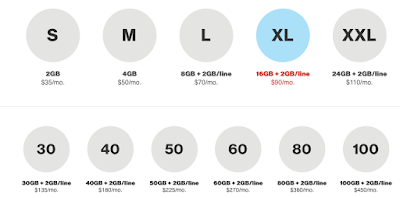
The Verizon changes that became effective on July 7th were leaked many days ahead of the launch. The media's, bloggers' and mobile industry junkies' discussion and focus has been on price increases at the S, M, L XL and XXL bucket levels.  As with many carrier plan actions, the Verizon message is that there is much more data (in light of strong data consumption trends) for the new price points. The graphic below shows the plans - old on top and the new on bottom.


For industry watchers, it's clear that competitors Sprint and T-Mobile continue to enjoy price advantage. The logical conclusion is that Verizon has no chance to win back former customers or draw from Sprint and T-Mobile with this action.

What? A price increase? What's Verizon smoking? 

Rather, Verizon's plan move was to attack AT&T to gain high-value customers AND retain its own.  It's no secret that AT&T and Verizon has been very vocal about not playing for the 'price-sensitive' customers and has concentrated on customers who yield greater revenue per account.  This means the target segment is large data consumers, small and medium business accounts.

Within this July price action, the more interesting movement happens at the XL and greater data levels.  The bottom line here is that Verizon increased the data value gap and reduced price points against AT&T.


Let's break the action out into two chunks, the mid-range and the high-end.  In the mid-range where I suspect a lot of bread and butter family plan battling happens, Verizon wins.  Verizon was already winning at the $100 price point, providing 18GB whereas AT&T offered 15GB.  However, the new move presented a less expensive $90 - 16GB level.  The same story is at the next data contention area; the value gap is most pronounced against AT&T's $140-20GB plan.  With a lower $110-24GB combination, Verizon should win the AT&T switcher.


At the high-end, it's pretty apparent that Verizon has a dramatic price and data value gap and the upper hand in selling to data hungry consumers and business data pooling accounts.  Verizon wins dramatically in price as the same data levels.


What's next?  Given this discrepancy, AT&T needs to respond in some fashion or risk losing these high-value users.  Verizon should be turning up the marketing within business sales channels now that their sales reps are armed with pretty good products - messaging price - data value and network.

Wednesday, May 11, 2016

Talking About Sprint Since Marcelo Claure's On-Boarding

Dan Meyer from RCR Wireless and I discuss Sprint's CY1Q16 results but revisit where Sprint is since Marcelo Claure has taken over as CEO.  We look at his priorities when he took over in August 2014 in the areas of:
  • The executive team - who is in, who left, how the company is organizing
  • Network - CapEx
  • Cost containment including leasing companies, layoffs and $2.5B savings target
  • Stabilizing revenue, the postpaid subscriber base and being the Value carrier


In the back half of the video, we talk about Glenlivet 12.

Monday, April 25, 2016

Handset Promos - BOGO from the US carriers + Scotch Second Take

In early 1Q16, the US carrier community pushed Buy One Get One (Free or 1/2 price) BOGOs hard in an effort to retain existing subscribers with an upsell of an additional line.  In parallel with this effort was the availability of the Samsung Galaxy S7, announced in February at Mobile World Congress.

Secondarily, it has to be that Samsung continues its marketing push to retain its loyal Galaxy customers to push them to the next iteration, whether they're Galaxy S4, S5 or S6 customers.

All these BOGOs are yet continuous carrier efforts to trot out the latest hardware. But BOGOs are not new and have been used for years. Unfortunately, the era of contract free plans and equipment financing have cut into upgrade rates.  In the old days, additional upgrades help retain/lock customers longer with low subsidized values. Given the sobering price tag of new devices and long term financing (24-30 months), that desire to upgrade has trended downward as more subscribers are keeping their handsets longer. Don't get me wrong, the early adopters will always have a place but the mainstream upgrade trend is slowing.  Caveat: We'll see how the public en masse embraces the next generation of iPhone (7).


For those scotch watchers, Dan Meyer and I talk a bit about the scotches we're currently drinking for the webcast here. We are self-admitted newbies and don't go in-depth as dedicated scotch YouTubers do but we share our likes and other scotch thoughts.

Monday, February 29, 2016

A Quick Take: Sprint's Retail Expansion w/Euro Company - Dixons Carphone

Sprint announced a joint venture with UK company Dixons Carphone Connected World Services (CWS) division to expand its retail footprint up to 500 stores.  


This follows the initial foray announced July 2015 where 20 test stores were to be opened. 
Particularly notable in the distribution of 'skin in the game" was the following:

Sprint stores will operate similarly to the third-party retailers who operate Sprint-branded wireless stores across the U.S. Sprint will own and staff the stores while CWS will manage them. CWS will also apply its expertise and best practices across all of Sprint’s sales channels.

Fast forward almost eight months and ostensibly the partnership was successful enough that warranted further stores - up to 500 nationally. However, no time table to meet the number was communicated. 

Quick Take:

Pros

  • This is about increasing the gross additions to offset subscriber defections that happen to all carriers. The more gross adds to offset defections yields a better churn metric. Simplistically , this will help the net addition and corporate turnaround story that Softbank and Sprint has been promising. 
  • Sprint further expands on its retail footprint following a deal with General Wireless in which Sprint was the lead brand and operating 1,435 to 1,700 stores. As Sprint of the RadioShack announcement in Feb 2015, the company had about 1,100 company owned retail stores. At the high range, Sprint will have about 3.300 stores. 
  • Sprint limits its risk and the cost of expansion as it is spread to Dixons which supposedly may have a hand it implementation on top of whatever monetary agreement there may be.
  • Presumably, this may help prepaid distribution since each retail store can also push prepaid brands Boost Mobile and Virgin Mobile (if they ever delineate each's niche and value).
  • Not that we're tracking Dixons from the US, it gives that company another U.S. foothold after a joint venture with Best Buy for Best Buy Mobile and Geeksquad.  As in this iteration, the partner operates the stores and provides the personnel.
Cons
  • For such a decent and impactful announcement, there was no mirror release on Dixons Carphone Media Centre/News Release site.  Doesn't the US expansion of a line of business warrant notice, particularly to he UK financial and mainstream press?

  • There is the 'out' language in the press release of 'up to 500' stores - no promises. There could be less, not realizing the full purported distribution impact. 
  • Sprint cost cutting may not be over. Any insider knows (regardless of carrier) that cost cutting/containment is constant. If things get bad, the 500 expansion number could be a pipe dream. A indicator could be the RadioShack partnership store traffic and sales metrics. 
  • T-Mobile has more Un-carrier announcements planned for '16. At this point, Sprint is competing with T-Mobile for the attacking large Verizon postpaid base.  A strong T-Mobile offering could impinge on Sprint's recovery momentum (albeit very small for now).
  • Honestly, this is an upside story. The heavy lifting of what to sell and get customers into the store has partially been answered with the successor of the long running 'Cut Your Bill in Half' promotion. 

Monday, February 22, 2016

4Q15 US Carrier Wrap Up - Some of what to Look at in '16 - Scotch

In early February,  Dan Meyer from RCR Wireless talk about what happened with results for 4Q15.  Who won in prepaid and postpaid and the details of the U.S. operators AT&T, Sprint, T-Mobile and Verizon Wireless.

We talk a bit about network, handset and price promotion trends and some things to look out for in 2016.  


At the end, we talk briefly with some toe in the water comments about single-malt scotch and hiding it from guests.


Friday, October 30, 2015

In Defense of Sprint's $20 1 GB/Unlimited Entry Plan

There has been much negative reporting and commentary about Sprint's new rollout of the $20 starter 1 GB/Unlimited plan with 2G speeds after 1GB is used up.  Essentially, they're getting rid of an overage tax.  Rather than a negative take as reported by the Verge, BGR, Droid Life and Android Authority (all tech blogs) on the unattractiveness and that Sprint was "fooling" customers.  To be sure, FierceWireless also picked up on the negative groundswell in their piece.  When I tweeted about the negative plan, the Twittersphere also weighed in.


I'm not pro-Sprint or anti-Sprint historically, I try to have an even balance and call it as I see it.  I see it differently and can understand what Sprint is trying to do. Let's look at the wireless landscape today. 100% wireless penetration has been reached. That is, theoretically those who want a wireless phone/device have already got them.

TARGET AUDIENCE

Of the big four carriers, Verizon and AT&T have the lion's share of the coveted 'prime' and high-value postpaid users. Both are protecting their bases as best as they can and invariably, some high-value subs and low value subs leave for competitors.   It's been well documented that Verizon and AT&T have said that they'll let some of their subscriber base go to protect profitability.  I interpret those as mainly (not totally) as price sensitive and lower ARPU/ARPA/ABPU customers. Add to that in most every carrier, there are the feature phone users.  Every carrier wants to migrate those feature phone users to smartphones because they know that when new data capabilities are used, more get consumed and eventually, the customer upgrades to higher data levels. Verizon and AT&T have been losing those feature phone and entry data customers for many quarters. So for Sprint, they see that as opportunity.

My point here is that the new entry plan is not targeted to existing users who have been data use veterans but for subscribers who have not really tasted data, don't have a smartphone yet, price-sensitive, all or a combination.  Note the Sprint price comparison is against competitors' entry plans.  This is where I think the tech bloggers are missing the point as they're techies and are all data vets.


2G?!

The other point of contention is that the vitriol concerning 2G. Yes, it is slow in today's LTE world. In today's environment, we even get upset when we're on 3G (EV-DO or HSPA). But the targeted sub may or may not care. MetroPCS before T-Mobile bought them out operated on LTE and a 1x fall back (MetroPCS never went to 3G) and yet they still promoted an 'unlimited' marketing message.  If subs did care, they'd jump to another competitive offering (likely in prepaid) or upgrade their data plan level (that's the point).

But why 2G and not 3G (EV-DO)?  My view on Sprint's thinking is that you don't want to have these entry/lower ARPU bearing customers contending for data on the 3G network that some of the higher ARPU bearing customers are using. That would be worse, alienating those customers and providing an overall bad user experience all around =-> churn.

Will it be successful? Ultimately, as a plan is designed, it comes down to sales and marketing execution in convincing the target segment that it's the best value/deal out there for what they're looking at.  Obviously, this plan is readied for the heavily promotion laden and competitive 4Q holiday season.  We'll see if competitors react.

Thursday, October 29, 2015

Three Win-Win Wireless Network Features


Published at FierceWIreless

Ho's Perspective: 3 network win-win features Verizon, AT&T, T-Mobile and Sprint are using 

Verizon 3Q15 Results and Unlimited Data Trending

Dan Meyer and I talk about Verizon's 3Q15 highlights and takeaways. Also we talk about unlimited data moves from carriers.


Wednesday, July 15, 2015

Direct 2 You's Progress and Execution

Since Sprint's Direct 2 You announcement, the market availability has been increasing. We should expect that given this is a big bet and instrumental in countering churn and perhaps new customer acquisition.


Here's a timeline:

  • April 14 - Direct 2 You announcement
  • May 18 - Initial markets: Kansas City, Chicago, Miami
  • June 29 - San Francisco, New York, Los Angeles, and Denver
  • July 13 - Dallas, Detroit, Tampa, Washington DC

Additional markets have also been telegraphed for the summer:

  • Atlanta, Boston, Houston, Minneapolis, Orlando, Philadelphia, Phoenix, San Antonio, Seattle and St. Louis
Given it's already mid-July, the end of summer is technically September 22 and there are 10 markets left to announce if they meet their summer commitments, news releases technically can come in mid-August and mid-September.  But from a macro view it'd be helpful to help CY 3Q15 churn statistics.

Beyond these large markets, there has to be additional planned going into the fourth quarter holiday selling season. This will test this concierge concept, especially if one of the value propositions is stress relief. 

If Sprint executes, Direct 2 You will be in 21 markets in parallel with approximately 4,500 points of postpaid distribution, thanks to the RadioShack deal.  The elements are there for improving churn and customer acquisition in a perfect world.   However, with T-Mobile's recent strong plan and North America roaming offers, it won't be so simple. 


Finally for cars people:

Anyone notice that the Fiat 500 is Direct 2 You's new face, replacing the Ford Focus?


OLD


NEW


Friday, June 26, 2015

Bullet Point Analysis: Jump! on Demand - more than just device leasing

WHAT IS IT?

Jump! on Demand is T-Mobile’s variation on Sprint’s device leasing idea that started with the iPhone (i.e., iPhone for Life).  The lease term is for 18 months and users may trade-up up to three times (or upgrade to different smartphones [“superphones”]) in a year.  An enterprising customer can milk six upgrades within this term at months 1, 2, 3 and then in months 13, 14 and 15 (or variations).  

Jump! on Demand’s availability begins on June 28, 2015 and to kick the program off, a limited time promotion of an iPhone 6 (16 GB) at $15/month will be the go-to market poster child.  While this shares the Jump! moniker (Un-carrier 2.0), there isn’t any direct connection aside from the theme of quick device upgradability.

ANALYSIS

From a macro view, just copying Sprint’s leasing scheme isn’t enough based upon T-Mobile’s in your face/pro consumer market positioning. The big consumer benefits are:
  • 18 month term vs. the Sprint norm of 24 months
  • Ability to swap smartphones.  Customers may swap three times in a year (12 months) at AND a maximum of six times in 18 months.
  • When a customer upgrades or swaps a smartphone, they receive a new, not refurbished, smartphone. 

WHAT’S IN IT FOR T-MOBILE?
  • Customer retention: Every carrier’s base have those early adopters who want the latest and greatest.  Jump! on Demand appeals to that base with up to six swaps in the short 18 month lease term.   This in essence furthers these customers’ device addiction.  Additionally, the Jump! on Demand’s device portfolio contains the most desirable flagship ‘superphones’  (for now, i.e., iPhone 6, iPhone 6 Plus, Galaxy S6, Galaxy Note 4, LG G4).
  • New customer acquisition: Any way to get a flagship device for cheap will draw attention. Coupled with plan promotions and lower pricing against the big two carriers, Jump! on Demand is a big and important weapon in the T-Mobile marketing arsenal. 
  • Overall net additions: In the Q1 earnings call, T-Mobile increased their postpaid net add guidance from 2.2/3.2M to 3/3.5M. Note also that they added 1.1M postpaid customers in 1Q15 and that they intended to ‘front load’ the adds.  Of course front load could mean three quarters instead of the first half of ’15.
  • Better vendor pricing leverage:  Though the price may be a wash from the customer facing view, large carriers with more scale look to limit their device acquisition costs. If a carrier can drive more volume, lower per unit price usually bears fruit, which helps in the whole profit picture.


WHICH COMPANIES WILL FEEL THE MOST IMPACT?

·      In the following order:

1.     Sprint – because the company is an alternative value leader against T-Mobile and those customers who are drawn to the once unique leasing scheme has been topped.  This also moves the focus for specifically those “Cut Your Bill in Half” Verizon and AT&T customers onto T-Mobile.  If the decision makers are device centric and price sensitive, then T-Mobile will be a prime consideration.
2.     Verizon Wireless – T-Mobile is specifically gunning for Verizon because that’s where the majority of the industry’s postpaid users are.  The Never Settle for Verizon campaign (a Test Drive [Un-carrier 5.0) on steroids) kicked off on May 5th with a trial period from May 13th to the 31st was extended until June 27.  Extending a switching campaign usually means that it is working.   
3.     AT&T – T-Mobile has historically targeted AT&T back in the same GSM technology days. I place AT&T last since of the big two, Verizon is the bigger fish in terms of postpaid base. Moreover, AT&T’s retention efforts have paid off tremendously in uber low churn metrics.  The aggressive $0 Next messaging has also been widely by AT&T as a key component of customer retention.

  • Apple stands to gain in terms of T-Mobile volume based upon specifically the $15/month promotion.  Normally $27.08/month, T-Mobile’s $12.08 discounting is akin to a subsidy but T-Mobile PR cringed at that word.  Regardless of whether it’s filed as a marketing cost, the discounting is real.  Perhaps like in a car leasing analogy, a lower monthly price may be had with assigning a higher residual at lease end.
  • Samsung, LG and possibly HTC may likely see more flagship device volume movement since Jump! on Demand calls for new and not refurbished devices. Logically, if there is the possibility of long term device swapping, more units should be in the pipeline. However, the iPhone promotion may increase the volume gap in Apple’s favor.
  • Refurb and secondary market companies will sell increase business volumes. Though it’s logical that ‘used’ devices will feed the insurance side and some will find its way into MetroPCS, the secondary market whether domestic or international will see some benefit.


COMPETITIVE RESPONSE?
  • There are now two national players offering leasing. AT&T and Verizon may hold off but they cannot ignore this device payment approach. The concept is simple and by all accounts from Sprint’s initial success, customers like it.  T-Mobile adopting the approach validates the concept in the marketplace.  AT&T and Verizon will have to respond and it has to be before Q4.  If not, they will be even more vulnerable.
  • Sprint will need to modify its leasing approach, at a minimum expanding the term options, also before Q4. Matching the number of times to upgrade also needs careful consideration and figuring out a positive business case. Sprint has already stated that they can get favorable device pricing given SoftBank's global buying power.  Sprint needs to have a plan in place if it is to keep its positive net add momentum of which device leasing plays a crucial role. 
  • Aside from national players, regional players may or may not join. Large regional carrier US Cellular joined the equipment installation plan fray.  For that carrier, an EIP is now competitive tablestakes against competitors, and a component of returning to positive postpaid net adds (after a couple of years in the negative territory).